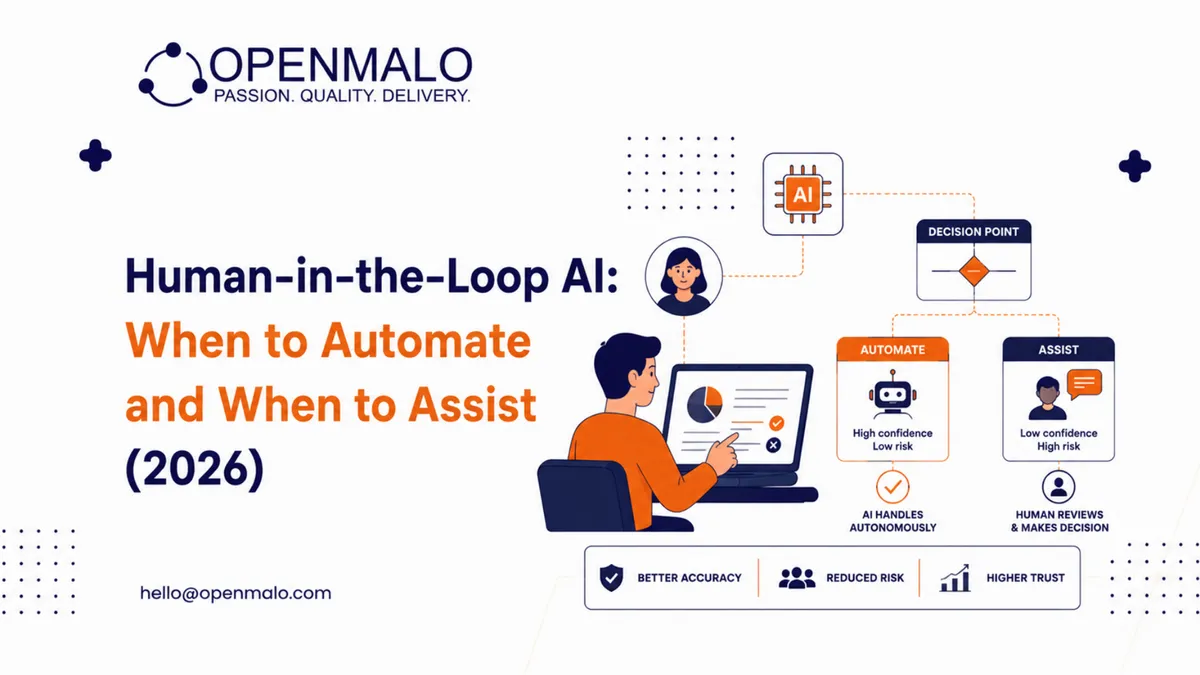
In the rapidly evolving landscape of 2026, the mantra for enterprise AI has shifted from "automate everything" to "automate strategically." While autonomous agents are now capable of handling complex, multi-step workflows, the most resilient organizations are those that have mastered Human-in-the-Loop (HITL) architectures.
As AI systems move from simple chatbots to high-stakes decision-making engines in fintech, healthcare, and automotive sectors, the human element has become the ultimate "fail-safe." At OpenMalo Technologies, we specialize in hardening these AI-human interfaces—ensuring that automation provides the speed while humans provide the sovereignty. This guide outlines the definitive framework for deciding when to let the AI run and when to step in.
1. Defining the Spectrum: Automation vs. Assistance
In 2026, we categorize AI engagement into three primary modes:
- Full Automation (Zero-Touch): The AI handles the entire lifecycle of a task without human intervention. This is reserved for low-risk, high-volume repetitive tasks where an error has negligible impact.
- Human-on-the-Loop (Supervisory): The AI operates autonomously, but a human monitors the system's health and can intervene if "Model Drift" or anomalous behavior is detected.
- Human-in-the-Loop (Collaborative): The AI performs the "heavy lifting"—data processing and drafting—but a human must explicitly approve or edit the final output before it is executed.
2. The 2026 Framework: The "Risk-Confidence" Matrix
To decide which mode to use, we use the OpenMalo Risk-Confidence Matrix. This mechanical check ensures your "Hardened AI" remains safe and cost-effective.
| Scenario | AI Confidence | Impact Risk | Protocol |
|---|---|---|---|
| Routine Data Entry | High (>90%) | Low | Full Automation |
| Customer Support FAQ | Moderate | Low | Full Automation (with Exit to Human) |
| Medical Diagnostics | High | Critical | Human-in-the-Loop |
| Credit Underwriting | Low (<70%) | High | Human-in-the-Loop |
| Fraud Monitoring | High | High | Human-on-the-Loop |
3. High-Stakes Use Cases: Where HITL is Non-Negotiable
As AI takes over more critical infrastructure, certain "Blind Spots" have emerged where human judgment is statistically superior:
- Ambiguity and Nuance: AI often struggles with "Edge Cases"—scenarios that fall outside its training data. A human can recognize a unique customer situation that a model might treat as a standard error.
- Ethical Reasoning: AI lacks a moral compass. In sectors like recruitment or legal sentencing, humans must review outputs to ensure that historical biases in the data aren't being perpetuated.
- Complex Creative Strategy: While AI can generate thousands of ideas, a human is required to curate the one that aligns with the specific "vibe" or cultural context of a brand.
4. Regulatory Mandates: DPDP, AI Act, and Accountability
The legal landscape of 2026 has made HITL a compliance requirement rather than a choice.
- EU AI Act: Classifies certain applications (like HR and Credit) as "High Risk," requiring mandatory human oversight and audit trails.
- India's DPDP Act: Emphasizes "Data Fiduciary" accountability. If an AI makes an error with personal data, the organization remains liable. HITL serves as the primary defense against "automated negligence."
5. Building Effective HITL Interfaces
A common mistake is making the HITL process a bottleneck. To "harden" your workflow, the human interface must be as optimized as the AI itself.
Best Practices for 2026:
- Confidence Scores: Don't just show the result; show how sure the AI is.
- "Draft Mode" Defaults: Present the AI's work as a draft that is one click away from being approved or edited.
- Feedback Loops: Every time a human corrects an AI, that correction should be used to fine-tune the model for the next cycle.
Key Takeaways
- Automate for Scale, Assist for Trust: Use AI to handle the 95% of standard cases and use humans for the 5% that require empathy or complex reasoning.
- Context is King: AI is a "map," but the human is the "driver" who understands the current road conditions.
- Accountability Cannot Be Outsourced: Even with 99% accuracy, the 1% of errors requires a human "circuit breaker" to maintain brand trust and legal safety.
Conclusion
The goal of AI in 2026 is not to replace the human, but to augment human potential. By implementing a robust Human-in-the-Loop framework, businesses can achieve the unprecedented efficiency of agentic workflows while maintaining the ethical guardrails and strategic oversight that only a person can provide. At OpenMalo Technologies, we build the bridges between machine intelligence and human intuition.
Is your automation strategy missing the human touch? OpenMalo Technologies helps enterprises design and deploy hardened Human-in-the-Loop systems that balance speed with safety.