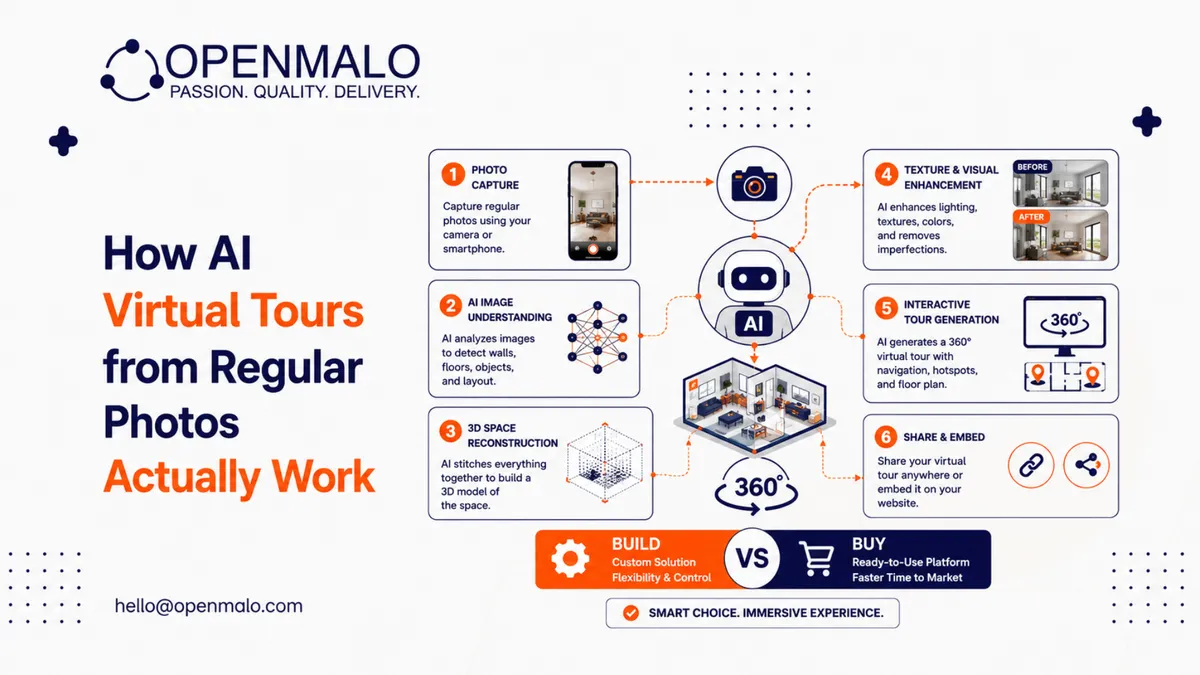
Quick answer: AI virtual tours from regular photos use Neural Radiance Fields (NeRF) or Gaussian Splatting to reconstruct a 3D scene from many overlapping 2D photos. You shoot a few dozen to several hundred photos (phone or DSLR) of a property, the algorithm estimates camera positions and builds a model, and users can fly through the space in real time. Quality has improved dramatically since 2023 and is genuinely useful for self-serve, mid-market, and high-volume tours — but still falls short of LiDAR-grade Matterport output at the premium end.
The pitch is seductive: take regular phone photos of a property and let AI turn them into a navigable 3D tour, without a Matterport camera, without a 360° rig, without a trained photographer. The reality in 2026 is that this works, sometimes, for certain inputs, with certain caveats. Here’s what’s actually happening under the hood, what the technology delivers today, and when you should use it versus stick to a 360° camera.
In plain language: AI virtual tours from regular photos use Neural Radiance Fields (NeRF) or Gaussian Splatting — two related machine learning techniques that reconstruct a 3D scene from many overlapping 2D photos. You take dozens of photos of a property from different angles, upload them, and the algorithm builds a viewable 3D model that users can pan, zoom, and navigate. The quality has improved dramatically since 2023 and is, for many use cases, genuinely useful — though it still falls short of LiDAR-grade tours and has specific failure modes.
What NeRF and Gaussian Splatting actually do
A traditional 3D scan (Matterport-style) uses depth sensors to measure where surfaces are. The result is geometrically accurate.
NeRF and Gaussian Splatting take a different approach. Given many photos of a scene from different positions, the algorithm:
- Estimates the camera position for each photo (Structure from Motion)
- Builds a model that, given any viewpoint, can predict what the scene would look like from there
- Lets the user “fly” through the scene with the algorithm rendering each new viewpoint in real time
NeRF (introduced 2020, with countless variants since) models the scene as a neural network. Quality is excellent but rendering is computationally heavy.
Gaussian Splatting (introduced 2023) represents the scene as a cloud of millions of “Gaussian splats” — small fuzzy points with colour and opacity. It renders much faster than NeRF while delivering comparable quality, which is why it has rapidly become the dominant approach for practical applications.
What you actually deliver to users
A Gaussian-Splatting-derived tour gives users:
- Free navigation through the space (pan, zoom, fly)
- Photorealistic rendering of viewpoints the photographer never explicitly captured
- Faster page load than a heavy 3D mesh tour
- Mobile-viewable in most cases
What it does not give:
- Measurement accuracy comparable to LiDAR
- A clean floor plan (some workflows reconstruct an approximate floor plan from the splat cloud)
- Crisp performance on reflective surfaces (mirrors, glass), thin features (plant leaves), or rapidly moving content (the photos must be of a static scene)
The capture workflow
For acceptable quality:
- Photo count — typically a few dozen to several hundred photos per property, depending on size and complexity
- Coverage — every wall from multiple angles, every doorway from both sides, every room corner
- Lighting — consistent. Mixed natural and artificial light, or photos taken across changing daylight, degrades the model
- Tripod or stabilisation — for sharp inputs
- Phone vs DSLR — modern phones produce acceptable inputs; DSLR helps
Some tools accept video instead of photo bursts — they extract frames and feed the algorithm.
What this technology costs in 2026
The cost structure is fundamentally different from Matterport / Insta360:
- No specialised hardware — your phone or DSLR is the camera
- Compute cost — model training and rendering have non-trivial GPU cost; vendors absorb this in subscription pricing
- Vendor subscription — most AI virtual tour platforms charge per scene processed
- Hosting — most platforms include hosting in the subscription
At low volume the AI route is often cheaper than buying a Matterport rig. At high volume the math tips depending on per-scene pricing.
When AI virtual tours win
- Self-serve owner listings — owners can shoot their own property with a phone; AI does the rest
- High-volume mid-market residential where Matterport is overkill
- Locations where sending a photographer is expensive (remote properties, rural land)
- Quick refresh when a property is restaged — re-shoot in 20 minutes
- Rentals where the tour adds value but not at Matterport prices
When they don’t yet win
- Premium listings where the dollhouse + floor plan + measurement accuracy of Matterport carries the marketing
- Commercial real estate with measurement needs
- Very large or complex spaces where the photo coverage required becomes impractical
- Outdoor + indoor combinations where lighting consistency is hard
- Properties with lots of mirrors or glass that confuse the algorithm
The right way to evaluate the technology
Don’t trust marketing demos — every vendor’s demo property is shot under ideal conditions. Run your own pilot:
- Pick three properties: easy, average, difficult
- Have your photographer shoot them per the vendor’s guidance
- Process through the vendor’s tool
- View on the devices and connections your buyers actually use
- Compare with the same property captured on your current 360° or Matterport workflow
- Decide based on actual output, not demo output
Where the technology is heading
Expect over the next 12 to 24 months:
- Faster processing — current per-scene processing times will shrink
- Better mirror / glass / fine-detail handling
- Smartphone-only workflows with no upload, on-device processing
- Closer convergence with Matterport-grade output for the cases where it matters
Some of this is already in production at certain vendors. The technology is moving fast — re-evaluate annually.
CTA: OpenMalo’s virtual tours module supports AI-generated 360°/3D tours alongside traditional Matterport and Insta360 inputs — pick the right approach per listing. See the module →
Closing
AI virtual tours are a category that earned its place in real estate workflows over the last two years. They are not a replacement for Matterport at the top of the market — yet. They are an excellent answer for the volume of mid-market and self-serve listings that Matterport’s economics never reached. The pragmatic posture: add them to your toolkit, pilot honestly, and put each property on the workflow that fits its tier.