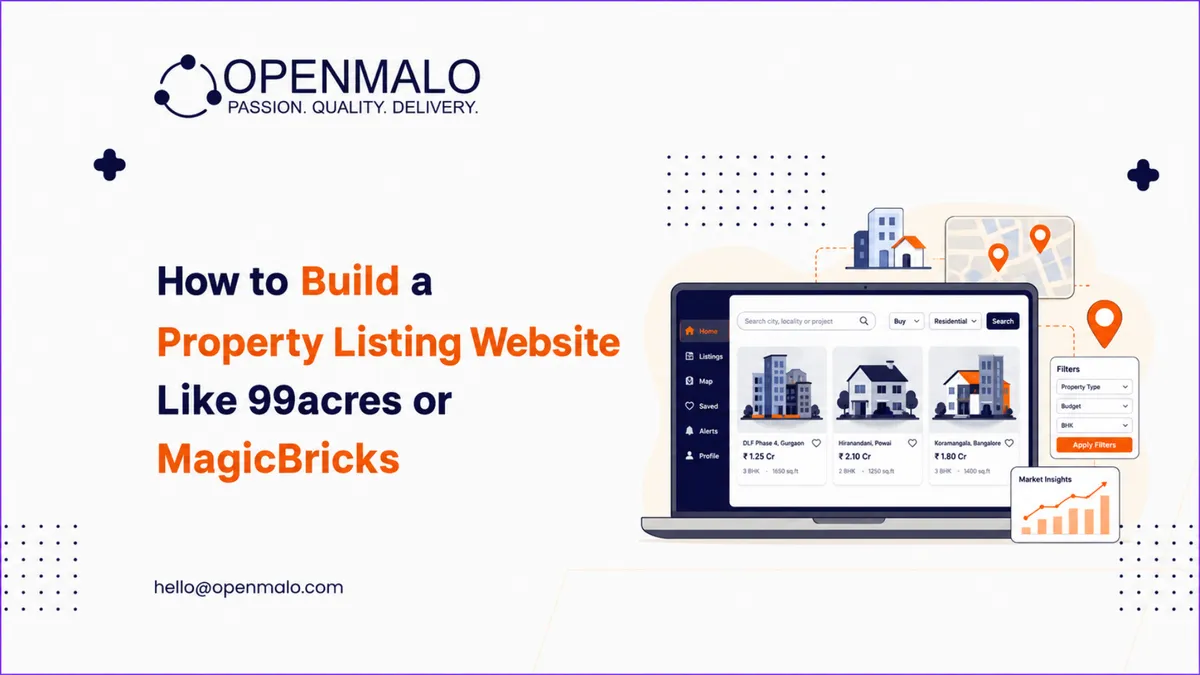
Quick answer: Building a property listing website like 99acres or MagicBricks is mostly a problem of inventory liquidity, not of code. A serious portal needs map-based search, faceted filtering, rich listing detail pages, painless seller onboarding, RERA verification, lead routing, and monetisation tiers — on a fast SSR stack (Next.js, Mapbox, Elasticsearch, PostgreSQL + PostGIS, image CDN). An MVP runs 2 to 4 months; multi-city polish and monetisation add 6 to 12 more. Inventory and SEO are the cost centres that never end.
If you want to build a property listing website in the league of 99acres or MagicBricks, the technical lift is solvable. The far harder problem is inventory liquidity — getting enough verified listings on the platform that buyers find what they want, and buyers in numbers that sellers want to list. Most failed property portals get the tech right and the liquidity loop wrong. This guide covers both.
In plain language: a serious property listing website needs a feature stack that covers buyer search, seller (agent / developer / owner) listing creation, RERA verification, lead routing, monetisation, content, and SEO; it needs a tech stack that handles map-based search at low latency and image-heavy pages at fast load; and it needs an inventory acquisition plan that gets to liquidity before runway runs out.
The minimum-viable feature set
| Feature | Why it matters |
|---|---|
| Map-based search with location-radius filtering | The single highest-engagement feature; users browse by neighbourhood |
| Faceted filters (price, bedrooms, type, age, possession) | Speeds discovery; reduces noise |
| Listing detail page with image gallery, floor plan, location, amenities | The page where conversion happens |
| Seller / agent listing creation with photo upload | Inventory growth depends on this being painless |
| Verification (RERA number, agent registration, contact) | Trust signal; required for compliance |
| Lead capture (call, WhatsApp, form) with routing | The product’s economic engine |
| Saved searches and email alerts | Re-engagement |
| Compare and shortlist | Decision support |
| Mortgage calculator and loan partner integration | Conversion enhancer |
| Reviews / ratings of agents and developers | Trust signal |
| Editorial content (neighbourhood guides, market reports) | SEO long-tail magnet |
| Admin / moderation dashboard | Inventory quality control |
The tech stack that works
- Frontend — Next.js or similar (SSR for SEO; map and image-heavy pages need ISR / streaming)
- Maps — Mapbox or Google Maps (consider cost at scale; Mapbox often cheaper above thresholds)
- Image pipeline — managed image CDN (Cloudflare Images, imgix, or equivalent) for fast variant serving
- Search — Elasticsearch / OpenSearch for full-text + faceted + geo queries (Algolia or Typesense for smaller deployments)
- Backend — language of your team’s preference; the stack you’ll be best at maintaining
- Database — PostgreSQL for transactional data; geo extensions (PostGIS) for spatial queries
- Lead routing — webhook to a CRM (build the integration; agents won’t log into your portal)
- CDN + edge — Cloudflare, Fastly, or CloudFront
- Analytics — first-party (server-side); GA4 for product metrics; dedicated tooling for SEO
The inventory acquisition flywheel
This is what kills most property portals. The plan must work:
- Seed inventory — partnerships with agents / developers in 2 to 3 cities to bootstrap. Free or paid inventory deals. Real, verified listings.
- Buyer demand — SEO, content, and limited paid acquisition to bring buyers. Every successful lead increases agent / developer perceived value of being on the platform.
- Self-serve onboarding — for agents and owners to list without ops involvement. Pricing tiers from free with limited listings to premium with promoted placement.
- Quality control — moderation to remove duplicate / fake / expired listings. Quality > volume.
- Monetisation — listing tiers, lead packages, banner inventory, mortgage partnerships, ancillary services.
Without this flywheel, the tech is useless. With it, the tech becomes the operating system.
Monetisation patterns that work
- Pay-per-listing tier — basic free; premium paid with promotion
- Pay-per-lead — agents pay per verified lead delivered
- Subscription — agencies pay monthly for unlimited listings + promoted inventory
- Sponsored placements — featured listings, banner inventory
- Mortgage / insurance partnerships — lead share with banks / NBFCs
- Ancillary services — home loans, legal, packers and movers, interior design
99acres, MagicBricks, Housing.com, and NoBroker each have a different blend of these. Pick the blend that matches your inventory profile.
RERA compliance for a listing portal
Cover this as a first-class concern. Practical implementation:
- Mandatory RERA number field for projects in covered categories
- Verification against state RERA portals at listing creation and monthly thereafter
- Agent RERA registration verification at agent onboarding
- Auto-display of RERA disclosures on the listing page
- Audit log of every listing publication / modification / takedown
- Named grievance redressal officer with public contact
SEO — the most under-invested lever
Property portals win or lose on long-tail organic traffic. The investments that pay off:
- City + neighbourhood landing pages —
/property-for-sale-in-bandra,/3bhk-in-koramangala— templated, but with unique editorial content per page - Internal linking — every listing detail page links back to neighbourhood, city, type, and similar listings
- Schema markup —
RealEstateListing,Place,Offer,AggregateRatingschemas - Image SEO — alt text, file naming, lazy loading, image variants for fast LCP
- Core Web Vitals — INP especially; map pages are heavy and need careful optimisation
- Content cluster — neighbourhood guides, buyer guides, market reports — that establish topical authority
A property portal with good SEO compounds traffic monthly. One without burns paid acquisition money indefinitely.
What it costs and how long it takes
Realistic phases:
- Phase 1 — MVP (2 to 4 months) — search, listing detail, listing creation, lead capture, 1 city
- Phase 2 — Polish + expansion (3 to 6 months) — multi-city, advanced filters, SEO, mortgage integration
- Phase 3 — Monetisation + scale (6 to 12 months) — tiers, sponsored placements, ancillary services, mobile apps
Cost ranges widely with team rate and scope. The tech can be done. The inventory and the SEO are the cost centres that don’t end.
CTA: OpenMalo’s property listing module gives you the full feature stack — map search, listing creation, RERA verification, lead routing, monetisation tiers — pre-built, so you focus on inventory and demand. See the module →
Closing
Building a property listing website like 99acres is mostly a problem of inventory liquidity, not of code. The code is the wrapper around the inventory. Build a thin, fast, compliant wrapper, invest the rest in inventory and demand, and you have the only kind of property portal that becomes valuable: one that real buyers and real sellers genuinely use.