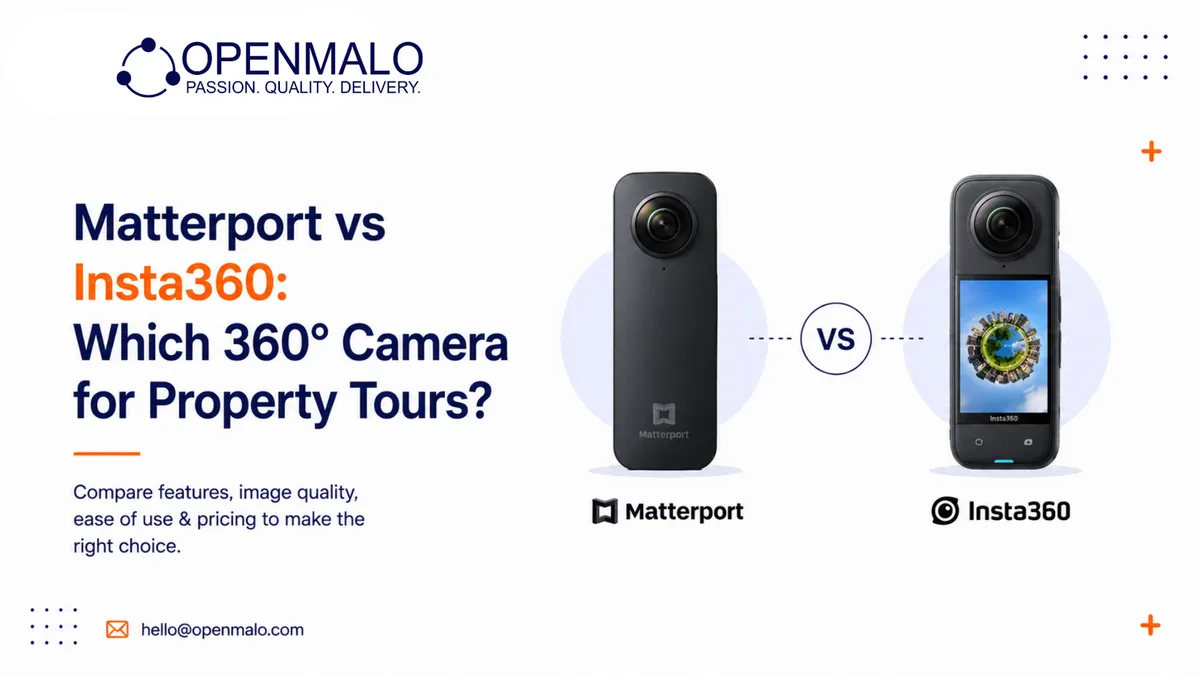
Quick answer: Matterport Pro3 (with LiDAR) and Insta360 X-series solve the same problem with two very different philosophies. Matterport sells a complete capture-to-publish pipeline optimised for 3D dollhouse tours with measurement accuracy — at a hardware, subscription, and per-property cost that compounds. Insta360 sells a 360° camera at a fraction of the price and leaves publishing to you. Most serious brokerages run a hybrid: Insta360 for volume residential, Matterport Pro3 for premium listings where the dollhouse view sells.
If you are shooting virtual tours for property listings, the camera you pick decides what you can deliver, how fast, and at what cost. Matterport and Insta360 represent two very different philosophies: Matterport sells a complete capture-to-publish pipeline optimised for 3D dollhouse tours, while Insta360 sells a 360° camera at a fraction of the price and leaves the publishing workflow to you. The right answer depends on volume, output quality target, and team capability.
In plain language: Matterport (especially the Pro3 with LiDAR) produces the highest-quality 3D dollhouse tours with measurement accuracy and a polished hosting platform — at a hardware price, subscription cost, and per-property hosting fee that compounds with volume. Insta360 (X-series) produces excellent 360° photos and videos at a fraction of the hardware price, with no per-property hosting fee — but you build the tour-viewer experience yourself or pick a third-party platform.
The comparison
| Dimension | Matterport Pro3 | Insta360 X-series |
|---|---|---|
| Capture format | 3D point cloud + 360° photos via LiDAR | 360° photos and video |
| Output | 3D dollhouse tour with floor plan and measurements | 360° image tour stitched from individual scans |
| Hardware cost | High (multi-thousand-USD camera) | Low (low-thousand-USD camera) |
| Subscription | Required, with tiered plans | Optional via third-party tour platforms |
| Per-property hosting fee | Yes, tiered | None (depends on chosen viewer) |
| Capture time per property | Fast, especially with Pro3’s LiDAR | Faster (less precise positioning needed) |
| Stitching / post-production | Automated by Matterport platform | Manual or via third-party software |
| Measurement accuracy | High (LiDAR-grade) | Limited |
| Floor plan generation | Yes, automated | Limited / manual |
| Best output use case | High-end listings, off-market premium, commercial | Volume residential, rentals, broker walkthroughs |
When Matterport wins
- High-end residential and commercial where measurement accuracy matters
- Off-market premium listings where the polished dollhouse view sells
- Real-estate agencies serving developers who can absorb the cost in marketing budgets
- Workflows where the buyer’s expectation is “Matterport-grade” tours
- Long-term hosting where the platform stickiness is a feature, not a lock-in
The Pro3 with LiDAR is genuinely a different category from previous Matterport cameras — significantly faster capture, outdoor capability, and better accuracy. If you’re going Matterport, the Pro3 is the buy.
When Insta360 wins
- High volume / lower price point listings where unit economics rule
- Brokerages where the photographer is in-house and there’s no pure-play virtual-tour budget
- Rentals where a quick 360° walkthrough is more useful than a dollhouse
- Mid-market residential where buyers value “I can see all the rooms” more than “I can measure the kitchen”
- Geographies where Matterport pricing is harder to recover
The hybrid pattern many serious teams use
For agencies serving multiple price points:
- Insta360 X-series for volume — fast capture, low cost per listing, host on your own viewer or a third-party platform
- Matterport Pro3 for premium — reserved for listings where the buyer experience and marketing budget justify the dollhouse
This is the pattern that compounds: every listing gets a tour; premium listings get a Matterport tour.
The non-camera decisions that matter as much
- Tour viewer platform. Where the tour actually displays. Matterport tours live on Matterport’s viewer. Insta360 tours can live on any 360° viewer — Kuula, CloudPano, your own React component, or a custom viewer in your portal.
- Embedding into listings. The tour must embed cleanly in your listing pages and behave well on mobile.
- Tour analytics. Track which rooms users dwell on, where they drop off, what they zoom on. Most agencies don’t, and they leave conversion intelligence on the table.
- Tour ageing. Tours need re-shoot when furniture changes, when occupants change, when the property is staged. Plan the lifecycle.
- Photographer training. Both cameras reward good operators and punish bad ones. Bad lighting, poor positioning, and skipped rooms produce tours buyers don’t engage with.
Beyond Matterport and Insta360
Other options worth knowing:
- Ricoh Theta — solid 360° cameras, common alternative to Insta360
- iPhone / iPad with LiDAR + apps — viable for low-end tours, especially for self-serve owner listings
- Custom photogrammetry rigs — for highest-end commercial / heritage / off-market premium
- AI photo-to-tour — an emerging category for ultra-low-cost tours
What this costs at portfolio scale
A brokerage shooting 500 tours a year:
- Pure Matterport route — hardware + subscription + per-property fees + photographer time — substantial annual budget
- Pure Insta360 route — hardware (one-time) + viewer subscription + photographer time — fraction of the Matterport budget
- Hybrid route — Insta360 for 80%, Matterport for the 20% premium — meaningful savings versus pure Matterport, with the premium experience preserved where it matters
CTA: OpenMalo’s virtual tours module supports both Matterport-style and Insta360-based tours — embed them directly into your property listings with consistent UX and analytics. See the module →
Closing
Matterport vs Insta360 is the wrong frame for most teams. The right frame is which tool fits which listing tier, and how you orchestrate both into a workflow that delivers consistent buyer experience without overspending. Pick by use case, run the math at portfolio scale, and revisit annually as both ecosystems evolve.