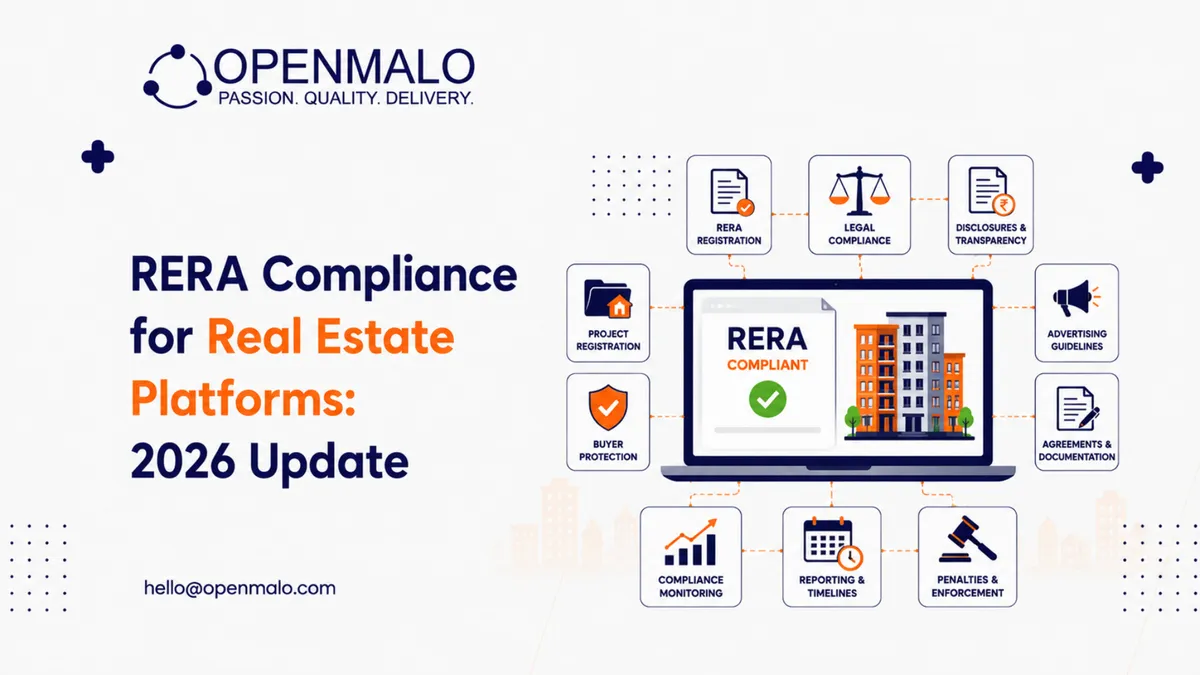
Quick answer: RERA (the Real Estate (Regulation and Development) Act, 2016) is the regulatory perimeter that every Indian real estate platform lives inside. The Act and its state-level rules require project registration, agent registration (Section 9), Section 4 developer disclosures including the 70% escrow rule, and Section 11 advertising disclosures. Platforms must display verified RERA numbers on every covered listing, re-verify periodically, and maintain audit logs — or risk advisories, takedowns, and reputational damage.
If you operate a real estate listing platform, broker portal, or developer marketing site in India, the Real Estate (Regulation and Development) Act, 2016 (RERA) is the regulatory perimeter you live inside. The Act and the state-level rules made under it impose disclosure, registration, and accountability obligations on developers, real estate agents, and — increasingly — on the platforms that list their inventory. The platforms that compound trust treat RERA as a product spec; the platforms that don’t end up with listings pulled and reputations damaged.
In plain language: RERA requires that every real estate project in scope be registered with the relevant state RERA authority before being marketed or sold, that real estate agents be separately registered as RERA agents in their state, that developers publish a defined set of disclosures (approvals, layouts, schedule, escrow account) on the RERA portal, and that platforms that list projects display the RERA registration number prominently. State rules vary; the principles do not.
The three RERA categories your platform deals with
- Projects — every project meeting the size thresholds (typically plots >500 sq m or apartments >8 units, with state variations) must be registered. The project registration produces a RERA registration number.
- Agents — anyone facilitating real estate transactions for compensation must register as a RERA agent in the relevant state.
- Platforms — RERA does not formally regulate platforms in the way it regulates developers and agents, but state RERA authorities have increasingly used platform-targeted advisories and complaints to enforce display requirements.
What every listing on your platform must show
For projects covered by RERA:
- The RERA registration number of the project, prominently
- The state RERA portal URL so users can verify
- The developer’s name as recorded on the RERA registration
- The project’s approvals and layouts as filed on RERA
- Any disciplinary actions the developer or project carries
For agents listing on your platform:
- The agent’s RERA agent registration number
- The state in which the agent is registered
- The agent’s contact and grievance redressal details
A listing without these for a covered project is a violation waiting to happen. Build the listing schema with these as required fields.
Section 4 — what developers register
Section 4 of the Act and the state rules require developers, at registration, to disclose:
- Project layout, plans, approvals
- Schedule of completion
- Details of the promoter’s prior projects (and any defaults)
- The escrow account (the 70% account) where 70% of buyer payments must be held for project use
- Architects, contractors, structural engineers
- And much else
This is the disclosure stack your platform should expose with deep links to the RERA portal for verification.
Section 9 — agent registration
Section 9 makes agent registration mandatory. The registration is state-specific. An agent registered in Maharashtra cannot facilitate transactions in Karnataka without separate registration there. Your platform’s onboarding flow must capture and verify the agent’s state of registration against the relevant authority.
Section 11 — website / advertising disclosures
Section 11 specifies the disclosures every developer’s website and advertising must carry — the RERA registration number, link to the RERA portal record, and the prescribed advertisement language. Where your platform serves as advertising medium, the same disclosure carries through.
State variations to watch
- MahaRERA (Maharashtra) — the most mature state authority; issues regular advisories on listing platforms; has run sweeps of platforms displaying non-registered projects
- Karnataka RERA — a separate portal with its own registration flow
- Gujarat RERA — also independent
- Telangana — initially had a non-RERA regulatory variant; check current status
- West Bengal — historically had its own act before alignment; check current status
Build your platform to handle state-specific registration formats — they are not uniform.
Verify in 2026: Confirm current registration status of any state-specific regulator (e.g., Telangana, West Bengal) before publishing.
Penalty risks for the platform
While RERA’s penalty regime targets developers and agents primarily, platforms have faced:
- Advisories from state RERA authorities demanding takedowns
- Complaints by buyers naming the platform as a respondent
- Reputational damage from association with non-compliant listings
- In some states, classification as an “agent” if the platform’s commercial role goes beyond pure listing
The defensive posture: never list a project without a verified RERA number, never list an agent without verified state registration, and respond to authority advisories within their timelines.
The compliance architecture that works
- Registration verification at listing creation. Verify the RERA number against the state portal (or via an integration) before publishing the listing.
- Agent registration verification at onboarding. Verify the agent number against the state portal.
- Periodic re-verification. Project registrations can lapse or be revoked; re-verify monthly for active listings.
- Disclosure templates baked into the listing display. Don’t rely on agents or developers to add the disclosures — your platform generates them from the verified data.
- Audit log of every listing publication, modification, and takedown. If an authority asks “when did you publish this,” you have the answer.
- Grievance redressal channel with a named officer, displayed on every listing.
Beyond RERA — adjacent compliance
Listing platforms also have to deal with:
- Consumer protection (deceptive listings, fake photos, misleading specifications)
- IT Rules 2021 — intermediary obligations
- DPDP Act 2023 — handling of buyer and seller personal data
- Sectoral advertising codes for real estate ads
The mature platforms treat these as one integrated compliance posture, not seven separate workstreams.
CTA: OpenMalo’s property listing module ships with RERA verification, agent registration validation, periodic re-verification, and the disclosure templates pre-built per state. See the module →
Closing
RERA is not the friend of cowboy listing platforms. It is, however, the friend of platforms that want to compound trust with serious buyers — the buyers who write the ticket sizes that matter. Treat the compliance architecture as a competitive advantage and build it well. Your shareholder return shows up in the lower fraud rate and higher repeat usage of buyers who feel safe.