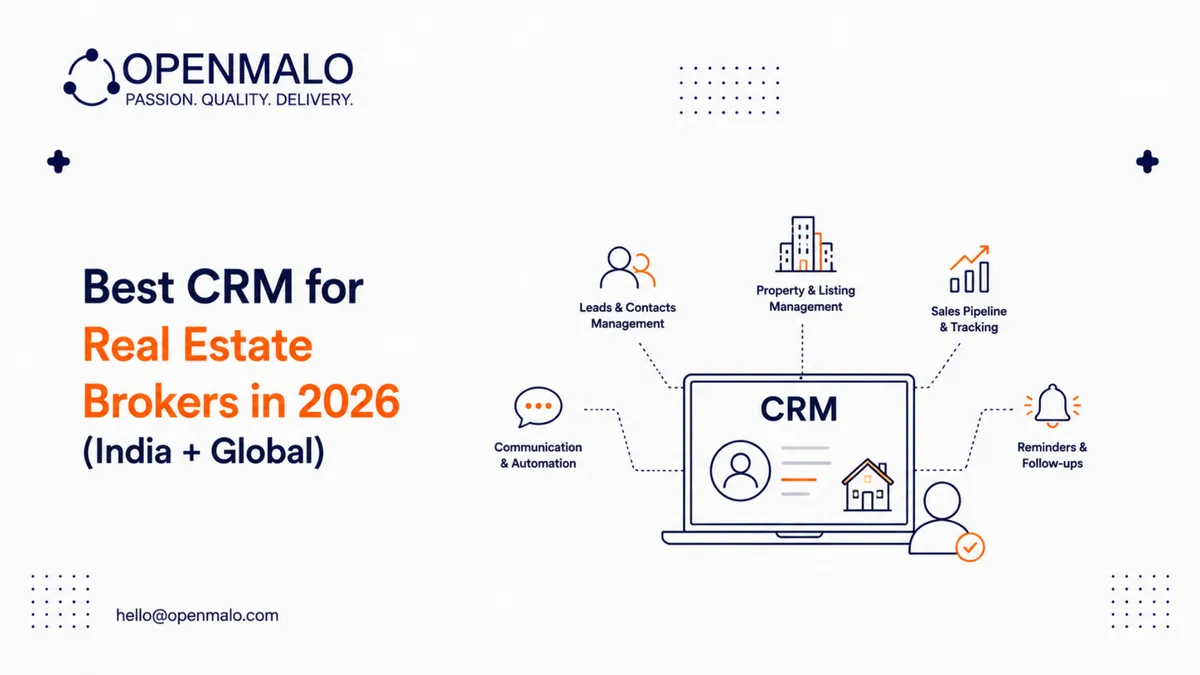
Quick answer: The best real estate CRM depends on your operating model, not on brand reputation. Sell.Do and LeadSquared dominate new-project sales in India; HubSpot and Salesforce (with Propertybase) lead for marketing-led and enterprise brokerages; Zoho and Pipedrive win on cost discipline; Follow Up Boss owns US residential follow-up. Pick by your sales cycle, lead volume, and where your team actually works — then accept the trade-offs.
Most real estate broker teams have the wrong CRM. They have either a horizontal CRM (Salesforce, HubSpot, Zoho) bent into a real-estate shape via custom fields, or a real-estate CRM that’s strong on lead management but weak on long-term relationship workflows. The right CRM is the one that matches your team’s specific operating model — and in real estate, models vary widely.
In plain language: brokers selling new projects need CRMs strong on developer-inventory integration, channel-partner workflows, and bulk lead distribution from portals; brokers selling resale need CRMs strong on long-cycle nurture, owner relationship tracking, and listing management; agencies running both need a CRM that handles segmentation and multi-team operations. The “best” CRM depends on which model you run.
The CRMs that actually compete in 2026
| CRM | Sweet spot | Strengths | Watch-outs |
|---|---|---|---|
| Sell.Do | New project sales in India | Built for developer + channel partner workflows; deep lead capture; ABM for new launches | Less suited to long-cycle resale; India-focused |
| LeadSquared | High-volume lead operations | Strong lead capture and distribution; marketing automation; mobile-first | Customisation can require partner support |
| Salesforce | Enterprise brokerages | Most flexible, most extensible; the global gold standard | Total cost of ownership; needs admin / consultancy support; over-engineered for small teams |
| HubSpot | Marketing-led brokerages | Best-in-class marketing automation; clean UX; free CRM tier | Real-estate-specific workflows require custom builds; enterprise tier expensive |
| Zoho CRM | Cost-sensitive teams | Affordable; deep India support; integrates with Zoho ecosystem | Real-estate-specific features lighter than dedicated solutions |
| Propertybase | Brokerages on the Salesforce ecosystem | Salesforce-native; MLS integration (US); deep real-estate features | US-leaning; subscription stack adds up |
| Pipedrive | Small broker teams | Visual pipeline; ease of use; affordable | Light on real-estate-specific automation |
| Follow Up Boss | US residential agents | Built for follow-up cadence; strong integrations | US-focused |
Verify in 2026: Pricing tiers and feature scopes change. Re-verify against current vendor pricing pages before publishing this article.
Pick by operating model, not by brand
You sell new projects (developer inventory):
- Primary need: capture leads from portals + developer ads, route by project + location + budget, track conversion through site visit → booking → registration
- Best fit: Sell.Do, LeadSquared, or Salesforce + Propertybase
- Look for: developer inventory feed integration, channel partner module, site visit scheduling
You sell resale residential:
- Primary need: long-cycle nurture, listing management, repeat-customer relationship, agent-owner-buyer triangle
- Best fit: HubSpot, Salesforce + Propertybase, Follow Up Boss (US), or a real-estate-purpose CRM
- Look for: listing management, contact relationship intelligence, long-cycle automation
You run a multi-vertical agency:
- Primary need: segmentation, multi-team operations, role-based access, reporting across business lines
- Best fit: Salesforce or HubSpot Enterprise
- Look for: granular permissions, cross-team dashboards, custom record types
You’re a small broker team:
- Primary need: lead capture, simple pipeline, cost discipline
- Best fit: Zoho, Pipedrive, or HubSpot Free + Starter
- Look for: free tier viability, ease of use, mobile-first
The features that actually matter
Ignore the marketing-page checklists. The features that matter day-to-day in a real estate CRM:
- Lead capture from portals — automatic ingestion from 99acres, MagicBricks, Housing.com, Facebook Lead Ads, Google Lead Form
- WhatsApp integration — most India broker communication happens here
- Mobile experience — agents work from cars and site offices
- Site visit scheduling — calendar with property + agent + customer coordination
- Listing-to-CRM link — when a lead expresses interest in a specific property, the CRM knows
- Channel partner workflows (for new project) or owner relationship tracking (for resale)
- Reporting — by agent, by stage, by source, by property
If a CRM does these badly, no amount of generic CRM brilliance compensates.
What goes wrong with horizontal CRMs
The classic trap: deploy Salesforce or HubSpot, customise for real estate via fields, watch the customisation accumulate technical debt, eventually replace.
The customisations that compound:
- “Property Interested” as a multi-value field instead of a relationship to a listing entity
- Stage models that don’t reflect the actual sales cycle
- Lead source attribution that breaks when portals add new campaigns
- Custom integrations that no one understands after the original admin leaves
If you’re going horizontal, accept that you’ll either pay for a real-estate accelerator (Propertybase) or build and maintain real-estate-specific customisations as a programme.
What goes wrong with dedicated real-estate CRMs
The mirror trap: pick a real-estate-specialised CRM, hit its limits when your operating model evolves, find migration painful.
Common limits:
- Marketing automation less sophisticated than HubSpot / Salesforce Marketing Cloud
- Integration ecosystem narrower
- Reporting less flexible
- Pricing scales steeply at larger user counts
The hedge: pick a real-estate CRM with a public API and ensure your inbound lead capture and outbound reporting could be replicated elsewhere if needed.
When you should consider building your own
Almost never. The cases where it makes sense:
- You’re a very large developer with idiosyncratic project sales workflows that no CRM models well
- You’re a technology-first brokerage where the CRM is a core competitive moat
- You’ve absorbed the cost of building and maintaining the CRM as a programme, not as a project
For everyone else: pick from the list above, accept some compromise, win on operations.
CTA: OpenMalo’s broker CRM module is the specialised option for India broker teams — lead capture from major portals, WhatsApp-first, channel partner workflows, mobile from day one. See the module →
Closing
The best real estate CRM is the one whose model matches your business — not the one with the longest feature list. Pick by operating model, accept the trade-offs honestly, and invest the saved time in the operations the CRM is supposed to enable.