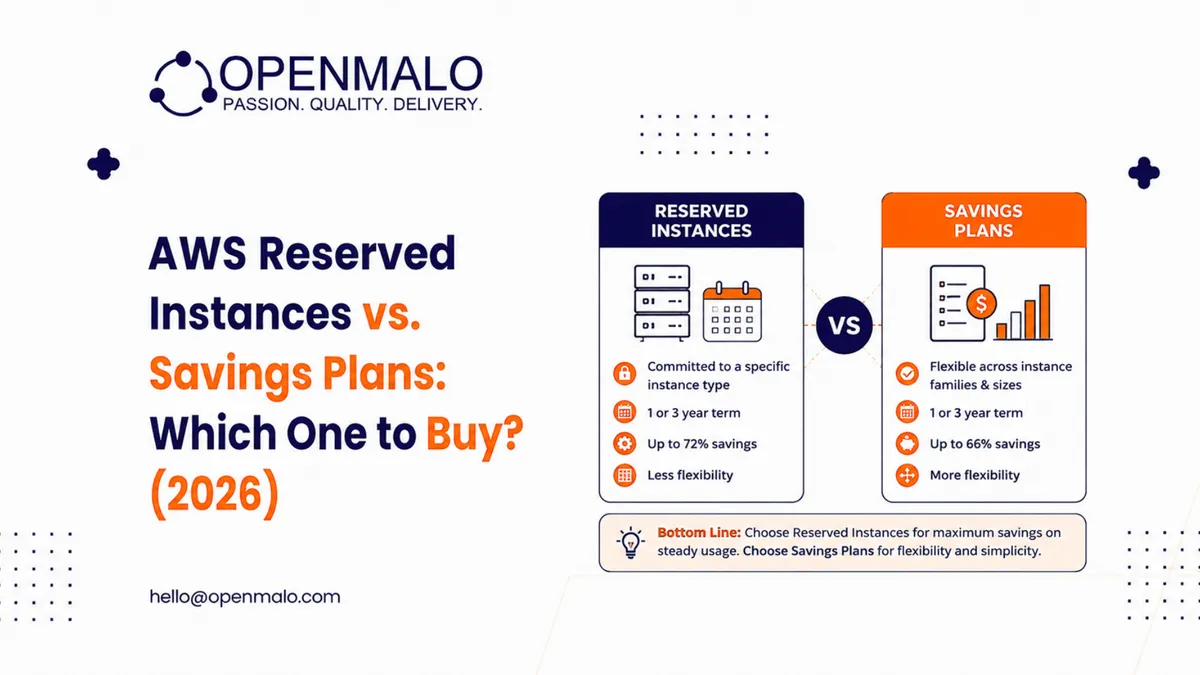
In 2026, cloud financial management (FinOps) has moved from a "nice-to-have" to a survival skill. As AWS infrastructure becomes more fragmented across containers, serverless, and AI workloads, the question isn't just about saving money—it's about Commitment Agility.
At OpenMalo Technologies, we help our partners navigate the complexity of AWS billing. While both Reserved Instances (RIs) and Savings Plans (SPs) offer up to 72% discounts over On-Demand pricing, choosing the wrong one can leave you with "Stranded Costs" or unoptimized spend. This guide breaks down the 2026 landscape to help you choose the right "Hardened" savings vehicle.
1. The Core Difference: Capacity vs. Dollars
The fundamental shift between these two models lies in what you are promising AWS:
- Reserved Instances (RI): You are committing to a Specific Resource (e.g., an m7g.large in Mumbai). In exchange, AWS often gives you a Capacity Reservation (zonal RIs), guaranteeing the hardware is there when you need it.
- Savings Plans (SP): You are committing to a Spend Amount (e.g., $10/hour). AWS doesn't care if you use EC2 today and Lambda tomorrow; as long as you spend the $10, the discount applies.
2. AWS Savings Plans: The Flexibility King
In 2026, Savings Plans are the default choice for 90% of startups and growth-stage companies.
Types of Savings Plans:
- Compute Savings Plans: The most flexible. They apply to EC2, Fargate, and Lambda regardless of region, instance family, or OS. If you migrate from Intel to Graviton (ARM), the discount follows you.
- EC2 Instance Savings Plans: Locked to a specific instance family in a specific region (e.g., c7g in us-east-1). They offer deeper discounts (up to 72%) but less flexibility than Compute SPs.
- SageMaker Savings Plans: Specifically for AI/ML workloads, covering SageMaker instances used for training and hosting.
Pro Tip: Savings Plans have a 7-day return window. If you over-commit, you have one week to undo the mistake—a feature RIs do not offer.
3. Reserved Instances: When the "Old Way" Wins
While Savings Plans are more popular, RIs still have a critical place in a "Hardened" infrastructure:
- Standard RIs: The only option that can be sold on the RI Marketplace. If your project is cancelled after 6 months, you can recoup your costs by selling the remaining term to another user.
- Capacity Guarantees: If you are running high-availability workloads in a specific Availability Zone (AZ), a Zonal RI ensures you won't get an "Insufficient Capacity" error during a regional spike.
- Non-Compute Services: Currently, services like RDS, Redshift, and ElastiCache still rely heavily on the RI model. Savings Plans do not yet cover the full database suite.
4. 2026 Comparison Matrix
- Compute Savings Plan: ~66% max discount, can change region, can change family, covers Fargate, covers Lambda, no marketplace, no capacity guarantee.
- EC2 Instance Savings Plan: ~72% max discount, region/family locked, no Fargate or Lambda, no marketplace, no capacity guarantee.
- Standard RI: ~72% max discount, region/family locked, no Fargate or Lambda, sellable on Marketplace, Zonal capacity guarantee available.
- Convertible RI: ~66% max discount, can change family, no Fargate or Lambda, no marketplace, no capacity guarantee.
5. The "Hardened" Selection Logic: A Decision Flow
At OpenMalo Technologies, we use this simple logic to guide our architecture:
- Do you need a Capacity Guarantee? Yes → Buy a Zonal Standard RI.
- Is the workload a Database (RDS/Redshift)? Yes → Buy a Standard RI.
- Is the workload EC2, Fargate, or Lambda? If you expect to change regions or instance types → Buy a Compute Savings Plan. For a static baseline → Buy an EC2 Instance Savings Plan.
Key Takeaways
- Don't buy 100% coverage: Target 60–80% coverage to allow for architectural shifts.
- Compute SPs are the "Safe" Bet: For most engineering teams, the 5% difference in discount between Compute and Instance plans isn't worth the loss of flexibility.
- RDS is the Exception: Remember that your Savings Plan won't help your database bill.
- Check the Marketplace first: You can often find Standard RIs with 6 months left on the term at a steep discount.
Conclusion
Choosing between RIs and Savings Plans in 2026 isn't just about the lowest price—it's about Strategic Fit. If your roadmap involves moving to Serverless (Lambda) or switching to ARM-based Graviton instances, Savings Plans are your best friend. If you have a rock-solid, multi-year database baseline, RIs are your foundation.
Confused by your AWS bill? OpenMalo Technologies provides comprehensive Cloud Cost Audits to help you select and manage the perfect blend of Savings Plans and RIs.