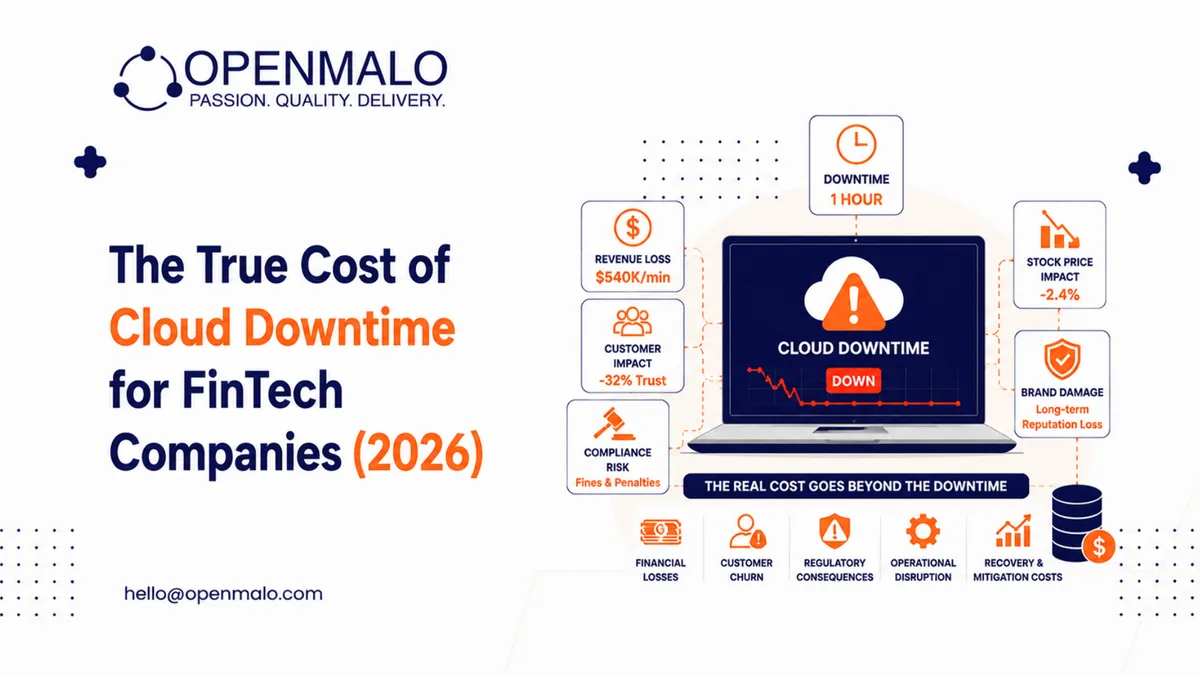
In 2026, "Uptime" is no longer a technical metric; it is the Oxygen of Finance. As the global FinTech market surges past $220 billion, the cost of a single minute of downtime has reached heights that can threaten the very survival of an organization. Gone are the days when an outage was just a "minor inconvenience"—in the era of India's DPDP Act and Europe's DORA (Digital Operational Resilience Act), an hour of offline service is a direct invitation for regulatory intervention.
At OpenMalo Technologies, we specialize in "Hardened Reliability." We've analyzed the shift from 2024 to 2026 and found that the "True Cost" of downtime has tripled, fueled by transaction volume, high-stakes compliance, and the instantaneous nature of modern customer trust.
1. The Staggering 2026 Benchmarks: By the Numbers
In 2026, the financial services sector remains the most expensive industry for outages.
- The High-End Reality: For large banks and trading platforms, downtime now averages $1.5 million per hour, peaking at over $9 million per hour during high-load trading sessions.
- The Mid-Market Impact: 91% of mid-sized enterprises report that an hour of downtime costs them at least $300,000.
- The Per-Minute Pulse: Across the industry, the average cost of unplanned downtime has escalated to $14,056 per minute.
2. The "Hidden" Triad: Where the Money Actually Goes
Most FinTech leaders focus on "Lost Sales," but that is often less than half the total impact.
- Direct Revenue Loss (37%): Missed trades, failed payments, and blocked transaction fees.
- Idle Productivity (51%): High-cost engineers, traders, and support staff unable to work.
- Recovery & Overtime (7%): Emergency vendor fees (3x normal rates) and staff overtime to catch up.
- Brand & Churn (5%): Marketing spend required to "win back" users who switched to competitors.
3. Regulatory Hammers: DORA and DPDP Enforcement
In 2026, a cloud outage is no longer a "Third-Party Problem"—it is Your Problem.
- DORA (Digital Operational Resilience Act): Under this mandate, regulators no longer accept "Amazon/Azure was down" as a valid excuse. You are legally required to prove you have a Hardened Failover Plan. A 15-hour outage without a tested fallback can lead to fines exceeding £50 million, as seen in historic UK banking failures.
- DPDP Act (India): If an outage leads to data corruption or a "Data Fiduciary" being unable to fulfill a user's right to access, the penalties can scale into the hundreds of crores.
4. The Brand Erosion Factor: The 66% Trust Gap
Research in 2026 shows that 66% of customers will stop trusting a financial company after a single significant service disruption. In the world of "Embedded Finance," where your service is hidden inside other apps, an outage doesn't just hurt you—it breaks your partners' products, leading to cascading contract terminations.
5. The Hardened Fix: Architectural Resilience
At OpenMalo Technologies, we move our partners toward Active-Active Multi-Region setups.
- Chaos Engineering: We don't wait for an outage; we cause them in a controlled environment. By simulating "Cloud Region Kill Switches," we ensure your system self-heals in under 60 seconds.
- Sovereign Cloud Strategy: For DPDP compliance, we ensure your "Hardened" backup site is located within national borders, ensuring zero interruption to your regulatory data mandates.
Key Takeaways
- $14k/Minute is the Baseline: If you can't afford this, you can't afford to be un-automated.
- SLA Credits are a Myth: Your cloud provider's 10% refund won't cover your million-dollar revenue loss.
- Resilience is a Product Feature: Market your "99.999% uptime" as a reason to choose you over a fragile competitor.
- Test the Failover: A backup that hasn't been tested in 30 days is not a backup.
Conclusion
The true cost of cloud downtime in 2026 is measured in more than just dollars; it is measured in License to Operate. When your systems go dark, you lose more than transactions—you lose the digital "Social Contract" you have with your users and regulators. At OpenMalo Technologies, we build the hardened, resilient infrastructure that keeps the lights on, no matter what happens in the cloud.
Is your FinTech "Outage-Proof"? OpenMalo Technologies provides comprehensive Resilience Audits and Hardened Multi-Cloud implementations to protect your bottom line.