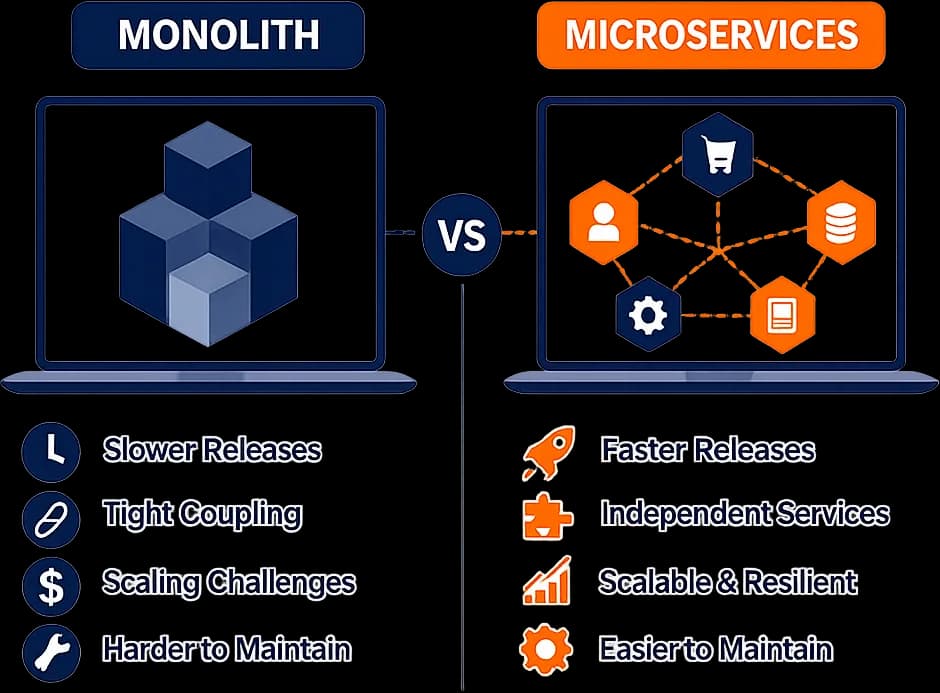
In 2026, the architectural pendulum has swung back toward pragmatism. After years of "Microservices by Default" leading to complex, high-cost "Distributed Monoliths," engineering leaders are returning to a fundamental truth: Complexity is a cost, not a feature. At OpenMalo Technologies, we view architecture as a business commitment. In the 2026 era of FinOps and AI-driven scale, the goal isn't just "splitting services"—it's "Hardening Boundaries."
Whether you are scaling a fintech app in Dubai or a logistics platform in Rajkot, the 2026 playbook is no longer "Monolith vs. Microservices." It is about Modular Monoliths as the starting point and Strategic Extraction as the growth path.
1. The 2026 Landscape: The Rise of the Modular Monolith
By 2026, "Monolith" is no longer a dirty word. The Modular Monolith has emerged as the most efficient architecture for 80% of enterprises.
- The Definition: A single deployment unit where code is strictly organized into independent modules with clean, internal APIs.
- The 2026 Advantage: You get the Logical Separation of microservices (clear boundaries) without the Operational Tax of network latency, distributed transactions, and fragmented observability.
2. When to Stay Monolithic: Simplicity and Velocity
If your team is under 50 engineers, a well-structured monolith is almost always your best "Hardened" choice.
- In-Process Performance: Functions call each other in memory, eliminating the milliseconds of latency introduced by networked API calls.
- Unified Data: You have Strong Consistency. Transactions are easy because you aren't managing a "Saga Pattern" across five different databases.
- FinOps Efficiency: It is significantly cheaper to run one large server than 50 tiny ones, especially when factoring in the cost of load balancers, sidecars, and service meshes.
3. When to Move to Microservices: The 3 "Hard" Signals
At OpenMalo, we advise migration only when the "Complexity Tax" of the monolith exceeds the "Operational Tax" of microservices. Look for these three signals:
- Team Scaling Bottlenecks: When 10+ teams are all tripping over each other in the same codebase, and "Merge Hell" is delaying your weekly release.
- Independent Scaling Needs: Your "Payment Processor" needs 100x the CPU of your "User Profile" service. In a monolith, you have to scale everything; in microservices, you scale only the bottleneck.
- Diverse Tech Stacks: You need a high-performance Go-based engine for real-time calculations while the rest of your app stays in Python/Node.js.
4. The Danger Zone: The "Distributed Monolith"
The biggest risk in 2026 is building a system that has the Cons of both and the Pros of neither.
- The Symptom: You have 20 services, but to deploy a single feature, you have to update 15 of them simultaneously.
- The Result: You've traded a simple monolith for a "Distributed Mess" with high latency and zero team autonomy.
5. The OpenMalo "Strangler Fig" Framework
We don't "Rewrite" from scratch. We Evolve.
- Harden the Boundaries: First, refactor your monolith into a Modular Monolith. If you can't separate the code internally, you'll never separate it over the network.
- Extract the "Pain Point": Identify the single most resource-heavy or frequently-changed module.
- The Strangler Fig Pattern: Build the new microservice alongside the monolith and use an API Gateway to slowly shift traffic from the old module to the new service.
Key Takeaways
- Don't Outpace Your DevOps: If you can't automate a single-unit deploy, don't try to automate 50.
- Architecture is a Hiring Strategy: Large organizations use microservices to allow teams to move fast; startups use monoliths to stay lean.
- Data is the Hardest Part: Breaking a database is 10x harder than breaking code. Plan your Data Sovereignty early.
- Focus on "Loose Coupling": Whether it's one service or fifty, the "Hardened" secret is minimizing how much services need to know about each other.
Conclusion
In 2026, the best architecture is the one that lets you ship value, not the one that looks coolest on a whiteboard. At OpenMalo Technologies, we help you build Hardened Architectures that grow with you—starting with modular clarity and scaling to distributed power only when the business demands it.
Is your legacy monolith slowing you down? OpenMalo Technologies provides Architectural Audits and Strangler Fig migration services to help you modernize without the "Token Shock."