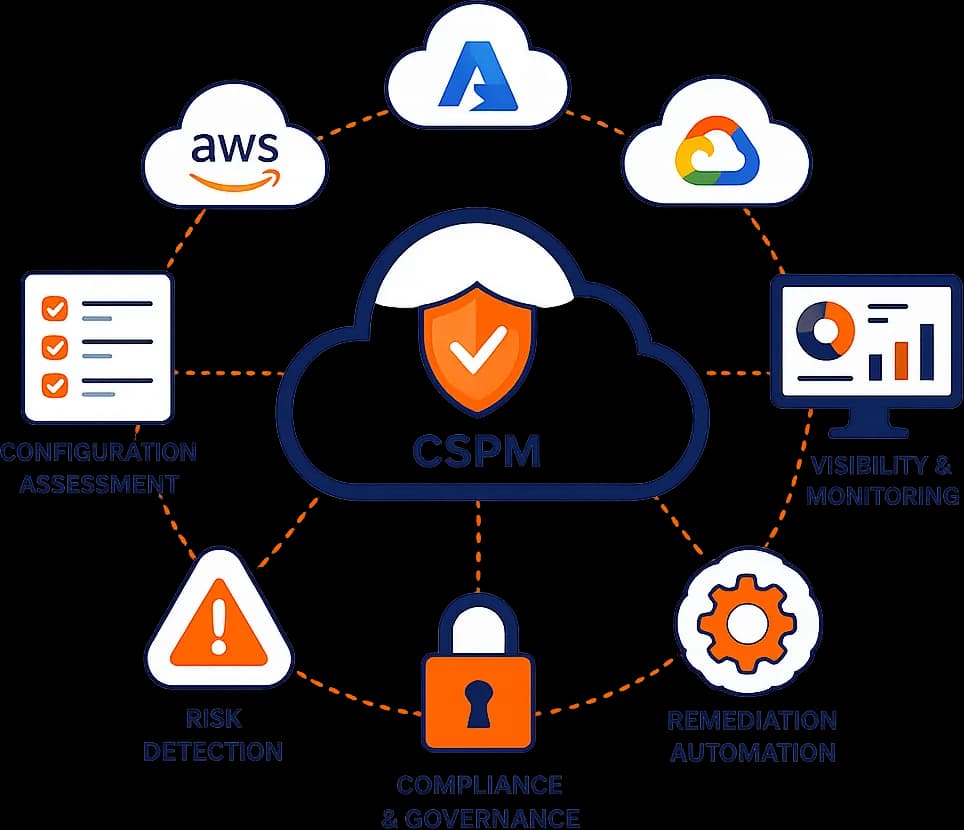
In 2026, the "Cloud Perimeter" has officially evaporated. As enterprises in Rajkot, Dubai, and beyond scale their digital footprints, the biggest threat isn't a sophisticated zero-day exploit—it's a misconfigured S3 bucket or an over-privileged IAM role. According to 2026 benchmarks, 90% of cloud security failures are the result of customer misconfigurations.
At OpenMalo Technologies, we view Cloud Security Posture Management (CSPM) as the nervous system of your infrastructure. It is the automated layer that constantly "checks the pulse" of your cloud, ensuring your settings match your security promises. This guide provides a hardened, 2026-ready blueprint for implementing CSPM that actually protects your business.
1. The CSPM Shift: From Monitoring to Governance
In early cloud eras, CSPM was a "Reporting Tool"—it told you what was broken. In 2026, CSPM has evolved into a Governance Engine.
- Continuous, Not Periodic: We no longer wait for weekly scans. Modern CSPM uses Event-Driven Detection (via CloudTrail or EventBridge) to identify a misconfiguration within seconds of it being created.
- Visibility vs. Context: Seeing an "Open Port" is one thing; knowing that port connects a public-facing web server to a database containing PII is Context. CSPM now uses "Security Graphs" to prioritize risks that actually matter.
2. Core Capabilities: The "Hardened" Checklist
If your CSPM tool doesn't do these four things in 2026, it's a liability:
- Automated Asset Discovery: It must find "Shadow IT"—those unmanaged resources a developer spun up in a forgotten region.
- Policy-as-Code Enforcement: It should scan your Terraform or CloudFormation templates in the CI/CD pipeline, stopping misconfigurations before they reach production.
- Risk Prioritization (Toxic Combinations): It must identify "Toxic Combinations"—for example, an identity with no MFA + a wide-open security group + a vulnerable VM.
- AI-SPM: With the 2026 surge in AI, your CSPM must now monitor AI Data Pipelines and ensure your training buckets aren't exposed to the public.
3. Step-by-Step Implementation Framework
At OpenMalo, we follow a "Phase-Hardening" approach:
- Phase 1: Read-Only Discovery (Day 1-7): Connect your cloud accounts via read-only IAM roles. Catalog every resource across AWS, Azure, and GCP.
- Phase 2: Baseline Alignment (Day 8-15): Map your environment against CIS Benchmarks and industry standards like PCI-DSS 4.0.1.
- Phase 3: Remediation Workflows (Day 16-30): Integrate with Jira or ServiceNow. Don't just alert; assign.
- Phase 4: Guardrail Automation (Continuous): Enable "Auto-Remediation" for high-risk issues (e.g., automatically closing a public S3 bucket that contains sensitive tags).
4. CSPM vs. CNAPP: Knowing the Difference
In 2026, the lines are blurring, but the distinction remains critical for your budget:
- CSPM (Posture Management): Primary focus is Infrastructure Configuration. Best for Compliance & Visibility. Includes Misconfiguration, IAM, and Compliance.
- CNAPP (Application Protection): Primary focus is Full Lifecycle (Code to Runtime). Best for Modern Container/Serverless Apps. Includes CSPM + CWPP + CIEM + Vulnerabilities.
OpenMalo's Advice: If you are just starting your cloud journey, lead with CSPM for immediate visibility. As you move to Kubernetes and AI-driven workloads, evolve toward a CNAPP model.
5. Compliance Integration (DPDP Act & PCI-DSS 4.0.1)
India's DPDP Act requires you to prove "reasonable security safeguards."
- The Hardened Strategy: We use CSPM to create Automated Evidence. Every time the tool checks an encryption setting, it generates a log that satisfies auditors.
- Residency Monitoring: We set up "Geo-Fencing" alerts. If a developer accidentally moves a database from a Mumbai region to a cheaper US region, the CSPM flags it as a DPDP violation instantly.
Key Takeaways
- Misconfiguration is the Enemy: 99% of cloud breaches through 2026 will be the customer's fault.
- Context over Noise: Stop chasing "Medium" alerts; fix the "Toxic Combinations" that create attack paths.
- Shift Left: Scan your Infrastructure-as-Code (IaC) before it's deployed.
- Decentralize Remediation: Security finds the problems; DevOps fixes them. Integration is the key.
Conclusion
CSPM in 2026 is the bridge between a "Fragile" cloud and a "Hardened" business. By automating your visibility and enforcement, you allow your developers to move at the speed of the cloud without the risk of a catastrophic error. At OpenMalo Technologies, we don't just secure your cloud—we give you the confidence to innovate.
Is your cloud posture full of blind spots? OpenMalo Technologies provides specialized CSPM Audits and implementation services to harden your infrastructure.