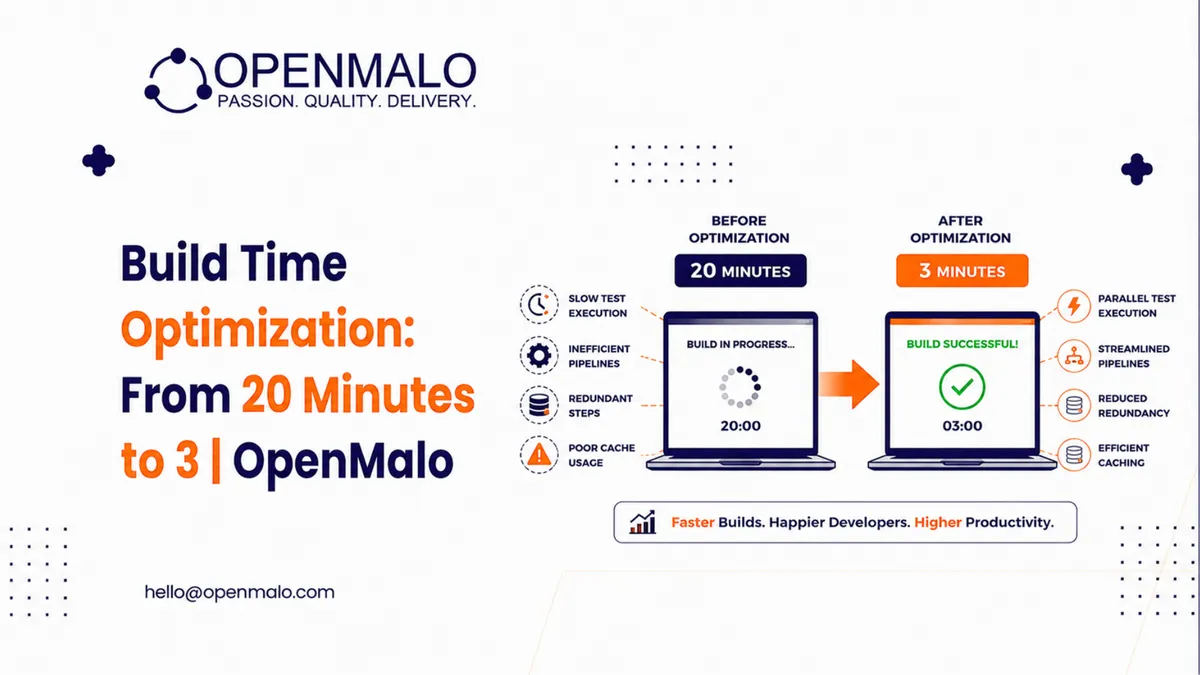
In 2026, a 20-minute build isn't just a nuisance—it's an engineering failure. With developers pushing code dozens of times a day, a slow CI/CD pipeline creates a "Context-Switching Tax" that can kill a team's momentum. If a developer has to wait 20 minutes to see if their one-line CSS fix broke the build, they will inevitably open Twitter, start a coffee break, or lose their "flow" state.
At OpenMalo Technologies, we specialize in Pipeline Hardening. We've helped our partners in Rajkot and globally take legacy "linear" builds and refactor them into high-concurrency engines. Reducing your build time by 85% isn't about buying a bigger server; it's about Smarter Architecture.
1. The "Linear" Trap: Why Your Pipeline is Stalling
Most 20-minute pipelines suffer from Sequential Dependency. They install dependencies, then build, then test, then scan—all in a single, unoptimized thread.
The OpenMalo Hardening Rule: If two tasks don't share data, they should never run in a line. In 2026, we move toward a Directed Acyclic Graph (DAG) model, where the CI system identifies exactly which parts of the build can run simultaneously.
2. Architecture Pillar 1: Remote Caching & Global Hashing
The fastest build is the one you don't have to do.
- Global Hashing: In 2026, we use content-aware hashing. If package-lock.json hasn't changed, the npm install step is skipped entirely.
- Remote Caching: Why should your CI runner rebuild the "Auth Service" if a developer already built it on their laptop? We implement Shared Remote Caching, where the results of a build are stored in a central vault. If the hash matches, the CI simply "downloads" the finished artifact in milliseconds.
3. Architecture Pillar 2: Sharded Test Execution
If your test suite takes 12 minutes, your build will never be 3 minutes.
- The Fix: Sharding. We split your tests into 10 parallel "shards." Instead of one runner doing 1,000 tests, 10 runners do 100 tests each.
- The Result: Your test phase drops from 12 minutes to 1.2 minutes. By 2026, tools like Playwright and Jest have sharding built directly into their CLI, making this a "Day One" optimization.
4. Architecture Pillar 3: Remote Build Execution (RBE)
For massive monorepos, even a powerful CI runner isn't enough. We utilize Remote Build Execution.
Instead of the build happening on the CI machine, the work is farmed out to a massive cluster of "Worker Nodes." This is how companies like Google and Uber maintain sub-minute build times across millions of lines of code. The CI runner becomes a "Coordinator," while hundreds of nodes handle the heavy lifting of compilation in parallel.
5. The 2026 Toolchain: Which One for You?
| Tool | Best For | Complexity | Speed Gain |
|---|---|---|---|
| Turborepo | JS/TS Monorepos | Low | 5x |
| Nx | Large-scale Fullstack | Medium | 7x |
| Bazel | Polyglot (Go, C++, Java) | High | 15x |
OpenMalo Technologies' Choice: For most high-growth startups in 2026, Nx or Turborepo provides the best balance of "Setup Speed" and "Execution Velocity."
Key Takeaways
- Cache Everything: If the input hasn't changed, reuse the output.
- Parallelize by Default: Use a DAG-based build runner to eliminate sequential bottlenecks.
- Shard Your Tests: Distribute the load across multiple runners to cap test time at 2 minutes.
- Measure the Bottleneck: Use "Build Tracing" to see exactly which step is eating your time.
Conclusion
A 3-minute build is a "Hardened" competitive advantage. It allows your team to iterate faster, fix bugs in real-time, and maintain a state of high-velocity "Flow." At OpenMalo Technologies, we don't just optimize code; we optimize the Engine that ships it.
Is your team losing hours every week to "Build Wait"? OpenMalo Technologies provides CI/CD refactoring and pipeline hardening to get you to sub-5-minute builds.