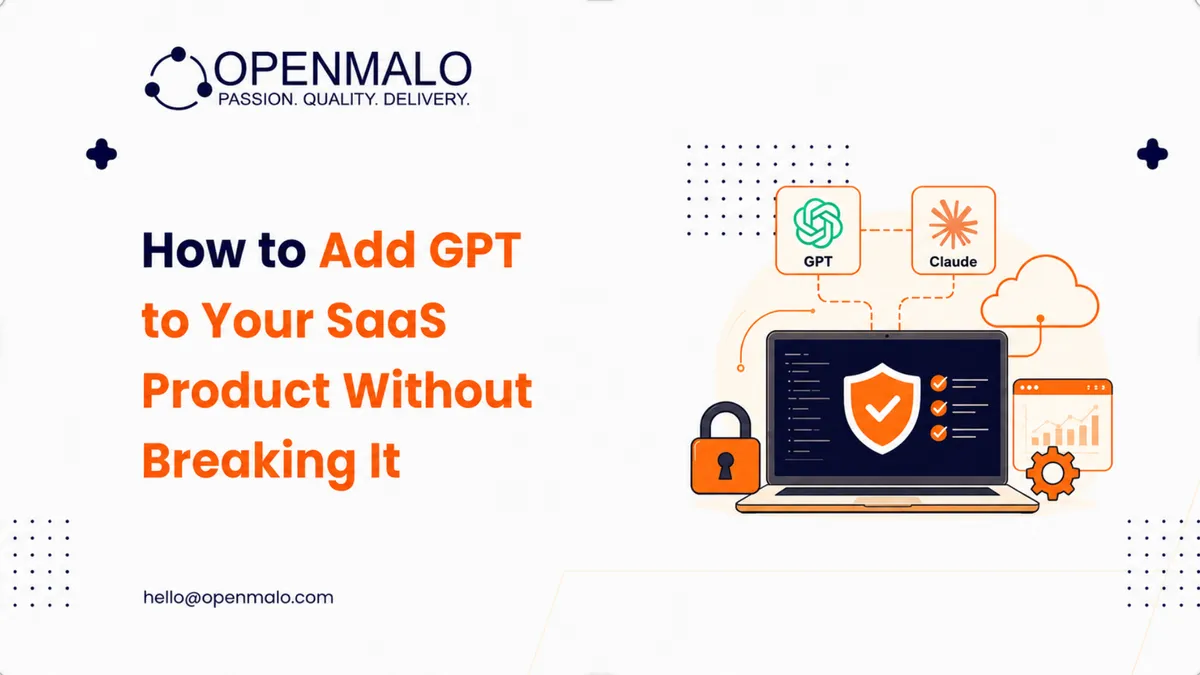
If you are building a SaaS product in 2026 and need to integrate an LLM, you have three serious choices: OpenAI's GPT-4o, Anthropic's Claude, and Google's Gemini. Every other option either lags on capability or lacks production-grade reliability.
The question gets asked constantly and answered poorly - usually with 'GPT is best' or 'Claude is smarter' without any context. The right answer depends entirely on what you are building. Here is an honest, use-case-driven comparison. No affiliate bias. No hype.
The Three Contenders: What They Actually Are
GPT-4o - OpenAI
The market leader. Best ecosystem, most community resources, most third-party integrations. Strong across text, code, vision, and audio. Cost-efficient compared to earlier GPT-4 versions. Over 70% of AI developers rely on OpenAI APIs - which means the most tutorials, the most troubleshooting resources, and the most pre-built tools are built around GPT.
Claude 3.5 / Claude 4 - Anthropic
Built with a strong emphasis on instruction-following, safety, and long-document accuracy. The largest context window of the three at 200K tokens - making it the best choice for tasks involving long documents, complex codebases, or multi-step reasoning chains. Consistently outperforms GPT on tasks requiring complex, nuanced instruction-following.
Gemini 1.5 / 2.0 - Google
Google's bet on multimodal AI. Strongest native integration with Google's ecosystem: Workspace, Search, Cloud. Best for tasks combining text, image, audio, and video. If your product lives in the Google ecosystem or involves heavy multimedia processing, Gemini has a structural advantage no amount of prompting can replicate.
Head-to-Head: 6 Use Cases
Code Generation and Review
Winner: GPT-4o (Claude close second). GPT-4o's code performance is battle-tested at scale. Claude excels at complex refactoring and multi-file reasoning. Gemini trails on code tasks. For developer tools, start with GPT-4o.
Long Document Analysis
Winner: Claude. A 200K token context window means Claude can ingest an entire legal contract, codebase, or knowledge base in a single call. GPT-4o's 128K context is competitive but falls short on very large documents. If your product involves document-heavy workflows, Claude's context advantage is decisive.
Complex Instruction Following
Winner: Claude. When you need the model to follow specific, multi-part instructions consistently across thousands of production calls, Claude is more reliable. This matters enormously when output format consistency directly affects your application logic.
Multimodal - Image, Video, Audio
Winner: Gemini for video and audio; GPT-4o for image understanding. Gemini's native multimodal architecture gives it an edge on complex vision tasks. If your product ingests mixed media, Gemini's integration depth is unmatched.
Cost at Scale
Winner: context-dependent. All three have moved to competitive pricing in 2026. GPT-4o is typically cheapest for standard text. Claude Haiku is extremely cost-effective for high-volume simpler tasks. Run the numbers on your actual token volumes before committing.
Ecosystem and Integrations
Winner: GPT-4o. The volume of pre-built integrations, LangChain support, vector database connectors, and community resources makes OpenAI the path of least resistance for most SaaS builds. You spend less time on infrastructure, more time on your product.
The Multi-Model Strategy: The 2026 Architecture
An increasing number of production SaaS products now use multiple LLMs simultaneously. Simple, high-volume queries go to a cheap fast model. Complex reasoning goes to GPT-4o or Claude Sonnet. Document analysis routes to Claude for the context window. This approach costs more engineering time upfront but delivers better performance and lower cost at scale.
Design for model-agnosticism from day one. Build abstraction layers that make swapping providers a one-week engineering task. The model landscape will keep evolving - your architecture should not require a rebuild every time it does.