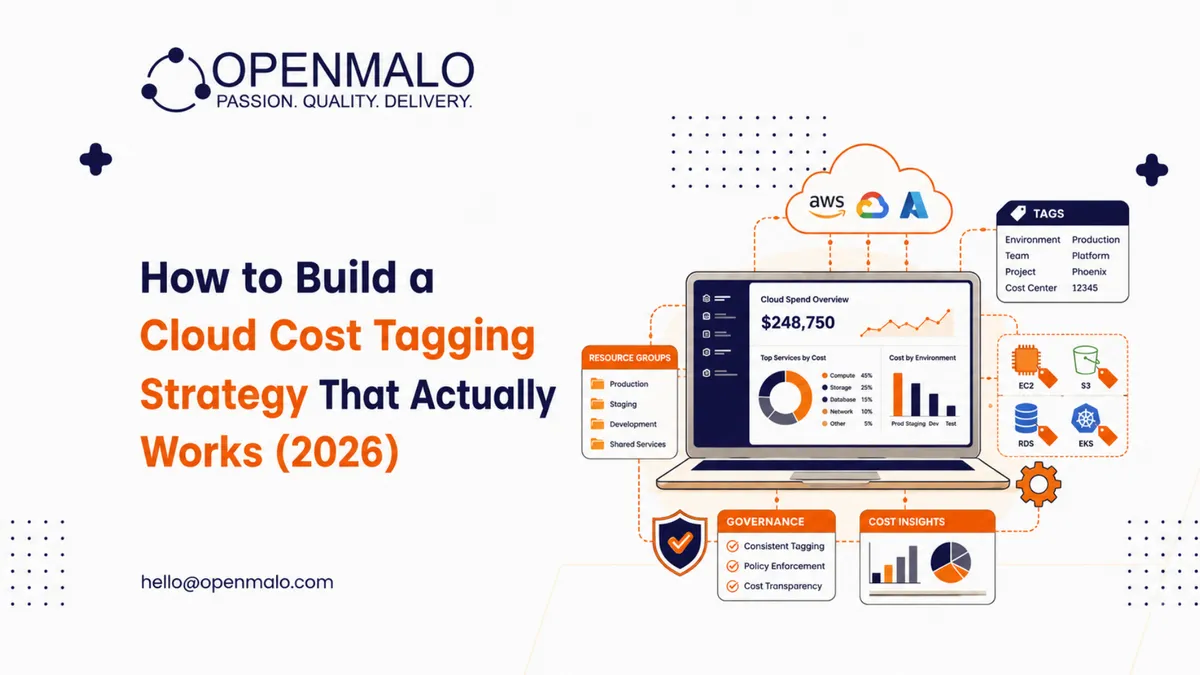
In 2026, a cloud resource without a tag is a "Ghost Resource"—it consumes budget, creates security blind spots, and offers zero accountability. As infrastructure scales across multi-cloud environments and specialized AI clusters, a manual "best effort" tagging approach is no longer enough. To survive the 2026 audit cycle, you need a Hardened Tagging Strategy.
At OpenMalo Technologies, we believe visibility is the first step toward profitability. If you can't attribute a dollar of spend to a specific team or project, you can't optimize your margins. Here is how to build a tagging framework that sticks.
1. The "Golden Five": A Mandatory 2026 Schema
Standardization is the enemy of waste. In 2026, every resource in your AWS, Azure, or GCP environment must carry these five core keys. Consistency in casing (e.g., all lowercase) is critical to prevent "Tag Sprawl."
- owner: The specific team or functional lead responsible (e.g., platform-eng, data-science).
- project: The revenue-generating initiative or internal product (e.g., customer-portal, ai-inference-v2).
- environment: The lifecycle stage of the resource (e.g., prod, staging, sandbox).
- cost_center: The financial code for internal chargebacks (e.g., fin-042, mkt-99).
- compliance: Data sensitivity or regulatory requirements (e.g., dpdp-sensitive, pci-dss, public).
2. Enforcement: Moving from "Policy" to "Guardrails"
A PDF policy document is where tagging strategies go to die. In 2026, enforcement must be Mechanical.
- Infrastructure as Code (IaC): Use Terraform or Pulumi to bake tags into your modules. If the tags aren't present, the code shouldn't compile.
- Organization Policies: Use AWS Service Control Policies (SCPs) or Azure Policy to explicitly "Deny" the creation of any resource that lacks the mandatory "Golden Five" keys.
- Automated Remediation: Deploy "Janitor" bots. If a resource bypasses the policy (rare but possible), the bot should tag it as temporary-quarantine and notify the creator. If not fixed in 24 hours, the resource is automatically terminated.
3. Handling the "Untaggable": 2026 Workarounds
Not every cloud cost can be tagged directly (e.g., Data Transfer fees, Shared Support plans, or some Serverless sub-components).
- The Solution: Use Cost Categories (AWS) or Billing Export Labels (GCP). Create "Virtual Tags" that group untaggable costs based on the account or VPC they reside in.
- Shared Clusters: For multi-tenant Kubernetes clusters, use tools like KubeCost to simulate tagging by namespace, allowing you to split the "Untaggable" cluster bill among different project teams.
4. Governance & Compliance (DPDP Act Integration)
In 2026, tagging isn't just for FinOps; it's a legal requirement under frameworks like India's DPDP Act.
- Data Residency Tags: Use tags like data_location: mumbai to prove to auditors that sensitive PII is staying within authorized borders.
- Auto-Deletion Tags: Use a lifespan or delete_after tag. Under the DPDP Act, you cannot hold personal data indefinitely. Automated scripts can read this tag and purge data buckets once the "Purpose Limitation" period ends.
5. The OpenMalo "Tag-or-Terminate" Framework
At OpenMalo Technologies, we implement a high-discipline approach for our partners:
- Define the Dictionary: We establish a single source of truth for tag values (no more Prod vs production).
- Audit First: We run a 7-day "Showback" period where teams see exactly how much "Anonymous Spend" they are responsible for.
- Harden the Gate: We enable "Deny" policies in non-prod environments first to train the team, then move to production.
- Continuous Clean-Up: Monthly "Hygiene Reports" identify orphaned snapshots or disks that have lost their owner tags.
Key Takeaways
- Automation is Mandatory: If a human has to type a tag, they will eventually forget. Use IaC.
- Case Sensitivity Matters: Environment:Prod and environment:prod are different costs in your billing report. Pick one standard.
- Start Lean: Don't start with 20 tags. Start with the "Golden Five" and expand only when necessary.
- Visibility = Accountability: When engineers see the cost of their specific project, they naturally begin to optimize.
Conclusion
A successful cloud cost tagging strategy in 2026 is less about "labeling" and more about Governance. By treating tags as a mandatory part of your infrastructure's DNA, you bridge the gap between engineering velocity and financial sanity. At OpenMalo Technologies, we don't just build clouds; we build Accountable Infrastructures.
Is your "Other/Unallocated" spend the largest item on your cloud bill? OpenMalo Technologies provides specialized Tagging Audits and Automated Governance implementation.