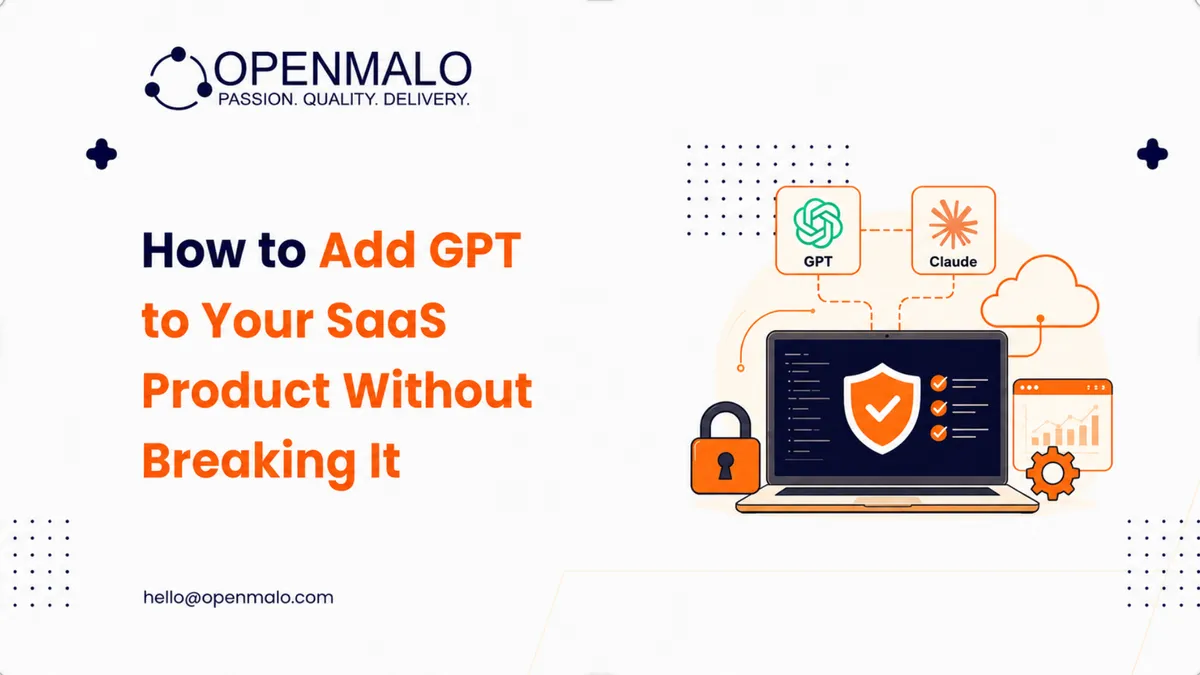
Most SaaS founders discover the same ugly truth about six weeks post-launch: GPT is not a feature. It is a system. And the teams that treated it like a feature are the ones in the forums asking why their OpenAI bill is $14,000 this month.
The good news? Every single failure mode is predictable and preventable. Here is how to build GPT into your SaaS product the right way - before production punishes you.
The Real Reason Most GPT Integrations Fail
Over 70% of SaaS GPT integrations run into serious problems before reaching production. Not because GPT doesn't work. The failure is almost always architectural. Teams treat LLM integration like dropping in a third-party widget. It isn't. GPT is a probabilistic system living inside a deterministic product. Those two things need careful engineering to coexist.
What this means in practice: the same input will not always produce the same output. Responses can be confidently wrong. Response time is variable. And cost scales directly with token consumption - input and output. Miss any of these properties in your design, and production will remind you.
The Three Integration Approaches
1. API Wrapper - Fastest, Least Customised
Call the OpenAI API directly. Your backend handles prompts and post-processing, surfaces results to the UI. Works well for text generation, summarisation, and quick assistants. Implementation time: 1-2 weeks. The risk: your product differentiates on prompt engineering alone, which competitors can replicate in a weekend.
2. Fine-Tuning - Most Consistent for Repeated Tasks
Train the model on your own labelled examples to produce consistent, domain-specific behaviour. High-volume, low-variability tasks - automated customer responses, invoice classification - are where fine-tuning pays off. More setup cost, but predictability that prompt engineering cannot match. Implementation time: 3-6 weeks.
3. RAG - Best for Knowledge-Intensive Products
Retrieval-Augmented Generation is the standard architecture for serious SaaS products in 2026. Instead of fine-tuning, you give the model access to your own data at inference time via a vector database. The model retrieves relevant context before generating. This kills hallucinations on factual queries and keeps your data current without retraining. If your product handles customer data, internal knowledge, or proprietary content - this is your architecture.
The 5 Mistakes That Kill GPT Integrations in Production
- No rate limiting. One misconfigured loop or a bot hitting your endpoint can generate $10,000+ in unexpected OpenAI charges overnight. Implement per-user, per-session limits before launch - not after.
- No fallback logic. OpenAI has downtime. If your product has no fallback - cached responses, graceful degradation, simpler model - every OpenAI outage becomes your product outage.
- Raw user input sent directly to the model. Users will test your system with inputs designed to override your instructions (prompt injection). Always sanitise and wrap user input in structured system prompts.
- No output validation. GPT outputs are strings. Validate format, length, and content before they touch your database or UI. An AI that returns a sentence where your code expects a phone number creates failures that are nightmares to debug.
- Ignoring latency. GPT adds 500ms-3s to response time. For real-time features, streaming responses - token-by-token rendering - are not optional. Build for streaming from day one. Retrofitting it is painful.
The Production-Ready GPT Integration Checklist
Before you write a single line of code, confirm you have answers to these:
- What is the exact use case and expected output format?
- How will user input be sanitised and structured before hitting the model?
- What are the per-user rate limits and cost monitoring thresholds?
- What is the fallback if the API is down or slow?
- How will outputs be validated before touching your application logic?
- Are streaming responses built in for user-facing features?
- How will you monitor quality drift in production over time?
What a Real GPT-Integrated SaaS Feature Looks Like
Here is the concrete version. A CRM where GPT auto-drafts follow-up emails based on deal stage and notes. When a rep opens a deal, the backend retrieves deal metadata, recent notes, and the rep's communication style preferences from past sent emails. These are injected into a structured prompt. GPT-4o returns a draft email. Output is validated for length and format. The rep reviews and sends with one click.
Result: reps go from 15-20 minutes crafting follow-ups to 90 seconds reviewing and sending. Pipeline velocity increases. No additional SDRs hired. This is what good GPT integration looks like - not an AI chatbot bolted to the side of your product.