You have a problem. You can see exactly how AI should reshape a part of an industry. You have a clear product vision. You are not a developer. What do you actually do?
This article is for that person. Not a technical deep dive - a practical guide to the decisions, the process, and the landmines of building an AI web app as a non-technical founder. From validated idea to launched product.
The Most Expensive Mistake Non-Technical Founders Make
Commissioning a build before validating whether anyone will use the product. Technical founders make this mistake too, but it costs non-technical founders more - they are entirely dependent on external engineers, so every rebuild is both expensive and slow.
The validation questions you need answered before any code is written:
- Who specifically is your first user? Not a demographic - a named individual or company you have already spoken to.
- What workflow are you replacing or improving? Not 'customer service' - 'a 5-person support team handling 200 tickets per day manually.'
- What would they pay for this, and how do you know? Have you asked them with a price attached, not just in the abstract?
If you cannot answer all three with specific evidence, spend two weeks on validation before spending a dollar on development.
Define Your AI Feature - Not Your AI Strategy
Non-technical founders arrive at development conversations with 'I want AI in my product' instead of 'I need the product to do X automatically.' The second framing is what engineers can actually build.
Pick one for your MVP. Not all five.
Three Decisions Your Development Team Will Make on Your Behalf
You do not need to write code. You do need to understand these decisions - because they affect your product's cost, performance, and future flexibility.
Decision 1: Which LLM?
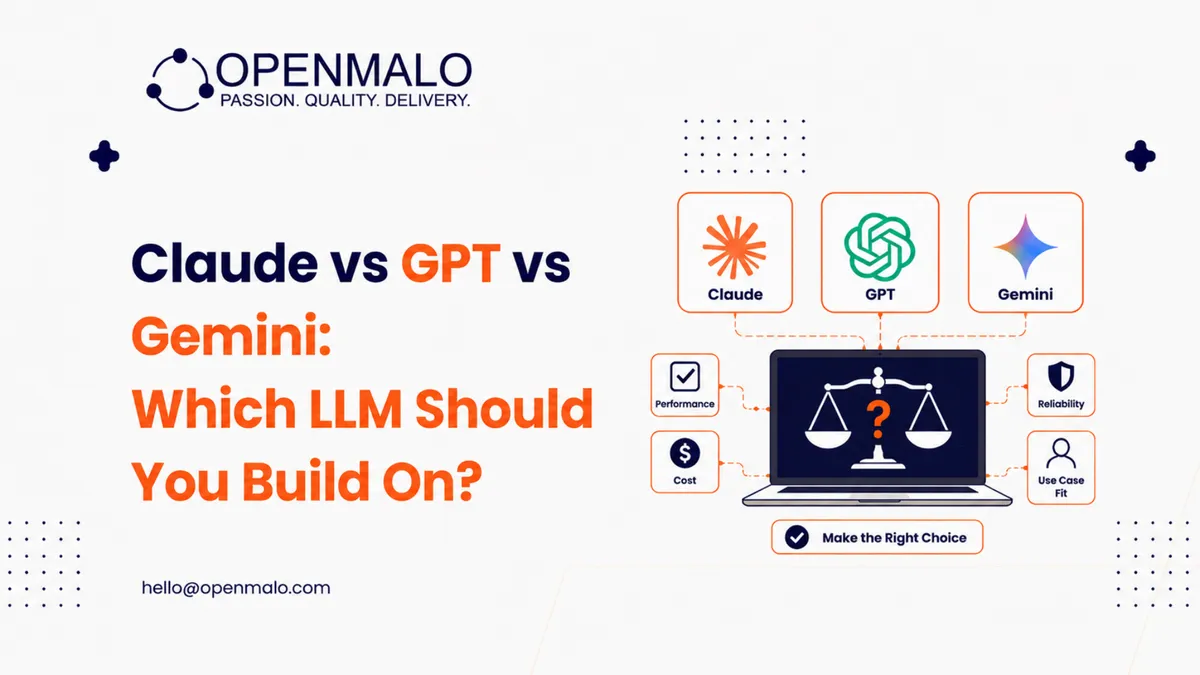
GPT-4o, Claude, or Gemini. For most founders in 2026, GPT-4o is the pragmatic default - widest ecosystem, most documentation, most integrations.
Decision 2: How Is Your Data Used?
There is a big difference between a product that sends queries to an LLM and gets generic responses, and one that retrieves relevant context from your own data before generating a response (RAG). The second approach produces far more relevant, accurate outputs for B2B products. It is more complex but the standard for serious builds in 2026.
Decision 3: How Do You Handle the AI Being Wrong?
AI systems produce incorrect outputs. This is not a bug - it is a property of the technology. Your product needs a defined approach: human review before publishing, confidence thresholds, correction mechanisms, or escalation for high-stakes decisions. This is not optional. Build it into the MVP.
Choosing the Right Development Partner
For a non-technical founder, the development partner is the most important variable in whether your product ships on time, on budget, and as envisioned.
- They ask hard questions about your use case before quoting. Anyone who quotes before understanding your specific workflow is guessing.
- They have production AI experience - not just demos. Ask for examples of AI features they have shipped and the outcomes achieved.
- They explain tradeoffs in plain English. If they cannot explain an architectural decision in terms you understand, they either do not know or do not care whether you follow along. Both are problems.
The Build Process: What to Expect Week by Week
Weeks 1-2: Discovery and Architecture
Your development partner maps your validated workflow, defines the data model, selects the tech stack, and designs the AI integration architecture. You provide: detailed workflow documentation, sample inputs and expected outputs, access to any existing data or systems the AI needs.
Weeks 3-6: MVP Build
Core product built with the primary AI feature integrated. Expect working software demos every week - not just at the end. If your partner only shows you a final demo, that is a red flag.
Weeks 7-8: Testing and Prompt Tuning
AI outputs tested with real user scenarios. Prompt templates iterated until output quality meets the target. This phase is consistently underestimated by founders. AI quality lives in the prompts and the data, not just the model.
Weeks 9-10: Production Deploy and Monitoring
App launched with monitoring for AI performance, cost tracking, and error logging. Post-launch, your development team watches for model drift and output quality degradation. AI products are not fire-and-forget.