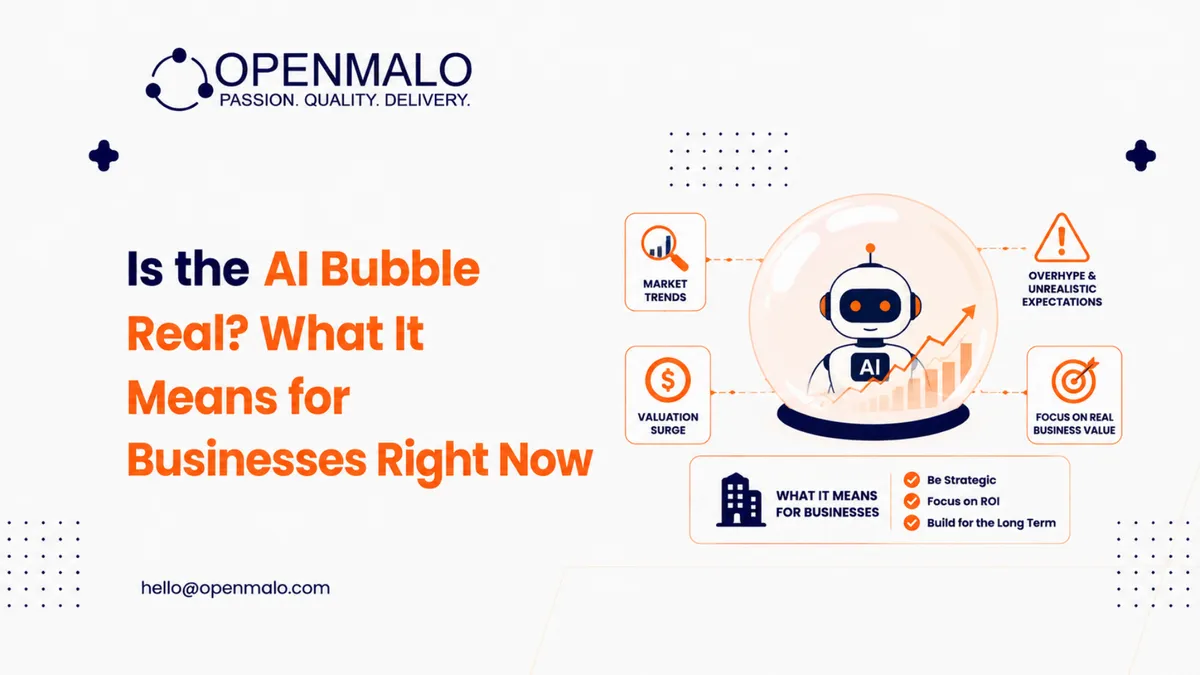
Is AI a bubble? The question is everywhere in 2026 - in board meetings, on finance podcasts, in the comments of every AI funding announcement. The honest answer: it depends on which layer of AI you are talking about. And for most businesses, the distinction is everything.
Where the Bubble Concern Is Legitimate
The concern is most credible at the infrastructure layer. Hyperscalers - Microsoft, Google, Amazon, Meta - collectively plan to spend over $300 billion on AI infrastructure in 2026. Data centers are being built faster than demand currently justifies.
The skeptic case: if AI revenue does not scale fast enough to justify this infrastructure spend, we will see a contraction. The parallel is the fiber optic buildout of the late 1990s - absolutely the right infrastructure vision, just years ahead of viable revenue models. Nortel's stock did not survive. The internet did.
Where the Bubble Concern Is Overblown
At the application layer - actual businesses deploying AI to solve real workflow problems - the returns are clearly measurable and already being realised:
- Average SMB worker saves 5.6 hours per week using AI tools. Managers save over 7 hours.
- Companies using AI in sales operations report 35% faster lead conversion.
- AI in customer service is reducing cost-per-contact by 20-40% at scale.
These are not projected future returns. They are current operational numbers from businesses running AI in production today. This is not a speculative bubble - it is compounding operational advantage.
The Real Risk for Businesses: Undisciplined Adoption
The bubble concern that matters most for a business owner is not 'will the AI market crash?' It is: 'am I deploying AI with the discipline to get real returns, or am I spending because everyone else is?'
Gartner's warning is pointed: over 40% of agentic AI projects are at risk of cancellation by 2027. Not because the technology does not work, but because projects were launched without clear ROI definitions, proper integration, or governance frameworks.
The failure pattern looks like this:
- Company announces AI initiative in response to board or competitive pressure.
- AI is deployed as a point solution to a vaguely defined problem.
- Results are hard to measure because success was never defined.
- Project gets cancelled after 12 months. Conclusion: 'AI doesn't work for us.'
The problem is not AI. The problem is investing in AI the way you would invest in a trend, not the way you would invest in infrastructure.
Four Disciplines That Separate Winners from Wasters
1. Define the Metric Before You Build
'AI will make us more efficient' is not an investment thesis. 'Reduce Tier-1 support tickets handled by humans by 40% within 6 months' is. Define the number first. If you cannot define it, you cannot build toward it.
2. Start With Workflow, Not Technology
The question is not 'what AI should we use?' It is 'what workflow is costing us the most, and what does AI need to know to automate it?' Technology selection follows workflow definition, not the other way around.
3. Treat Integration as the Core Work
AI that does not connect to your actual data and systems delivers no value. The engineering that matters is not the model - it is the integration layer that gives the model context about your business.
4. Plan for Governance From Day One
Who reviews AI decisions? What triggers a human escalation? How do you audit what the AI did and why? These are not bureaucratic questions. They are the difference between an AI system you can trust and one that creates liability.
The Bottom Line
The AI bubble - to whatever extent it exists - is a story about valuation, not utility. The infrastructure may be overbought. The applications are delivering real, measurable value to businesses that deploy them with discipline.
The risk of waiting is real: every quarter competitors automate workflows you are still doing manually is compounding advantage they are building over you. The risk of acting without discipline is also real: wasted budget and an organisation that becomes AI-sceptical after a failed initiative.
The path forward is not to wait for the bubble to resolve. It is to invest with the discipline of someone who needs ROI, not someone chasing a trend.