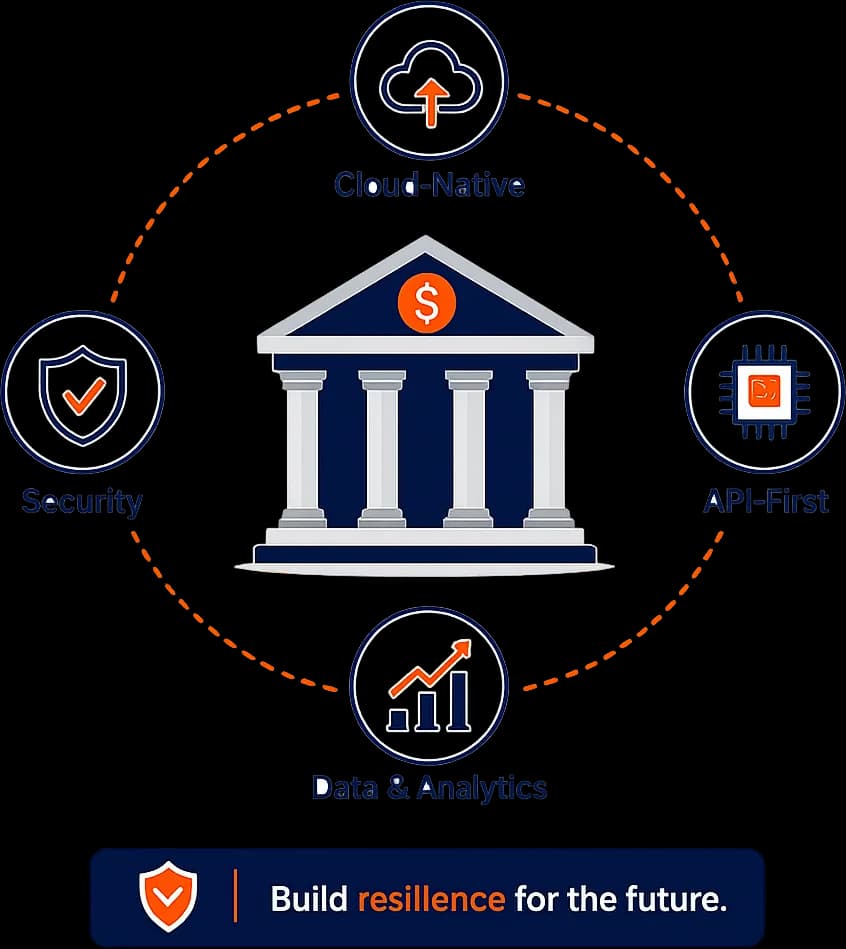
In 2026, the "Heart" of the bank—the Core Banking System (CBS)—is under unprecedented pressure. Legacy monoliths built on COBOL or early Java are struggling to keep pace with the instant settlement demands of UPI 2.0, the "Token Economics" of AI agents, and the rigid data residency requirements of India's DPDP Act.
At OpenMalo Technologies, we specialize in the Engineering of Trust. Modernizing a bank isn't like updating a retail app; it is like performing a heart transplant while the patient is running a marathon. To succeed without losing your mind (or your customers), you need a strategy that prioritizes Hardened Resilience over "Hype-Driven" development.
1. The 2026 "Core" Dilemma: Why Now?
For decades, banks followed the "If it ain't broke, don't fix it" rule. But in 2026, the old systems are breaking—not because they crash, but because they are operationally brittle.
- The Scalability Wall: Legacy systems cannot handle the 100x surge in micro-transactions driven by IoT and machine-to-machine payments.
- The Talent Gap: The pool of engineers who can maintain 40-year-old mainframe code is evaporating.
- Agentic Readiness: To deploy Agentic AI (automated financial advisors that execute trades), you need a real-time API layer that traditional cores simply do not possess.
2. The "Hardened" Migration Framework: Hollowing Out the Center
At OpenMalo Technologies, we advise against the "Big Bang" approach for CBS. Instead, we use the "Hollow Out the Core" strategy, a specialized evolution of the Strangler Fig pattern.
- Edge Decoupling: Move non-core functions (like KYC, Loan Origination, and Customer Portals) to a modern microservices layer.
- The Integration Bridge: Deploy a "Hardened" API orchestration layer that translates modern JSON requests into legacy protocols (like ISO 8583 or SOAP).
- The Component Extraction: One by one, move core modules (e.g., General Ledger, Deposits, or Lending) to the new system.
- The Final Cut: Once only the "empty shell" of the legacy system remains, decommission the mainframe.
3. Modernization Archetypes: From Cloud-Native to Agentic
Banks in 2026 are choosing between three primary modernization paths:
- Progressive Refactoring: Incremental replacement of specific modules over 3-5 years. Best for large Tier-1 Banks with massive legacy debt.
- Sidecar Launch: Building a "Digital Bank" in parallel to the main bank on a fresh stack. Best for rapidly launching new products without touching the old core.
- Clean Slate (Neo-Core): Total replacement with a cloud-native, API-first vendor (e.g., Mambu or Thought Machine). Best for smaller, agile banks or credit unions.
4. Compliance as an Anchor: DPDP and DORA Integration
Modernization in 2026 is a legal imperative.
- DPDP Act (India): Modern cores must have "Privacy-by-Design" built into the ledger. This means the system must be able to programmatically "Forget" a user's data across all financial logs—a task that is nearly impossible on old mainframes.
- DORA (Digital Operational Resilience Act): Your new core must prove it can survive a "Cloud Exit." If your primary cloud provider fails, your modernized core must be able to failover to a different provider or an on-premise "Hardened" site within minutes.
5. The OpenMalo Technologies "Zero-Drift" Implementation Protocol
When we modernize a CBS, we implement the "Binary Truth" verification system:
- Parallel Run: For every transaction, we process it through both the old and new core.
- The Auditor Agent: An autonomous AI agent monitors both outputs. If there is even a 0.0001% discrepancy in interest calculation or ledger balance, the agent triggers an immediate "Circuit Breaker" to prevent financial drift.
- Data Residency Guardrails: We ensure that all primary transaction data stays within Indian borders, utilizing local cloud availability zones to remain 100% DPDP compliant.
Key Takeaways
- Risk is the First Metric: Don't modernize for "features"; modernize for Resilience.
- The Data is the Core: The software can change, but the integrity of the ledger is sacred.
- Invest in Middleware: A great API orchestration layer buys you the time to migrate the back-end safely.
- People over Code: Train your staff on the new cloud-native stack 6 months before the first module goes live.
Conclusion
Modernizing a core banking system is a marathon of discipline. In 2026, the banks that survive aren't the ones that move the fastest, but the ones that build the most Hardened foundations. At OpenMalo Technologies, we bridge the gap between your legacy past and your agentic future, ensuring your "Heart Transplant" is a success.