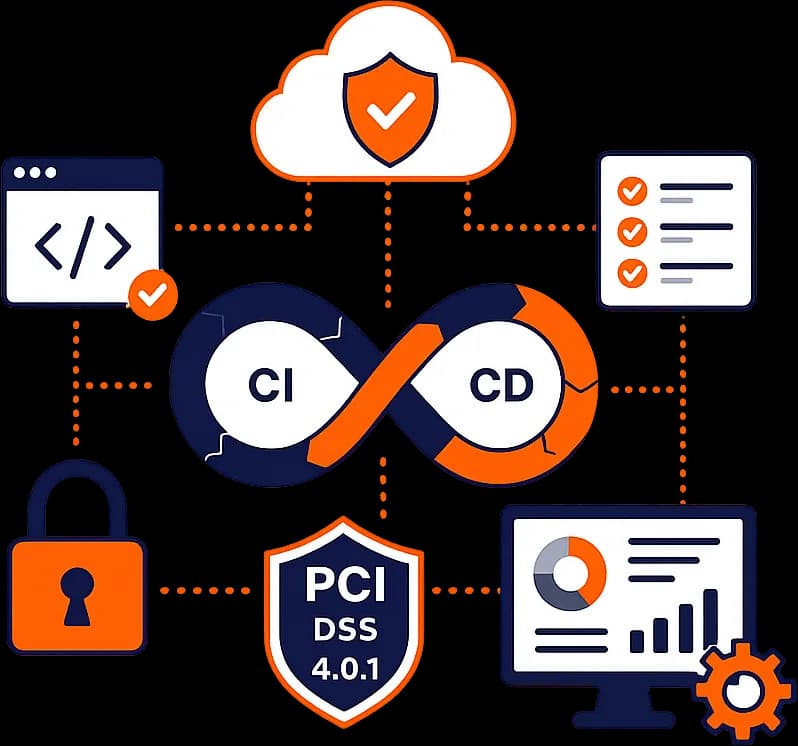
In 2026, the PCI-DSS 4.0.1 standard has fundamentally redefined the scope of "compliance." It no longer starts at the database; it starts at the Git Commit. Under the current mandates, your CI/CD pipeline is recognized as a primary attack vector that can influence the security of the Cardholder Data Environment (CDE). If your pipeline can deploy code to a production server, that pipeline is now in-scope for PCI.
At OpenMalo Technologies, we specialize in "Compliance-as-Code." We don't just help you pass an audit; we help you build a hardened delivery engine where security is a silent, automated byproduct of every build. Here is the 2026 blueprint for a PCI-compliant pipeline.
1. Requirement 6.3 & 6.4: The DevSecOps Mandate
PCI-DSS 4.0.1 has moved from "periodic reviews" to continuous, automated prevention.
- Requirement 6.3.2: You must maintain an inventory of all custom software and third-party components (SCA).
- Requirement 6.4.2: Public-facing web applications must be protected by an automated technical solution that continually detects and prevents attacks.
The Hardened Reality: You can no longer wait for a quarterly scan. In 2026, a compliant pipeline must "break the build" if a critical vulnerability is detected.
2. Architecture Pillar 1: Pipeline Segmentation & Isolated Runners
A common mistake is using the same build agent for a public marketing site and a payment-processing API.
- The "Blast Radius" Rule: Under PCI-DSS 4.0.1, you must isolate the runners (the machines that execute your code builds) that touch the CDE.
- Hardened Approach: Use ephemeral, single-use runners that are destroyed immediately after the job finishes. This ensures that no credentials or artifacts persist on the build hardware.
3. Architecture Pillar 2: Automated Security Gates
At OpenMalo, we implement a "Three-Gate" strategy for every fintech partner:
| Gate | Tooling Type | PCI Requirement Addressed |
|---|---|---|
| Gate 1: SCA | Dependency Scanning (Trivy, Snyk) | Req 6.3.2: Vulnerability management of third-party libraries. |
| Gate 2: SAST | Static Analysis (SonarQube) | Req 6.2.4: Pre-merge code review for security impact. |
| Gate 3: DAST | Dynamic Analysis (OWASP ZAP) | Req 6.4.1: Detection of runtime attacks (SQLi, XSS). |
4. Architecture Pillar 3: Secrets Hardening & Identity-Based Access
PCI Requirement 8 mandates strict authentication and "Least Privilege."
- No Hardcoded Secrets: Using environment variables in plain text is a 2026 audit failure. We utilize Dynamic Secrets (via HashiCorp Vault or Cloud KMS) where credentials are generated on-the-fly and expire the moment the deployment is complete.
- MFA for Pipelines: Access to modify pipeline configurations or manually trigger a production deploy must be protected by Multi-Factor Authentication (MFA) and tied to a unique user ID, not a shared "Admin" account.
5. The Evidence Engine: Automated Audit Trails
The most painful part of a PCI audit is gathering evidence. A hardened pipeline solves this by treating every action as a Signed Log.
- Artifact Integrity: We use container signing (e.g., Cosign) to ensure that the image built in CI is exactly the same image deployed in Production.
- Compliance-as-Code: Every security scan result is automatically tagged to the commit and exported to a tamper-proof log (Requirement 10.2). When the auditor asks for proof of "Requirement 6.2.4," you simply export a report showing that every merge was gated by a passing security scan.
Key Takeaways
- Your Pipeline is the Perimeter: Secure it with the same rigor as your production servers.
- Automate the Reject: If a scan finds a "High" CVE, the pipeline must fail. Manual overrides are an audit red flag.
- Isolate Sensitive Workloads: Use dedicated runners and secrets for CDE-impacting code.
- Evidence is a Side Effect: If you build the pipeline correctly, your audit documentation generates itself.
Conclusion
Building a PCI-DSS 4.0.1 compliant pipeline in 2026 is no longer about checking boxes once a year; it's about engineering a system that is Secure by Default. By integrating automated testing, identity-based secrets management, and immutable audit trails, you transform compliance from a bottleneck into a competitive advantage. At OpenMalo Technologies, we don't just help you meet the standard—we help you exceed it.
Is your CI/CD pipeline an open door for auditors? OpenMalo Technologies specializes in building hardened, PCI-compliant DevSecOps workflows for the world's most demanding fintechs.