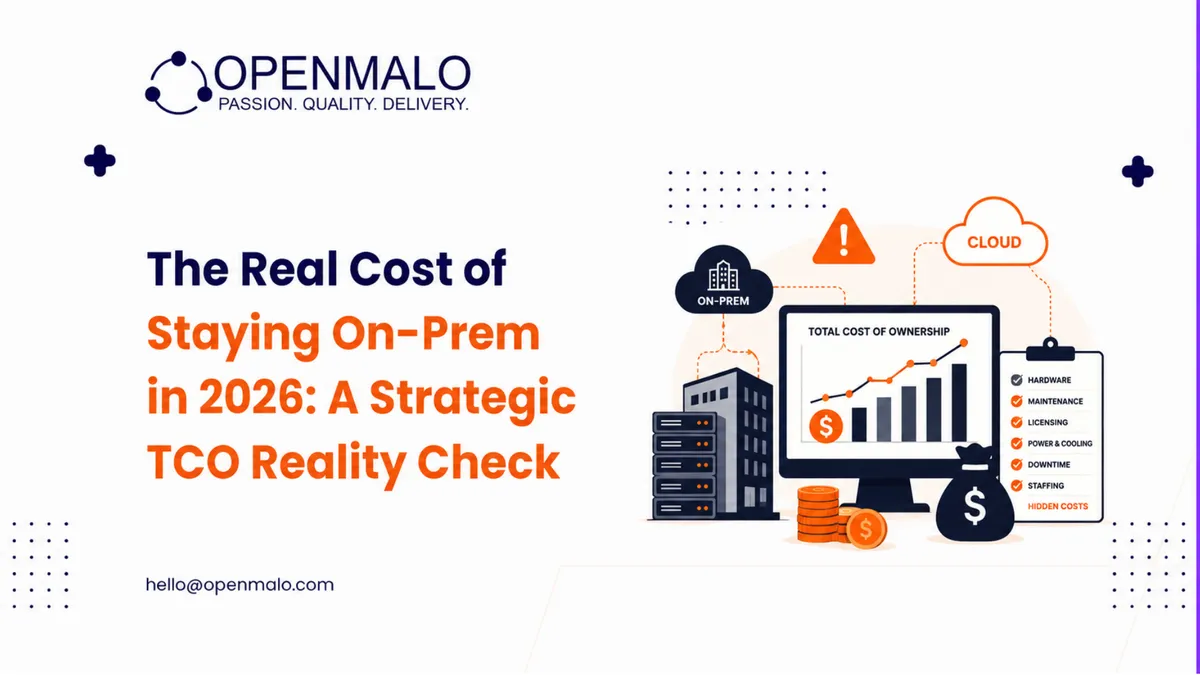
For a decade, the narrative was simple: "The Cloud is for agility; On-Prem is for saving money on predictable workloads." But as we move through 2026, that binary logic has collapsed. The rise of Generative AI, coupled with extreme Hardware Volatility and new Labor Economics, has flipped the Total Cost of Ownership (TCO) calculus on its head.
At OpenMalo Technologies, we help global enterprises navigate this "Hardened Infrastructure" transition. Whether you are operating out of Rajkot or Dubai, the decision to stay on-premise is no longer just a line item—it's a high-stakes bet on your ability to out-engineer the hyperscalers.
1. The "Token Economics" Shift: AI Inference Costs
In 2026, the primary metric for infrastructure success has evolved from "Server Uptime" to "Tokens Per Second per Dollar" (TPS/$).
The Reality Check: For sustained, high-throughput AI inference, owning your hardware can be 8x to 18x cheaper than using cloud APIs. A hardened on-premise setup using Blackwell-architecture (B200/B300) clusters can reach a breakeven point against cloud providers in as little as 4 months for workloads with >20% utilization.
However, this advantage only exists if you have the scale to saturate the hardware. For small-to-medium teams, the "retail price" of a Cloud API is still the lower-risk entry point.
2. Hardware Volatility: The 130% Memory Tax
If you are planning a hardware refresh in 2026, prepare for "Sticker Shock."
- The Component Crisis: DRAM and SSD prices have surged by up to 130% compared to last year. RAM now accounts for nearly 35% of the total bill of materials for a server.
- Lead Time Limbo: AI-optimized hardware has a massive backlog. While a cloud instance is available in minutes, a physical server order can face a 6-month lead time, resulting in "Opportunity Cost" that far outweighs the monthly cloud bill.
3. The "Shadow" OpEx: Power, Cooling, and Liquid Infrastructure
On-premise isn't just about the rack; it's about the Room.
- The Density Problem: Modern AI chips generate heat that traditional air-cooling can no longer handle. In 2026, staying on-prem for AI workloads often requires an upfront investment in Liquid Cooling systems.
- The Energy Bill: With global energy prices rising, the "Hidden OpEx" of running a private data center can increase your total cost by 15–20% year-over-year.
4. Regulatory Resilience: DPDP Act and Data Sovereignty
The strongest argument for on-prem in 2026 isn't financial—it's Legal.
Under India's Digital Personal Data Protection (DPDP) Act, the penalties for data mishandling are severe. For industries like Finance and Healthcare, the "Physical Control" of an on-premise server provides a level of Data Sovereignty that simplifies compliance audits.
5. The Financial Verdict: 2026 Comparison
| Metric | On-Premise (Hardened) | Cloud (Public) |
|---|---|---|
| Initial Cost | High (CapEx) | Near-Zero (OpEx) |
| Scalability | Slow (Weeks/Months) | Instant (Seconds) |
| Maintenance | In-house (High Staff Cost) | Managed (Included) |
| Data Control | Total / Sovereign | Shared Responsibility |
| Best For | Predictable, 24/7 AI workloads | Spiky, experimental apps |
Key Takeaways
- Own the Base, Rent the Spike: Use on-prem for your 24/7 "baseline" operations and cloud for "burst" capacity.
- FinOps is Mandatory: If you choose cloud, you must have a FinOps discipline to avoid the 30-40% cost overruns typical in 2026.
- Hardware is a Strategic Asset: View your servers as a long-term investment in AI efficiency, not just a depreciating piece of IT.
- Hybrid is the Winner: 85% of leaders now prefer a containerized hybrid model for maximum portability.
Conclusion
The "Real Cost" of staying on-premise in 2026 is no longer a simple hardware price tag. It is a complex mix of Token Economics, Supply Chain Agility, and Regulatory Compliance. At OpenMalo Technologies, we don't believe in "Cloud First" or "On-Prem First"—we believe in "Outcome First."
Confused about your 2026 infrastructure roadmap? OpenMalo Technologies provides deep TCO audits and Hybrid Cloud architecture design to ensure your "Hardened" stack is also your most "Profitable" stack.