Every week, a new headline declares that agentic AI will change everything. Every week, the definition gets murkier. If you have Googled 'agentic AI' and come back more confused than before, this article is for you. No jargon. No hype. Just a clear explanation of what it is, what it does, and what it means for your business.
The Death of the Chatbot
If 2024 was the year of the prompt and 2025 was the year of integration, then 2026 is the year of the agent. We are officially done with AI that just talks. Nobody wants a digital pen pal. We want digital workers - systems that do not just tell you how to process an invoice but actually open the system, extract the data, flag the anomaly, and route it for approval.
That is agentic AI. Here is the precise distinction.
The Three Levels of AI - Where Agentic Fits
Level 1: Responsive AI (Chatbots)
You ask, it answers. Reacts to a single prompt, waits for the next one. No memory between conversations. No ability to take action in the world. This is what most businesses deployed in 2023-2024 and called 'AI transformation.'
Level 2: Traditional Automation (RPA, Workflow Tools)
Pre-programmed to execute a fixed sequence of steps. Follows rules perfectly but breaks when something unexpected happens. Zero judgment. Zero adaptability. Useful but brittle.
Level 3: Agentic AI
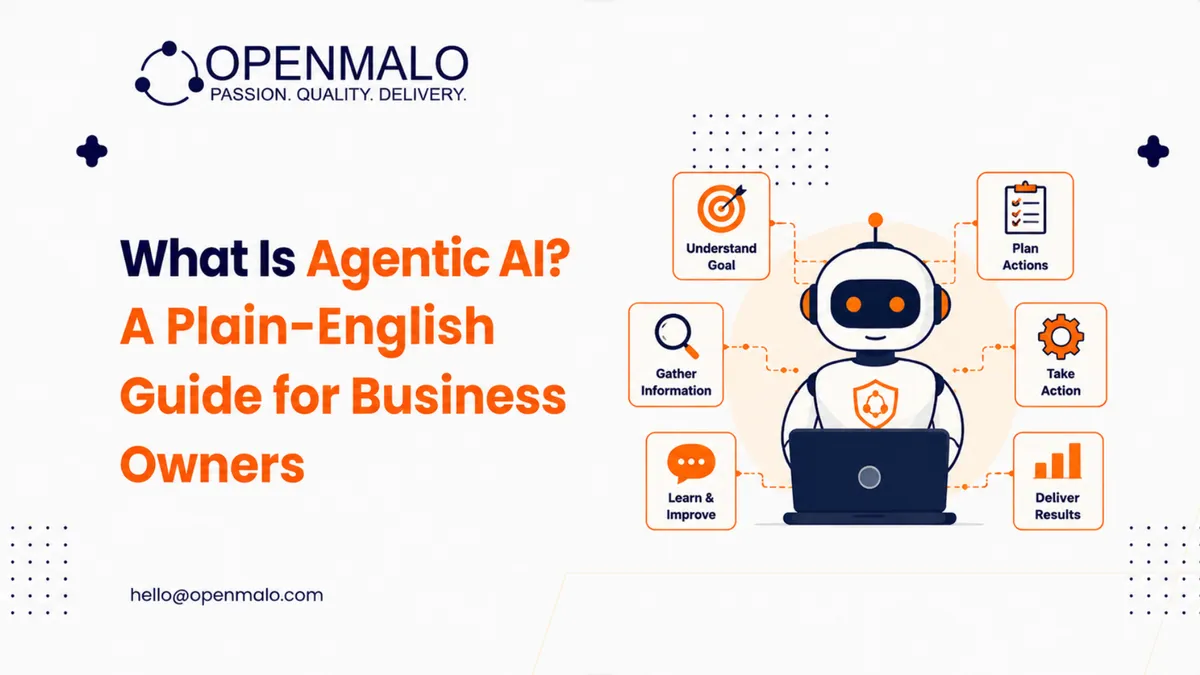
Given a goal, it figures out the steps. It plans, uses tools (APIs, databases, browsers), executes, checks its own output, and adapts when things go wrong. It does not need someone to specify every micro-step. It reasons its way to the outcome. This is the paradigm shift.
A Concrete Example: Same Problem, Three AI Levels
Scenario: a customer emails asking about a delayed order.
- Level 1 - Chatbot: Reads the email. Replies: 'I'm sorry for the inconvenience. Please contact our support team.' No action. No resolution.
- Level 2 - Automation: Detects 'delayed order' keyword. Fires pre-written template. Logs ticket. Still no resolution - just process theatre.
- Level 3 - Agentic AI: Reads the email. Looks up the order. Checks the shipping API. Finds the package is stuck. Contacts the courier. Gets the updated ETA. Replies to the customer with the new delivery date and a discount code. Logs everything in the CRM.
That gap between Level 2 and Level 3 is where billions of dollars in operational cost live.
How an AI Agent Actually Works
Under the hood, every agentic system has four components:
- A planning layer - receives the goal, breaks it into a sequence of sub-tasks, decides the order.
- Tool access - the agent calls APIs, queries databases, browses the web, writes and runs code. It interacts with the world.
- Memory - retains context across steps in a task. Advanced systems remember across multiple sessions.
- Self-evaluation - after each step, the agent checks whether the output matches the goal. If not, it tries a different approach.
5 Real Business Use Cases With Outcomes
Customer Support Triage
Agent reads inbound tickets, categorises by issue and urgency, resolves Tier-1 autonomously, escalates complex cases with a full summary. Result: 40-60% reduction in first-response time.
Lead Qualification
Agent monitors new CRM leads, enriches with public data, scores against your criteria, sends personalised first-touch emails, books calls for top prospects. SDR teams focus on warm leads only.
Internal Knowledge Management
Agent indexes your documentation, Slack history, and past project notes. Employees ask questions and get answers from your actual internal data. Onboarding time cut by 30-50%.
Financial Operations
Agent processes invoices, flags anomalies, matches against PO records, prepares payment runs for approval. Accounts payable 40% faster, fraud reduced by 35%.
Development and QA
'Openclaw, watch the CI/CD pipeline. If the build fails, analyse the logs, find the breaking change, and DM the dev who pushed the code with a suggested fix.' This is not a demo. It is a standard Monday morning in 2026.
What You Actually Need to Deploy One
Here is the honest list for a business that is not a tech company:
- A clear, bounded workflow with defined inputs and outputs.
- Access to the data and systems the agent needs to act on.
- A development partner with production-grade agent experience - not just demos.
- A governance plan: who reviews agent decisions, what triggers human escalation, how do you audit outputs?
What you do not need: an AI team, a data science department, an ML PhD, or a million-dollar infrastructure budget.