In 2026, the global IT spend has crossed $6 trillion, yet "Deployment Velocity" remains the #1 KPI that CEOs are losing sleep over. Most leaders respond to slow shipping by buying more tools—a faster CI/CD provider, a shinier observability dashboard, or more AI copilots. But here is the "Hardened" reality we see at OpenMalo Technologies: You cannot fix a cultural or structural bottleneck with a software subscription.
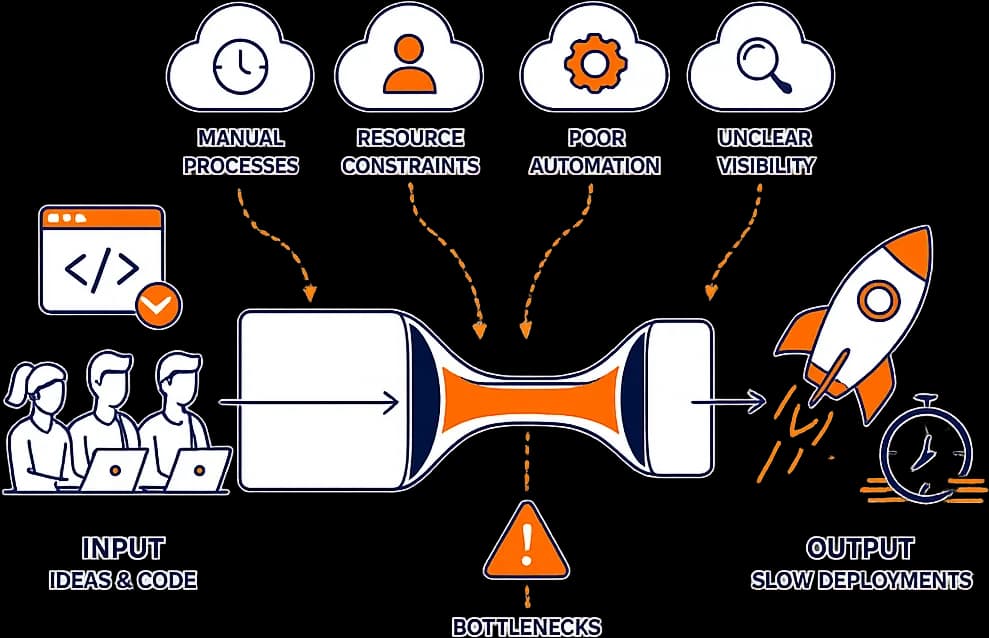
If your team has the best tools in the world but still takes weeks to push a minor feature, you don't have a tooling problem. You have a Flow problem. In 2026, the friction isn't in the writing of the code; it's in the movement of the code.
1. The "Coordination Tax": Why 10 Teams Move Slower Than 1
As engineering organizations grow, they often suffer from "Autonomy Fragmentation." Every team chooses its own way to deploy, its own database flavor, and its own tagging system.
- The Result: When you need to ship a cross-functional feature, you spend 80% of your time in "Sync Meetings" and 20% coding.
- The 2026 Lesson: In 2026, velocity is determined by Service Boundaries. If Team A has to wait for an approval from Team B's manager to update an API, your deployment speed is capped by your org chart, not your Jenkins pipeline.
2. The "Cognitive Load" Trap: Developers as Generalists
We expect the modern 2026 engineer to be a "Full-Stack-Dev-Sec-Ops-Cloud-Expert."
- The Reality: When a developer has to think about Kubernetes clusters, DPDP Act compliance, and CSS styling in the same hour, their "Cognitive Load" redlines.
- The Bottleneck: They deploy slowly because they are terrified of forgetting one of the 50 "Manual Checklists" required to get a piece of code into the wild.
3. The "Anxiety Architecture": Fear of the "Breaking Change"
Many teams deploy slowly because their system is "Fragile." If a single line of code in the "User Profile" service can crash the "Checkout" service, engineers will naturally move with extreme, agonizing caution.
- The Hardening Fix: Move from a "Monolith" mindset to Modular Contracts. When teams can deploy with "Fault Isolation," the fear of breaking the whole world disappears, and deployment frequency naturally triples.
4. The "Review Bottleneck": AI-Volume vs. Human-Throughput
In 2026, AI is generating code 50% faster than in 2024. However, humans are still reviewing that code at the same 2024 speed.
- The Crisis: Pull Requests (PRs) are piling up. "Time to First Review" is the hidden killer of 2026 velocity.
- The Hardened Strategy: We implement "Small Batch Deployment." Large PRs cause "Review Fatigue." By forcing teams to ship 10 small changes instead of 1 giant one, the review cycle moves from days to minutes.
5. The OpenMalo Fix: Moving to Platform-as-a-Product
At OpenMalo Technologies, we don't just "add more tools." we help our partners in Rajkot, the US, and the UAE implement Platform Engineering.
- Golden Paths: We build internal platforms where the "Safe Way" to deploy is also the "Easiest Way."
- Self-Service: A developer should be able to provision a database or a staging environment in 30 seconds via a CLI, without ever talking to an "Ops Person."
Key Takeaways
- Structure > Software: Your org chart is your biggest deployment bottleneck.
- Reduce Cognitive Load: Let developers focus on Business Value, while the platform handles the Infrastructure Noise.
- Shrink Your Batches: If it takes more than 15 minutes to review a PR, it's too big.
- Automate the "Why," Not Just the "How": Ensure everyone understands the product goals to reduce rework.
Conclusion
The secret to moving fast in 2026 isn't working harder; it's designing for flow. When you remove the manual handoffs, the coordination tax, and the fear of failure, speed becomes a natural byproduct of your culture. At OpenMalo Technologies, we specialize in hardening these engineering "Nervous Systems" so you can turn your creative sparks into functional, deployed reality—fast.
Is your deployment pipeline stuck in 2022? OpenMalo Technologies provides engineering leadership consulting and platform hardening to help your team ship on-demand.