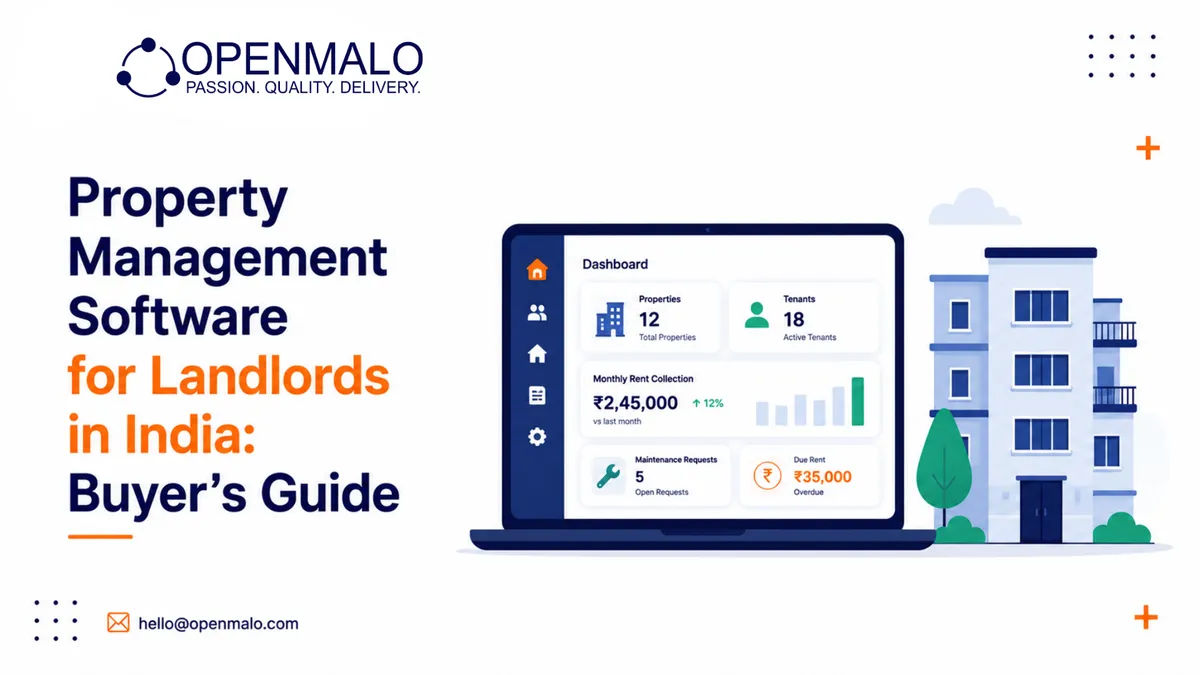
Quick answer: Property management software in India splits into three categories — society management apps (MyGate, NoBrokerHood, ApnaComplex, ADDA), landlord/portfolio PMS for individuals and small managers, and enterprise PMS (Yardi, RealPage, ERPnext customisations) for large portfolios. Pick by your role, not by feature checklist. Most buyers waste budget by buying a society app to manage rentals — or enterprise PMS for 10 units.
Property management software in India spans three different user types — individual landlords with a few units, multi-property managers running portfolios, and resident welfare associations / housing societies. The tools are different for each, the right pick depends on which problem you actually have, and most buyers waste budget on software that doesn’t match.
In plain language: individual landlords need lightweight rent collection, lease tracking, and tenant communication, often with a mobile-first interface; portfolio managers need everything above plus reporting, maintenance workflows, and accounting integration; housing societies need visitor management, maintenance ledger, dues collection, and community communication — a different category of product, often the dominant use case in India.
The three categories of "property management software in India"
| Category | Primary user | Core problem solved | Examples |
|---|---|---|---|
| Society management apps | RWAs, society committees, gated communities | Visitor management, dues, maintenance, community | MyGate, NoBrokerHood, ApnaComplex, ADDA |
| Landlord / portfolio PMS | Individual landlords, property managers | Rent collection, lease tracking, tenant communication | Various smaller players + horizontal tools |
| Enterprise PMS | Large property managers, REITs, commercial portfolios | Full lifecycle management, accounting, reporting | Yardi, RealPage, ERPnext customisations |
Pick by your role, not by feature list.
Society management — the dominant Indian use case
Most India PMS searches map to society management. The decision dimensions:
- Visitor management — pre-approved visitors, delivery notifications, security gate workflows
- Maintenance / facility — request raising, vendor assignment, status tracking
- Dues / billing — auto-generation of monthly bills, payment collection, defaulter tracking
- Community communication — notices, polls, classified, neighbour-to-neighbour
- Security and safety — staff verification, intercom, panic alerts
- Accounting — ledger, financial reports, audit trail
The market leaders compete primarily on UX and on the depth of the security gate integration. Pricing models vary — per-unit per month, per-society subscription, or freemium with monetisation through partnered services.
Landlord / portfolio PMS — the under-served middle
For an individual landlord with 2 to 20 units, the dedicated PMS market in India is more fragmented. Common needs:
- Lease creation with templates
- Rent invoice generation and reminders
- Online rent collection (UPI, cards)
- Tenant communication channel
- Maintenance request log
- Document storage (lease, ID, agreement)
- Renewal reminders and lease expiry tracking
Many landlords cobble this together from a CRM + invoicing tool + WhatsApp. Purpose-built tools exist but the segment hasn’t consolidated.
Enterprise PMS — for serious portfolios
Above a certain scale (hundreds of units, complex tenant mixes, commercial leases), enterprise PMS becomes the right answer:
- Yardi and RealPage are the global gold standards; both have India operations
- ERPnext / custom Odoo / SAP modules can be customised into PMS for portfolios with bespoke needs
The decision tips when the cost of generic horizontal tools exceeds the implementation cost of enterprise PMS, typically around the multi-hundred-unit mark.
Features that matter most by user
For individual landlords:
- Rent collection (UPI + cards), with auto-reminders
- Lease tracking with renewal alerts
- Tenant communication channel
- Document storage
- Basic reporting (income, defaulters)
For societies:
- Visitor management with mobile gate-pass
- Dues collection with automated billing
- Maintenance request workflow
- Community communication
- Accounting and audit trail
For enterprise portfolios:
- Full lease lifecycle management
- Accounts integration (ledger, GL, tax)
- Reporting (per property, per portfolio, per tenant)
- Maintenance and capex tracking
- Vendor management
What goes wrong in selection
- Buying a society app to manage rental units. They’re different products. Don’t.
- Buying enterprise PMS for a small portfolio. Implementation cost will dwarf the value.
- Choosing on price alone. Migration cost when you outgrow the tool is high.
- Ignoring mobile UX. Both landlords and tenants live on phones; a desktop-only tool will be abandoned.
- Skipping rent collection integration. Manual reconciliation eats time the software was supposed to save.
Build vs. buy for a small landlord
Almost always buy. Build only if you’re a property investment firm scaling fast enough that the build pays back, and only if the team can absorb maintenance. For everyone else, the buy options are mature enough that building is rarely the right answer.
CTA: OpenMalo’s lease management module is the right fit for landlords and property managers running 5 to 500 units — rent collection, lease tracking, maintenance, and tenant communication in one tool. See the module →
Closing
Pick property management software by user role, not by feature checklist. Societies need society tools. Landlords need landlord tools. Enterprises need enterprise PMS. The match determines whether the tool actually gets used after the first month — which is the only metric that matters.