One Counter, One System — Activations, Top-Ups, Financing and Commissions
A multi-location wireless dealer network was running activations, recharges, financing and commission tracking across separate systems and spreadsheets. We built the point-of-sale and dealer management platform that puts every one of those on the same counter, and reconciles the money automatically.
Industry
Wireless & Telecom Retail
Solution
Multi-Tenant POS & Dealer Management
Engagement
Dedicated Team, Ongoing
Services
Product Engineering
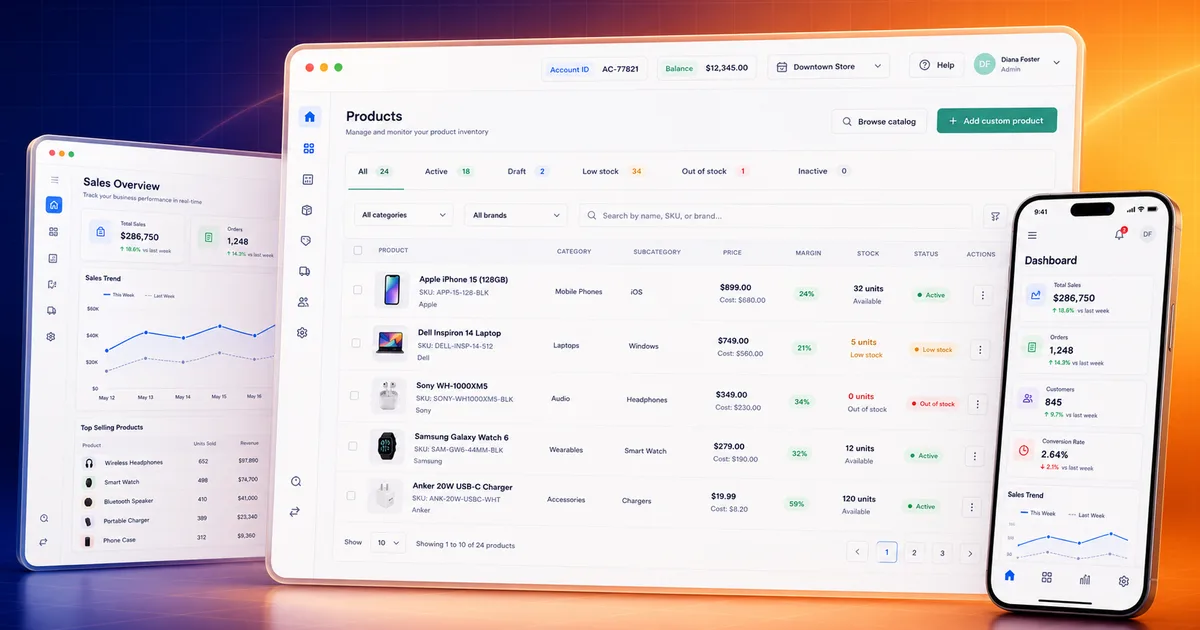
A Sale at the Counter Is Five Different Systems
A wireless retail store does not sell one thing. In a single visit a customer might activate a line on one carrier, top up a prepaid balance, take out a lease on a handset, pay a utility bill and buy device protection — each of which historically lived in a different portal, with a different login.
Multiply that by a network of dealer locations and the operator has a second problem on top of the first: commissions. What each carrier owes, what each location earned, and what actually arrived are three numbers that have to agree, and they were being reconciled by hand in spreadsheets.
What Was in the Way
Every problem on this list is the same problem in a different costume: the work was spread across systems that did not talk to each other.
Wireless activations were tracked manually across multiple carriers with no unified system
Commission calculations were done by hand in spreadsheets — slow, and wrong often enough to matter
Activations, top-ups, financing and payments each lived in their own disconnected tool
Carrier settlement reconciliation was difficult enough that revenue leaked through the gaps
Head office had no reliable view of sales performance across the dealer network
Put It All on One Counter, Then Reconcile It
The point-of-sale interface is what the store sees. Underneath it, the parts that actually pay for themselves are the commission engine and the settlement reconciliation.
One Cart, Every Service
A single point-of-sale workflow covering carrier activations, prepaid top-ups, lease applications, bill pay, device protection, check cashing, broadband and repairs — with a multi-line cart that handles the complex pricing when several of those happen in one visit.
Automated Commission Engine
Carrier commission files are imported and processed automatically, with configurable rates, hierarchical overrides down the merchant and location tree, and payout tracking — replacing the spreadsheet that everyone distrusted.
Settlement Reconciliation
Transactions are matched automatically against the carriers’ end-of-day settlement files, so a mismatch is surfaced as an exception to work through rather than revenue that quietly disappears.
Visibility at Three Levels
Real-time dashboards at enterprise, merchant and location scope, so head office, a dealer group and a single store each see their own version of the same truth.
What the Platform Does
Point-of-Sale
The full counter interface, with a multi-line cart that prices several activations and services in a single transaction.
Carrier Activations
Guided activation workflows integrated directly with the carriers’ activation APIs, replacing separate carrier portals.
Mobile Top-Up
Prepaid recharge processing through several top-up aggregators, handled from the same counter as everything else.
Consumer Financing
Lease-to-own applications submitted and tracked in-store, so a customer can be financed without leaving the workflow.
Bill Pay & Check Cashing
Utility payment processing and check cashing as first-class services rather than side systems.
Device Protection & Repairs
Insurance enrolment and device repair tracking, closing the loop after the handset is sold.
Commission Management
Configurable commission rates, carrier file imports, hierarchical overrides and payout tracking across the network.
Settlement Reconciliation
Automated matching of transactions against carrier end-of-day settlement reports, with exceptions raised for review.
Enterprise Dashboard
Real-time KPIs and performance analytics across every location in the network.
Location & Merchant Management
Create, configure and onboard dealer locations, and manage merchant accounts and their settings.
Three-Scope Access Control
Roles and permissions at global, merchant and location scope, so a store manager and a network administrator see different systems.
Carrier Authorisation & SIM Stock
Carrier authorisation codes with daily limits, and SIM inventory tracked across locations.
Subscription & Billing
Card-based subscription billing for the platform itself, with plan-based feature access at merchant and location level.
Invoicing & Financial Reports
Location invoices, revenue analytics and financial dashboards generated from live transaction data.
Work Queue
A single place to process pending approvals and tasks instead of chasing them through email.
API Health Monitoring
Automated health checks against the carrier APIs with alerting, so a broken integration is known before a store reports it.
Subscriber Tools
Customer lookup, plan changes and account management for staff serving an existing subscriber.
The Stack
Application
Data & Queues
Commerce & Money
Integrations & Ops
How We Built It
- 1
Core Point-of-Sale and Authentication
The counter workflow and the identity model first, because every later module either sells through the cart or is governed by who is standing at it.
- 2
Tenancy Before Features
A merchant, location and user hierarchy with data isolation, and three permission scopes — global, merchant and location — so access is decided by structure rather than by exceptions added later.
- 3
Carrier Integrations
Activation flows wired directly into the carriers’ APIs, so a line is activated from the same screen that takes the payment.
- 4
Commission and Settlement
Carrier file imports, rate configuration, hierarchical overrides and automated settlement matching — the module that turns a spreadsheet argument into a reconciled number.
- 5
Billing and Financing
Subscription billing for the platform itself, plan-based feature flags at merchant and location level, and in-store lease applications for the customer.
- 6
A Service Layer, Not a Pile of Controllers
Over forty dedicated service classes keep the business rules out of the controllers, which is what makes a platform this wide safe to keep extending.
- 7
Work Moved Off the Request
Commission imports and settlement reconciliation run as queued background jobs, so a large carrier file never blocks a sale at the counter.
The Shape of What We Built
40+
Dedicated Services
29
Modules Delivered
3
Permission Scopes
14 mo
Continuous Delivery
Activations, top-ups, financing, bill pay and protection are sold from one cart instead of five separate portals.
Commissions are calculated from imported carrier files with overrides applied down the hierarchy, rather than assembled by hand in a spreadsheet.
Transactions are matched automatically against carrier settlement files, so a discrepancy surfaces as an exception instead of leaking.
Head office, a dealer group and a single store each get a live view scoped to what they are responsible for.
Carrier API failures are detected by automated health checks and alerted, rather than discovered by a store that cannot activate a line.
Frequently Asked Questions
Yes — that is the core of this build. A single multi-line cart prices carrier activations, prepaid top-ups, lease applications, bill pay, device protection, check cashing, broadband and repairs in one transaction, so a customer doing several of those in one visit is served from one screen instead of five portals.
Services Behind This Build
Explore Other Case Studies
Reconciling commissions in a spreadsheet?
If your network’s earnings are assembled by hand every month, we will show you what an automated commission engine and settlement matching do to the argument at the end of it.
Talk to a Delivery Expert