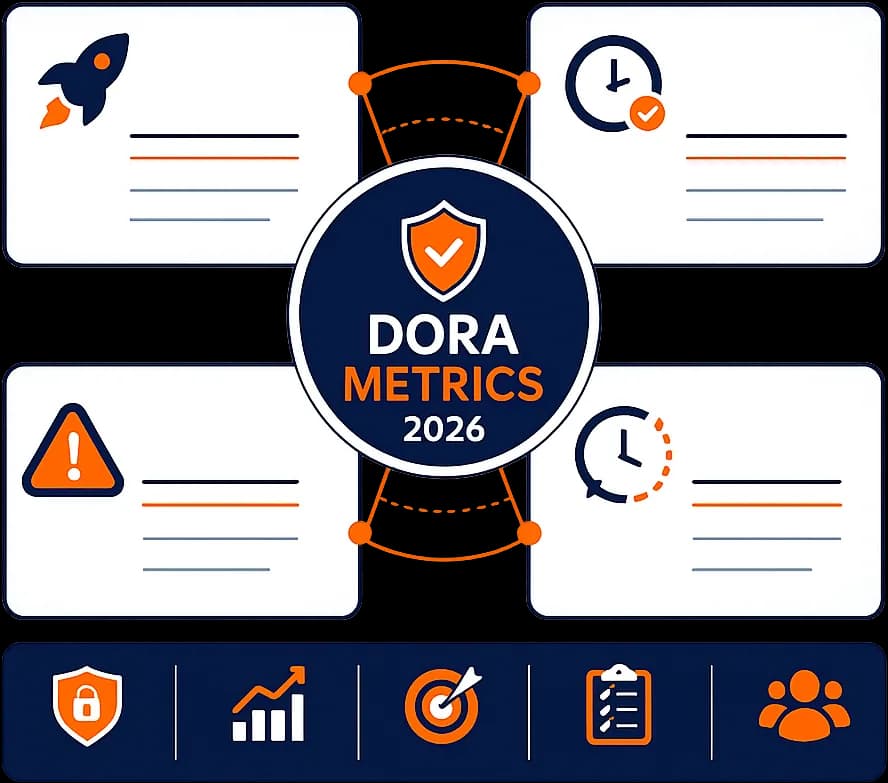
In 2026, the noise surrounding "Developer Productivity" is louder than ever. With AI agents generating code at 10x speed, many leaders are tempted to track "Lines of Code" or "PR Volume." These are vanity metrics. At OpenMalo Technologies, we've seen that in a hardened engineering culture, only four numbers truly matter.
The DORA (DevOps Research and Assessment) metrics have survived the "AI Hype" of 2024–2025 because they focus on outcomes, not activity. In 2026, they have evolved from "DevOps indicators" to the fundamental pulse of business agility. If you can't measure your delivery flow, you can't scale your AI advantage.
1. The Core 4: Balancing Velocity and Stability
DORA metrics are split into two "Speed" metrics and two "Stability" metrics. This balance ensures that your team isn't shipping fast just to break things faster.
The Velocity Metrics
- Deployment Frequency (DF): How often do you ship to production? Elite teams in 2026 deploy on-demand, often multiple times per day.
- Lead Time for Changes (LT): The time from "Code Committed" to "Code in Production." In 2026, the goal is under one hour for elite performers.
The Stability Metrics
- Change Failure Rate (CFR): What percentage of deployments require a rollback or hotfix? A hardened team keeps this under 15%.
- Failed Deployment Recovery Time: Previously known as MTTR, this measures how fast you get back to a working state after a failure. In 2026, automation makes "minutes" the standard for recovery.
2. The 2026 "Fifth Metric": Rework Rate
New for 2026, the Rework Rate has emerged as a critical stability signal. It measures how much of your pipeline is consumed by fixing work previously considered "complete" (e.g., bug fixes or technical debt). With AI-assisted coding, a low Rework Rate is the only way to prove that your "faster code" isn't actually "lower quality code."
3. The AI Productivity Paradox
In 2026, we've learned a hard lesson: AI can generate code faster than humans can review it.
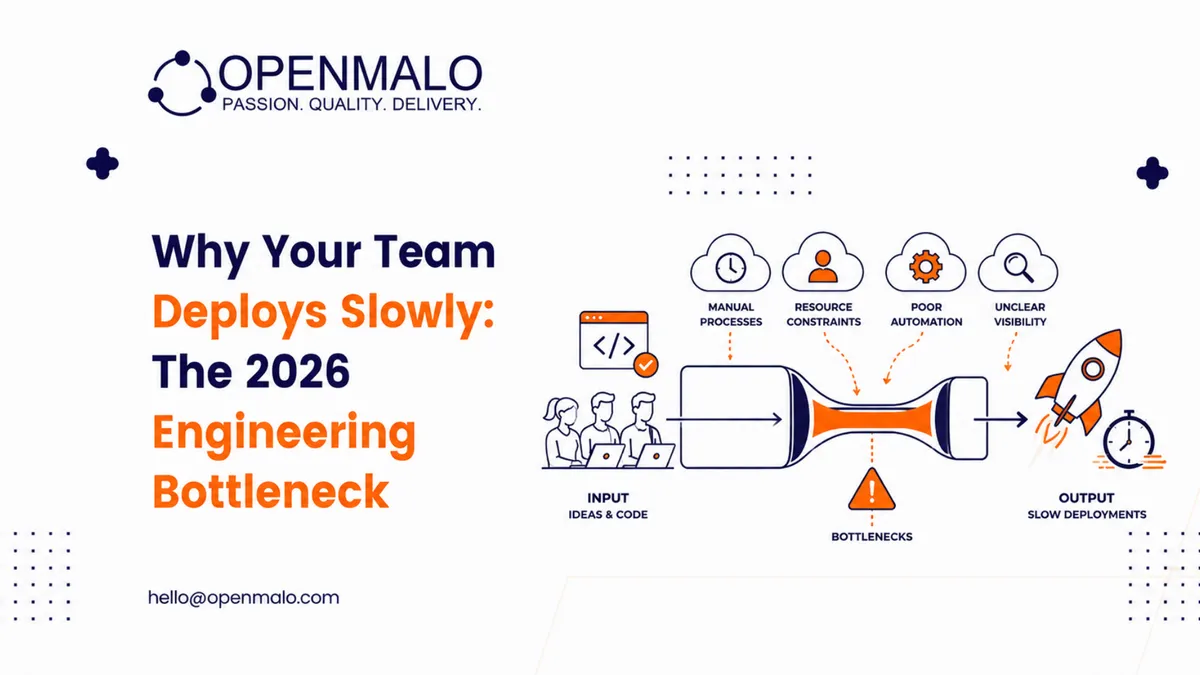
If your Deployment Frequency is high but your Lead Time is increasing, you likely have a Review Bottleneck. DORA metrics expose this instantly. A "Hardened" team uses these numbers to identify where AI-generated volume is clogging the system, rather than celebrating "Lines of Code" that haven't reached the customer yet.
4. Benchmarking 2026: What "Elite" Looks Like
| Metric | Elite (Top 10%) | High | Medium |
|---|---|---|---|
| Deployment Frequency | On-demand (Multiple/Day) | Once/Day to Once/Week | Once/Week to Once/Month |
| Lead Time for Changes | < 1 Hour | 1 Day to 1 Week | 1 Month to 6 Months |
| Change Failure Rate | 0–15% | 16–30% | 31–45% |
| Recovery Time | < 1 Hour | < 1 Day | 1 Day to 1 Week |
5. The OpenMalo Technologies Implementation Roadmap
At OpenMalo Technologies, we help our partners in Rajkot, Dubai, and the US move from "Guessing" to "Knowing" using this 3-step hardening process:
- Automate the Capture: Don't use manual spreadsheets. We integrate DORA tracking directly into your CI/CD pipeline (GitHub Actions, GitLab, or Jenkins).
- Visualise the Trend: We build real-time dashboards that show direction, not just a snapshot. Is stability improving as velocity increases?
- Actionable Retrospectives: We use DORA data to drive team meetings. If Recovery Time is high, we don't blame developers; we invest in Automated Rollbacks.
Key Takeaways
- Focus on Teams, Not Individuals: DORA is for measuring systems, not punishing people.
- Small Batches are Safer: High deployment frequency actually reduces risk because each change is smaller and easier to fix.
- AI Needs Guardrails: Use DORA to verify that AI-assisted development is actually delivering value, not just noise.
- Stability is the Foundation: You cannot scale velocity on a fragile infrastructure.
Conclusion
DORA metrics are the "Vital Signs" of a modern engineering organization. In 2026, they are the difference between a team that is "busy" and a team that is "productive." By focusing on these four (now five) numbers, you can ensure your engineering engine is hardened for the challenges of the AI era.
Is your engineering team running blind? OpenMalo Technologies specializes in building hardened DORA dashboards and optimized CI/CD pipelines for global leaders.