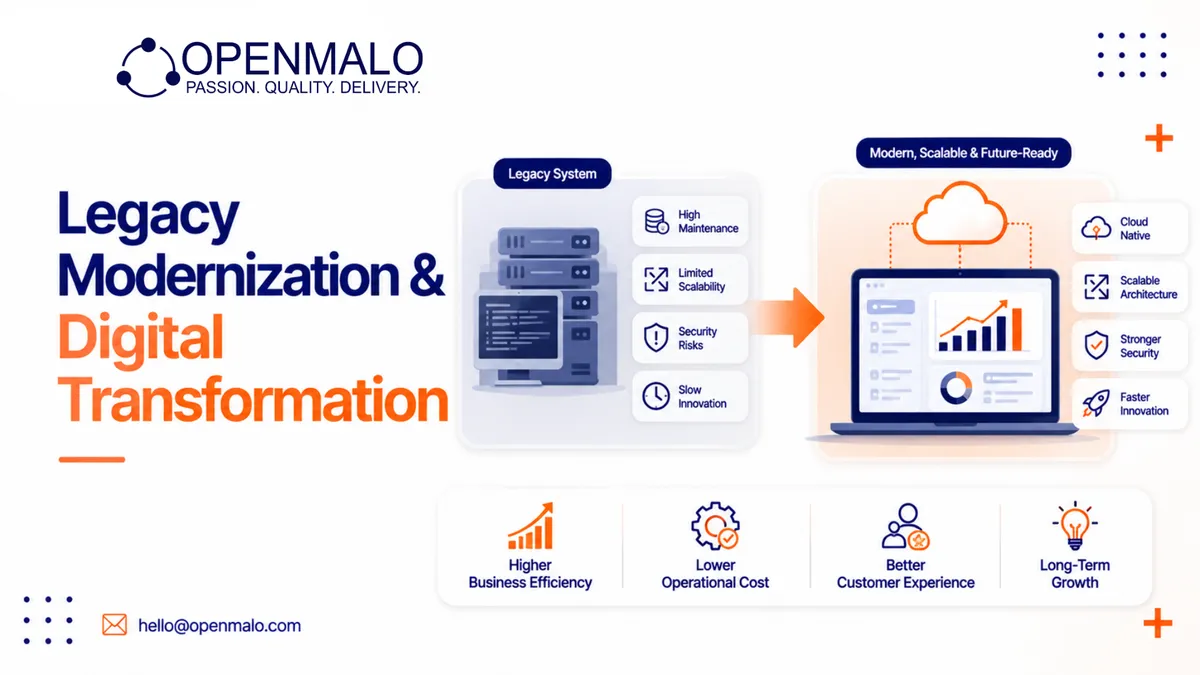
TL;DR: Digital transformation / legacy modernization replaces or upgrades aging systems so they're faster, cheaper and ready for AI. The safest approach is incremental — modernize piece by piece while the business keeps running — rather than a high-risk all-at-once rewrite that so often fails.
Legacy modernization is the work of bringing outdated systems and processes up to date — re-platforming legacy apps, moving to cloud, automating workflows and layering in AI — so the business runs faster and cheaper. The key is to modernize incrementally to avoid risky big-bang rewrites.
This post sits under our pillar on hiring an AI consulting partner.
What is legacy modernization?
It's modernizing outdated technology and processes: re-platforming legacy applications, migrating to cloud, automating manual workflows, and adding AI capabilities. The goal isn't change for its own sake — it's lower cost, more speed, better reliability, and the ability to build on a modern foundation.
How do you modernize legacy systems without disrupting operations?
The answer is incremental modernization. Instead of a "big bang" replacement, you change the system in safe, reversible steps:
- Assess and prioritize — map the system and target the highest-value, lowest-risk pieces first.
- Strangle, don't rip — route functionality to new components gradually while the old system keeps running.
- Modernize in slices — one module, integration or workflow at a time.
- Keep a rollback path — every step is reversible if something goes wrong.
- Validate continuously — test each slice in production-like conditions before cutting over.
Why big-bang rewrites fail
Replacing an entire system at once means a long period with no working software, ballooning scope, and a high-stakes cutover where everything must work on day one. Incremental modernization removes that cliff edge — the business runs throughout, and risk is spread across small, recoverable steps.
What does digital transformation include?
- Re-platforming legacy apps onto modern stacks.
- Cloud migration — see cloud migration services.
- Workflow automation — see workflow automation & RPA.
- AI enablement — adding AI capabilities on the modernized foundation.
- Data modernization — see data foundations for AI.
When is the right time to modernize?
When the old system is slowing the business down — high maintenance cost, can't integrate, can't scale, or blocks AI and new features. You don't have to wait for a crisis; incremental modernization lets you start with one painful area and expand as value is proven.