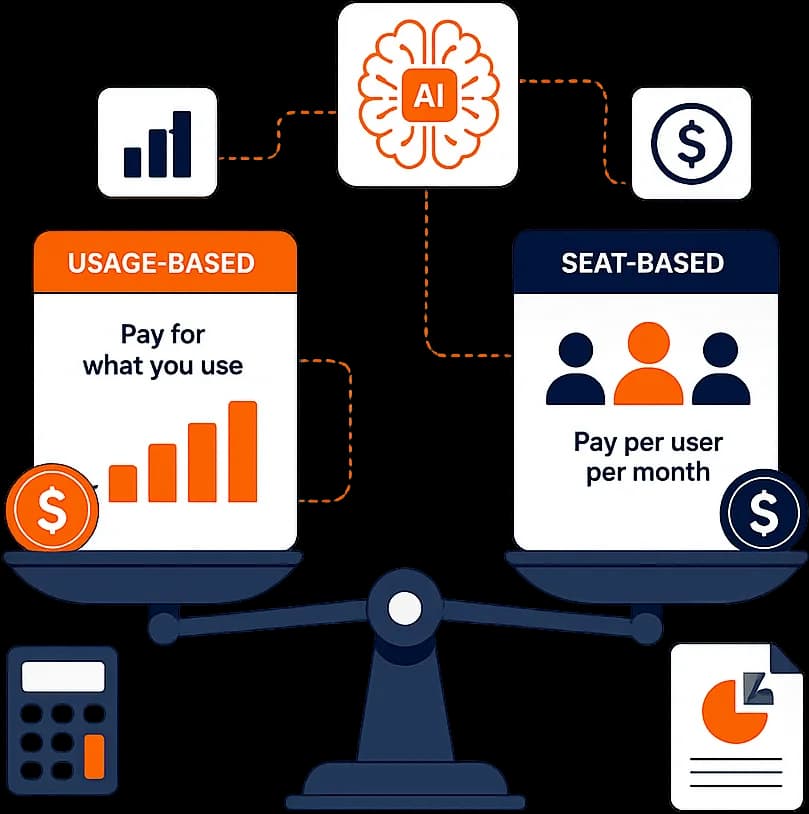
In 2026, the SaaS world is hitting a "pricing wall." For two decades, Seat-Based Pricing was the undisputed king of software. But as AI agents begin to perform the work of multiple humans, the "per-seat" model is decoupling from the actual value delivered. If one person using an AI agent can do the work of ten, charging for one seat is a fast track to bankruptcy.
At OpenMalo Technologies, we have watched this shift closely across the Indian, UAE, and US markets. The challenge for 2026 is balancing predictable revenue with the variable compute costs of LLMs. Whether you are building a boutique CRM in Dubai or a global FinTech platform, choosing the right billing architecture is as critical as the code itself.
1. The Death of the Simple Seat?
In the era of traditional SaaS, your costs were relatively flat. Whether a user logged in once or 100 times, your server costs barely moved. AI changed the math.
Every time a user prompts an AI, you incur a token cost (compute). If you charge a flat $30/month per seat, and a "power user" runs $200 worth of deep-reasoning queries, you lose money on that customer. This is why 2026 has seen a massive move toward Hybrid Billing.
2. Usage-Based Pricing: The "Utility" Model
Usage-based (or consumption-based) pricing treats software like electricity. You pay for what you burn—measured in tokens, API calls, or "tasks completed."
- Pros:
- Perfect Alignment: Your revenue scales exactly with your infrastructure costs.
- Low Barrier to Entry: Customers can "start small" and scale as they see ROI.
- Fairness: 80% of customers in 2026 report that usage-based models feel more "honest."
- Cons:
- Revenue Volatility: It's harder for you (and your CFO) to forecast monthly recurring revenue (MRR).
- "Bill Shock": Without strict guardrails, a customer might accidentally run a recursive agent that costs them $1,000 in a single afternoon.
3. Seat-Based Pricing: The "Predictable" Model
Despite its flaws, seat-based pricing remains popular for its simplicity and psychological comfort.
- Pros:
- Predictability: Both you and the customer know exactly what the bill will be next month.
- Simplified Selling: It is much easier for a procurement department to approve "10 seats at $50" than a variable token-based contract.
- Cons:
- Margin Risk: High-usage AI features can quickly eat your gross margins.
- Under-monetization: You fail to capture the extra value when a user heavily relies on your AI to drive their business.
4. The 2026 Winner: The Hybrid "Platform + Credit" Model
Most successful AI companies in 2026, including many OpenMalo partners, have converged on a Hybrid Model. This offers the best of both worlds.
The Anatomy of a Hybrid Plan:
- Base Subscription: A fixed fee (e.g., $50/month) for access to the platform and core features.
- Included Credits: The base fee includes a set amount of AI "credits" (e.g., 1,000 tokens or 50 images).
- Overage/Top-ups: Once credits are exhausted, the user can buy more or pay a per-unit fee for continued access.
This model provides a revenue floor for the vendor and cost certainty for the customer, while protecting your margins against heavy AI usage.
5. The OpenMalo Blueprint: 5 Steps to Implementation
If you are transitioning your AI feature to a new billing model, follow the OpenMalo hardening process:
- Identify the "Value Metric": Don't just charge for tokens. Charge for something the user understands, like "Reports Generated" or "Leads Qualified."
- Implement Real-Time Metering: You need a bulletproof system to track usage. Tools like Stripe or Metronome are the 2026 standards for this.
- Set Guardrails: Build "hard caps" and "soft alerts." Notify the user when they hit 80% of their monthly credit limit to prevent bill shock.
- Analyze Margin per User: Use internal dashboards to track which users are "profitable" vs. "costly" based on their compute consumption.
- Offer "Rollover" Credits: In 2026, fairness is a competitive advantage. Allowing unused credits to roll over for 30 days significantly reduces churn.
Key Takeaways
- Seats are for Access, Usage is for Action: Use seat-based pricing for the "shell" of your app and usage-based for the "AI engine" inside it.
- Avoid "Pure" Usage if possible: It makes enterprise budgeting too difficult. Always try to include a base subscription.
- Transparency Wins: Provide a dashboard where users can see exactly how many credits they are spending in real-time.
- 2026 Trend: Hybrid models are outperforming pure subscription models in terms of Net Revenue Retention (NRR).
Conclusion
Pricing is no longer just a marketing decision; it is an architectural one. As AI becomes more agentic and autonomous, the way we bill for it must reflect the "work" it does, not just the "seat" it occupies. At OpenMalo Technologies, we help you design billing systems that are as innovative as the AI features they power—ensuring your growth is both scalable and sustainable.
Ready to optimize your AI monetization strategy? OpenMalo Technologies specializes in building hardened, scalable billing infrastructures for modern SaaS and AI platforms. Consult with our SaaS Strategy Experts at OpenMalo