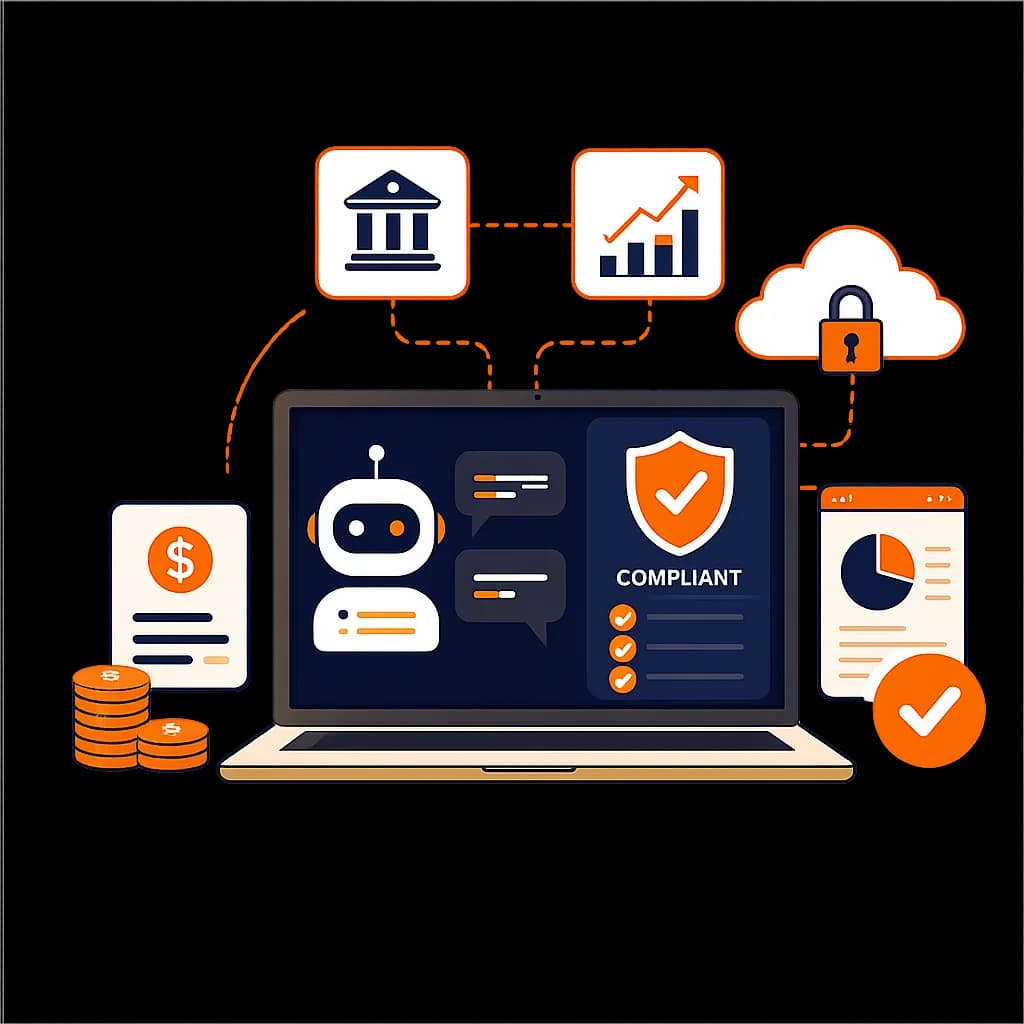
The financial services sector is currently caught between two powerful forces: the urgent need to automate via Generative AI and the rigid hammer of global regulatory compliance. In 2026, "moving fast and breaking things" is a luxury fintech founders can no longer afford.
Whether you are building an AI-powered wealth manager, an automated loan processing agent, or a customer support bot for a digital bank, the technical challenge isn't just getting the AI to give a "smart" answer. The challenge is ensuring that answer is audit-ready, respects data sovereignty, and protects Personally Identifiable Information (PII).
This guide outlines the architectural blueprint for building AI assistants that satisfy both the CTO and the Compliance Officer.
1. The Compliance Landscape in 2026
Regulatory bodies like the SEC in the US, ESMA in Europe, and SEBI in India have moved beyond general guidelines. They now demand specific "AI Governance" frameworks. Key requirements include:
- Explainability: You must be able to show why an AI made a specific recommendation.
- Bias Mitigation: Proving your AI doesn't discriminate based on demographic data.
- Data Residency: Ensuring financial data doesn't leave specified geographic borders (e.g., GDPR or India's DPDP Act).
2. Architecting for Data Privacy: The "PII Firewall"
One of the biggest risks in financial AI is "Data Leakage"—where sensitive customer info (like credit card numbers or account balances) is sent to a third-party LLM provider or stored in a vector database.
The Solution: The Interceptor Pattern
Before any user query reaches the AI model, it must pass through a PII Masking Layer.
- Detection: Use specialized models to identify account numbers, names, and addresses.
- Redaction/Tokenization: Replace "Account #12345" with "[ACCOUNT_ID_1]".
- Re-hydration: Only after the AI generates a safe, general response does your internal system swap the token back for the real data to show the user.
3. Governance in RAG: Who Can See What?
In a production-grade Retrieval-Augmented Generation (RAG) system, your AI has access to a massive library of documents. But in finance, not every employee—or every customer—should see every document.
Implementing Document-Level Security
Your vector database must support Metadata Filtering.
- Tagging: Every document chunk is tagged with an access_level (e.g., "Tier 1 Support" or "HNI Customer").
- Scoped Search: When the AI searches for an answer, the system automatically adds a filter: Where access_level matches user_clearance.
- The Result: The AI can never "hallucinate" an answer based on data the user isn't authorized to see.
4. Auditability: Turning the "Black Box" into a Ledger
Financial institutions are built on audits. If an AI agent gives a customer the wrong interest rate, you need a forensic trail.
The 2026 Audit Stack:
- Traceability: Every AI response must be stored alongside the specific document chunks used to generate it.
- Feedback Loops: A "Human-in-the-Loop" (HITL) system where compliance officers can flag and correct AI responses, which then serves as a "Gold Dataset" for future training.
- Versioning: Just as you version code, you must version your Prompts and Knowledge Base states.
5. Handling Financial Advice: The Liability Guardrails
There is a fine line between "Financial Information" and "Financial Advice." To protect against liability:
- Intent Classification: Use a specialized "Gatekeeper" model to detect if a user is asking for speculative advice (e.g., "Which stock should I buy?").
- Hard-Coded Disclaimers: When high-risk intents are detected, the system should pivot to pre-approved, legally-vetted scripts rather than generative text.
Key Takeaways
- Privacy First: Use an interceptor layer to mask PII before it ever hits an LLM.
- Security by Design: Use metadata filters to ensure document-level access control within your RAG pipeline.
- Explainability is Mandatory: Always provide citations for AI claims to satisfy regulatory "Right to Explanation" laws.
- Hybrid Intelligence: Combine generative power with deterministic "guardrails" for high-risk financial queries.
Conclusion
Building an AI assistant for the financial sector is an exercise in Hardening. While the underlying technology is transformative, its value is zero if it cannot survive a compliance audit. By focusing on PII masking, rigorous access controls, and a transparent audit trail, fintech companies can move from experimental "vibe coding" to robust, enterprise-grade AI production.
The future of finance isn't just AI—it's Accountable AI.
Building in Fintech or Wealthtech? Don't let compliance be an afterthought. OpenMalo helps financial institutions build secure, scalable, and fully compliant AI agent frameworks tailored to global regulations. Schedule a Compliance-First AI Consultation