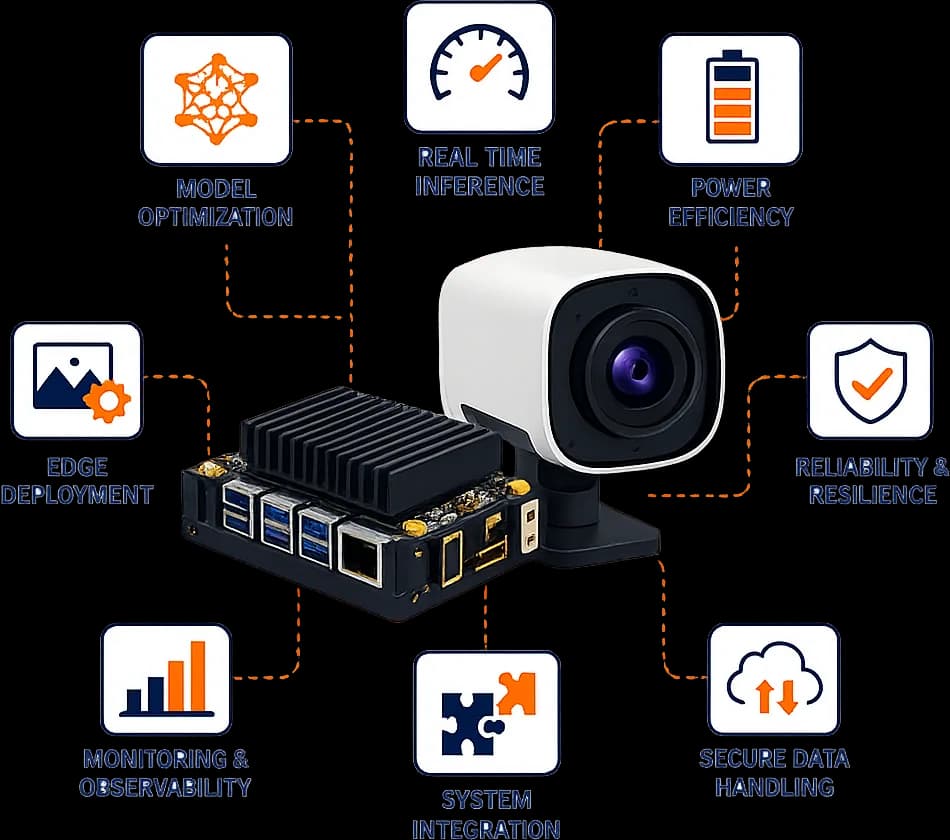
In 2026, the "Cloud-First" era of Computer Vision is coming to an end. Whether it's autonomous drones in Dubai, smart manufacturing in Rajkot, or retail analytics in New York, the requirement is the same: Intelligence must happen at the source. Sending high-definition video streams to a central server is too slow, too expensive, and—in the age of the DPDP Act—too risky for data privacy.
At OpenMalo Technologies, we specialize in "Hardening" AI for the real world. Moving a vision model from a high-powered NVIDIA H100 in the lab to an ARM-based edge processor in the field is a journey fraught with "Performance Debt." Based on our 2026 production deployments, here are the critical lessons for scaling vision at the edge.
1. The Edge Reality: Latency, Power, and Thermals
In the lab, we optimize for Accuracy. In production at the edge, we optimize for Stability. When a vision model runs on an edge device (like a Jetson Orin or a Coral TPU), it faces constraints that don't exist in the data center:
- Thermal Throttling: If your model consumes 100% of the GPU, the device will overheat within minutes, causing the clock speed to drop and your 30 FPS stream to crawl at 2 FPS.
- Power Budget: For battery-powered devices (like agricultural sensors), a model that is 1% more accurate but consumes 20% more power is a failure.
2. Model Optimization: The "Triple Crown" of Shrinkage
To make a model "Edge-Ready," you must compress it. At OpenMalo, we use a three-pronged hardening strategy:
A. Quantization (INT8 & FP4)
Most models are trained in 32-bit floating point (FP32). At the edge, we convert these to 8-bit integers (INT8) or even 4-bit (FP4). This reduces the model size by 4x to 8x with a negligible (typically <1%) drop in accuracy.
B. Pruning
Pruning involves identifying and removing "dead" neurons in the neural network that don't contribute significantly to the output. In production, we've successfully pruned up to 30% of model weights without losing performance, significantly reducing the compute load.
C. Knowledge Distillation
We train a massive "Teacher" model (like a Vision Transformer) and then use it to train a tiny "Student" model (like MobileNetV4). The student learns the "wisdom" of the teacher but runs at a fraction of the cost.
3. Hardware Selection: Choosing the Right "Brain"
In 2026, the "best" hardware depends entirely on your environment:
- NVIDIA Jetson Series: The gold standard for high-performance edge AI (Robotics, Medical).
- ARM Ethos-U: Perfect for ultra-low power "Always-On" vision (Smart Doorbells).
- ASICs (Application-Specific Integrated Circuits): Best for massive scale in single-use cases (Automotive safety).
4. Production Lesson: Handling Environmental "Vibration"
One of the biggest lessons from 2026 production is that Models fail in the wild. A model trained on perfect, static images will fail when the camera vibrates due to wind, or when the lighting changes during a Gujarat monsoon.
The Hardening Fix:
- Augmentation in Training: We inject "synthetic noise," motion blur, and varied lighting into the training set to ensure the model is "vibration-proof."
- Adaptive Pre-processing: Implementing a lightweight "Image Enhancement" layer at the edge that stabilizes the frame before it hits the neural network.
5. The MLOps of the Edge: Over-the-Air (OTA) Updates
Deploying a model is only the beginning. In the wild, models suffer from Concept Drift. If you deploy 1,000 smart cameras across a city, you cannot manually update them. A hardened edge deployment must have a secure OTA Pipeline that allows you to push new model weights and patches without bricking the devices.
Key Takeaways
- Accuracy is not ROI: A model that is "fast enough and stable" beats a "perfect" model that crashes the hardware.
- Hardware-Aware Design: You must know your target hardware before you start training.
- Optimize the Pipeline, Not Just the Model: Often, the "bottleneck" isn't the AI—it's the time it takes to decode the video stream or resize the image.
- Edge is Private: Edge AI is the most effective way to comply with the DPDP Act, as PII never leaves the local device.
Conclusion
Deploying vision models on the edge in 2026 is an exercise in "Aggressive Efficiency." It requires a deep understanding of both the mathematical elegance of neural networks and the messy reality of hardware and physics. At OpenMalo Technologies, we bridge this gap—taking your high-fidelity vision models and hardening them for the most demanding edge environments on the planet.
Ready to take your vision models out of the cloud and into the field? OpenMalo Technologies provides the engineering expertise to optimize and deploy production-grade edge AI.