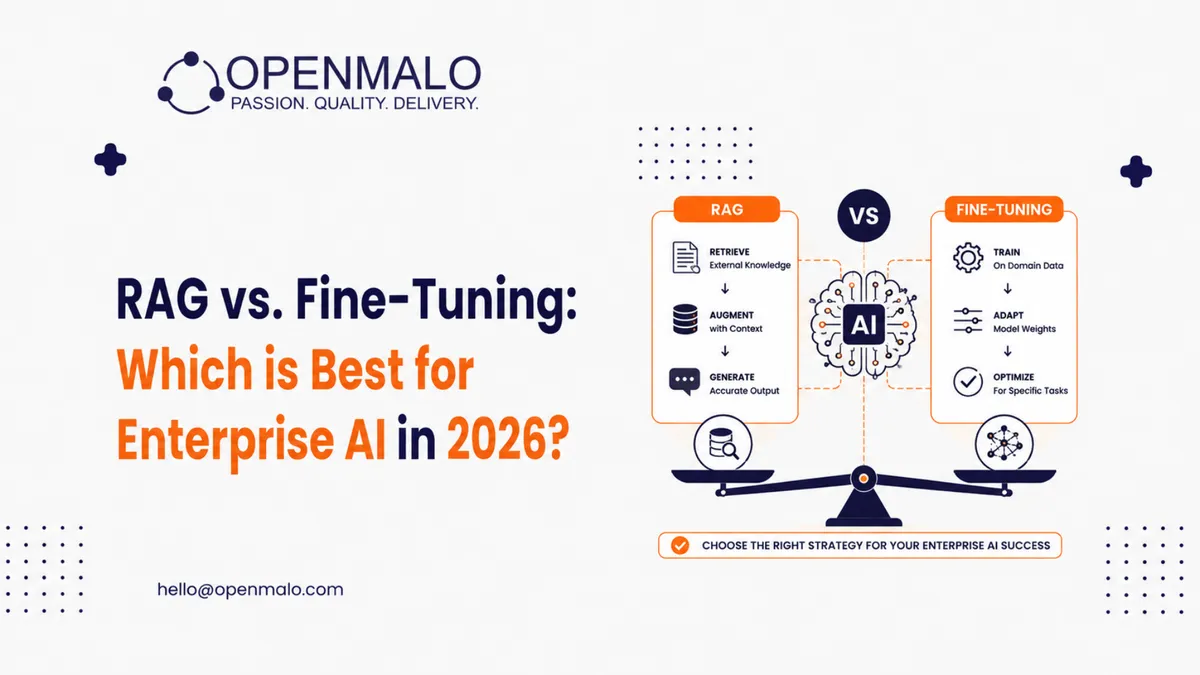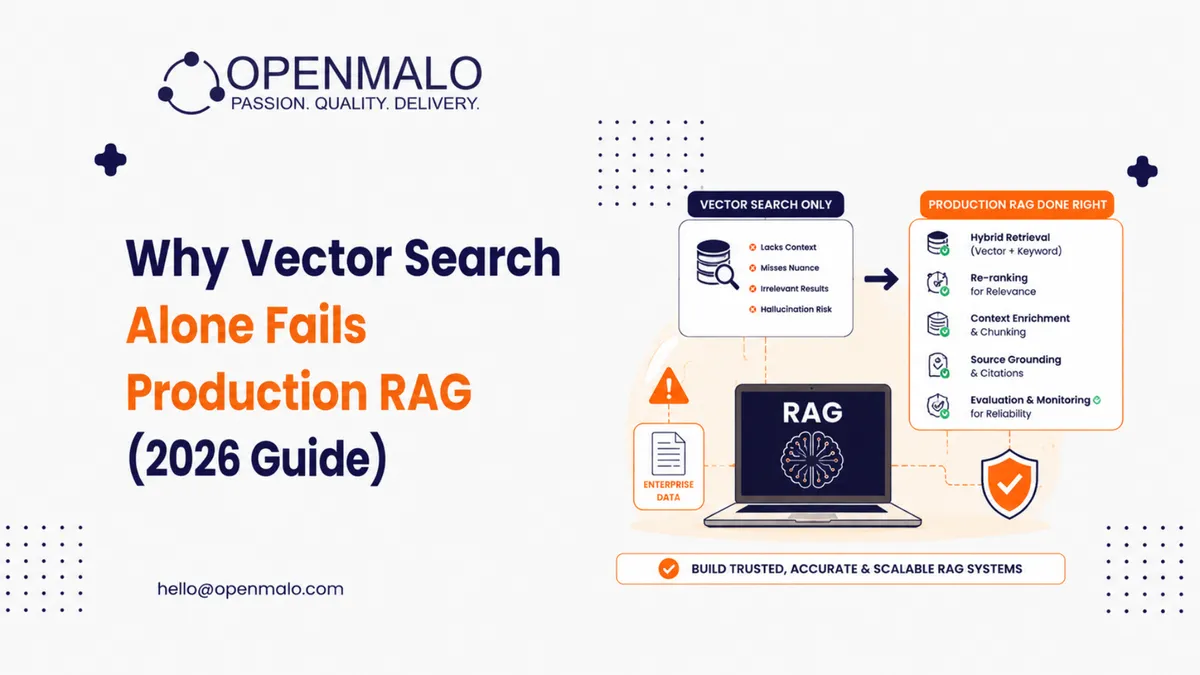
In 2026, the question for enterprise leaders is no longer "Should we use AI?" but "How do we architect it?" When building production-ready AI agents, three core strategies dominate the landscape: Prompt Engineering, Retrieval-Augmented Generation (RAG), and Fine-Tuning.
Choosing the wrong path can lead to "hallucinating" agents, spiraling API costs, or stale data. At OpenMalo Technologies, we specialize in hardening these AI architectures to ensure they survive the transition from a lab demo to a high-stakes production environment.
This guide provides a definitive framework to help you choose the right strategy for your 2026 roadmap.
1. Defining the Contenders
- Prompt Engineering: Giving the model explicit instructions and examples (Few-Shot) within the chat window. Think of this as giving a smart intern a detailed memo.
- RAG (Retrieval-Augmented Generation): Connecting the model to a live database (like a vector store). The model "looks up" information before answering. This is like giving the intern access to your company's entire library.
- Fine-Tuning: Retraining the model on a specific dataset to bake knowledge or behavior into its "brain." This is like putting the intern through an intensive, months-long specialized training program.
2. Comparison Matrix: At a Glance
| Feature | Prompting | RAG | Fine-Tuning |
|---|---|---|---|
| Upfront Cost | Near-Zero | Moderate | High |
| Data Freshness | Manual/Static | Real-Time | Stale (until retrained) |
| Hallucination Risk | High | Lowest | Moderate |
| Specialized Tone | Moderate | Low | Highest |
| Implementation Speed | Hours | Weeks | Months |
3. When to Choose Prompt Engineering
Best For: Prototyping, simple tasks, and low-budget MVPs.
Prompting is the fastest path to value. If your task can be explained in a few paragraphs and relies on general knowledge (e.g., "Summarize this email" or "Write a polite response"), prompting is sufficient.
- Pros: No infrastructure needed; instant iteration.
- Cons: Limited by "context window" (you can't fit a whole database in a prompt); becomes expensive at scale due to high token counts.
4. When to Choose RAG (Retrieval-Augmented Generation)
Best For: Dynamic knowledge, factual accuracy, and internal "knowledge bases."
In 2026, RAG is the enterprise standard. If your AI needs to answer questions about live inventory, changing legal policies, or private customer data, RAG is non-negotiable.
- Why RAG Wins: It provides citations. You can see exactly which document the AI used to generate its answer, which is critical for compliance in sectors like Fintech or Healthcare.
- The OpenMalo Advantage: We build "Hardened RAG" pipelines that use Hybrid Search and Re-ranking to ensure the most relevant data is always found.
5. When to Choose Fine-Tuning
Best For: Niche specialized tasks, consistent brand voice, and high-volume latency-sensitive apps.
Fine-tuning is no longer the go-to for "adding knowledge." Instead, it is used for behavioral change. Use it if you need your AI to speak in a very specific medical jargon, follow a strict proprietary coding style, or perform a narrow task (like sentiment analysis) with 99.9% consistency.
- Pros: Reduced latency (no retrieval step); lower token costs per query.
- Cons: Expensive to train; the model "forgets" facts as soon as they change in the real world.
6. The OpenMalo "Hybrid" Approach
For 90% of production use cases in 2026, the answer isn't "one or the other"—it's a Hybrid Architecture.
- Fine-Tune for Format: Teach the model how to output perfect JSON or follow your brand's specific tone.
- Use RAG for Facts: Connect that fine-tuned model to your live database so it always has the latest information.
- Prompt for Logic: Use system instructions to guide the model's reasoning on a per-query basis.
This "Triple-Layer" strategy is how OpenMalo builds AI agents that are both smart enough to reason and grounded enough to be trusted.
Key Takeaways
- Start with Prompting to prove the concept.
- Move to RAG if you need to use your own data or require factual citations.
- Fine-Tune only when you need to "lock in" a specific behavior or tone that RAG/Prompting can't achieve.
- Freshness matters: If your data changes daily, RAG is your only viable path.
Conclusion
Navigating the AI landscape requires a balance of speed, cost, and reliability. By understanding the trade-offs between prompting, RAG, and fine-tuning, you can build an architecture that scales with your business. At OpenMalo Technologies, we help you navigate these technical crossroads to build AI solutions that don't just work—they excel.
Ready to build a production-grade AI agent? OpenMalo Technologies provides the expertise to design and deploy the perfect hybrid AI architecture for your business. Consult with our AI Architects at OpenMalo.