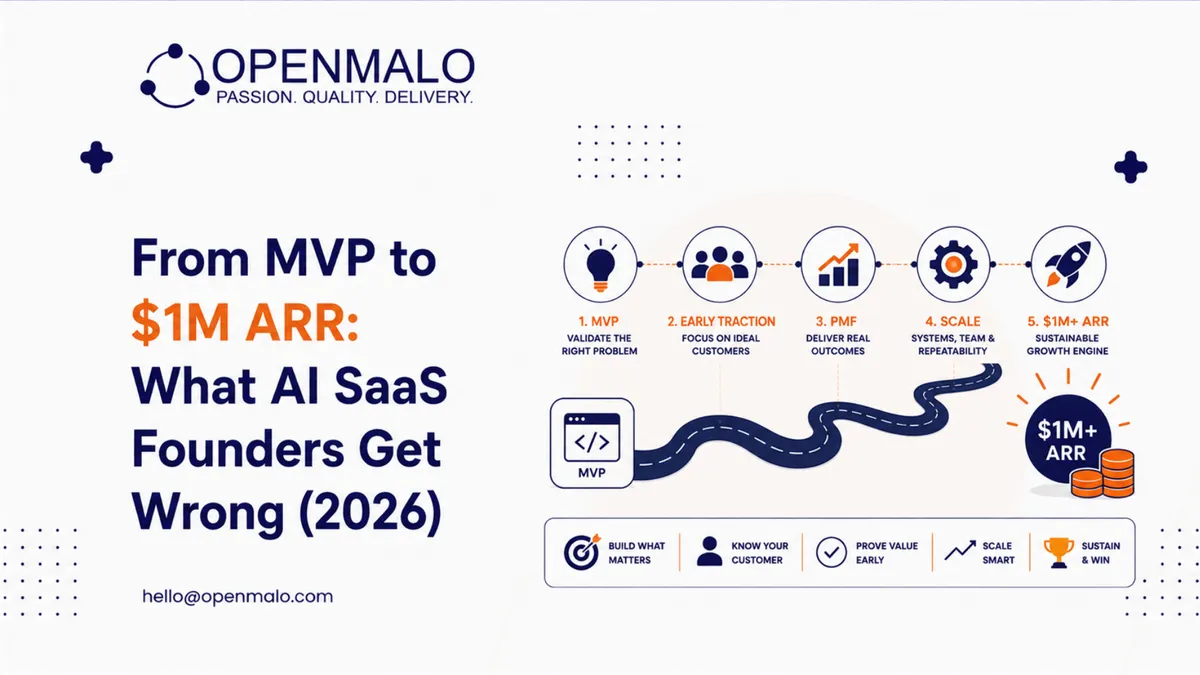
Reaching $1 million in Annual Recurring Revenue (ARR) is the "escape velocity" milestone for any startup. In 2026, the timeline for AI-native companies to hit this mark has shrunk dramatically—outliers are doing it in under 12 months. However, the graveyard of AI startups is also larger than ever.
The difference between a "viral wrapper" that spikes and crashes and a sustainable $1M+ ARR business lies in how you transition from your initial prototype to a hardened production system. At OpenMalo Technologies, we've analyzed the trajectory of dozens of AI products. Most founders don't fail because their AI is bad; they fail because their business architecture is fragile.
Here are the five most common traps AI SaaS founders fall into on the road to $1M ARR.
1. The "Wrapper" Trap: Thinking Features are Defensibility
In early 2024, you could build a business by putting a nice UI on top of an LLM. In 2026, those businesses are being obliterated. Founders often mistake "cool features" for a "moat." If a competitor (or the model provider themselves) can replicate your core value with a single system prompt update, you don't have a business; you have a feature.
The Correction: Move beyond the "Execution" layer and into the Workflow layer. Successful $1M ARR startups in 2026 don't just generate text; they own a complex business process. They integrate with ERPs, handle regulatory edge cases, and capture proprietary data that makes the AI smarter for that specific user every day.
2. Premature Scaling: Hiring Before Nailing the Playbook
We see this constantly in the Indian and US startup scenes: a founder gets their first 10 customers through "heroic" manual selling and immediately hires a VP of Sales.
The Trap: If the founder hasn't created a Repeatable Sales Playbook, a new hire will just burn cash trying to find one. In 2026, investors aren't just looking for revenue; they are looking for "Efficiency."
- The Rule: You should be the one to close the first $200k in ARR. Only hire when you are so overwhelmed by qualified leads that you are physically unable to handle the volume.
3. The "Token Burn" Blindspot: Ignoring Unit Economics
In the MVP stage, high API costs don't matter. On the road to $1M ARR, they are everything. Many founders realize too late that their Gross Margins are actually 30% because they are using over-powered models for simple tasks.
The Correction:
Hardened AI startups use Model Routing.
- Use a "Cheap" model (8B or 14B) for 80% of tasks (classification, summarization).
- Reserve the "Expensive" frontier models for the 20% of tasks that require deep reasoning.
- Goal: Aim for 75%+ Gross Margins to be "Series A ready."
4. The Retention Mirage: High Growth vs. High Churn
AI products often see a "Novelty Spike." Users sign up, play with the AI for a month, and then realize it doesn't solve a daily pain point. Founders celebrate the 20% Month-over-Month (MoM) growth while ignoring the 10% monthly churn.
The Reality: You cannot outrun high churn. To hit $1M ARR and stay there, your Net Revenue Retention (NRR) must be over 100%. This means your existing customers should be spending more money with you over time than you are losing from cancellations.
5. The "Horizontal" Hype: Failing to Pick a Vertical
"Our AI helps everyone write better!" sounds like a massive market. In reality, it means you are competing with Microsoft, Google, and every other generic tool.
The Winner's Strategy: The most successful AI SaaS companies in 2026 are Vertical SaaS.
- Instead of "AI for HR," build "AI for Nurse Staffing Compliance in the UK."
- Instead of "AI for Legal," build "AI for Patent Litigation in the Automotive Sector."
Depth beats breadth every time when you are scaling to your first million.
Key Takeaways
- Workflow > Features: If you don't integrate into the user's daily tools, you are replaceable.
- Watch Your NRR: Retention is the only true proof of Product-Market Fit (PMF).
- Hardening is Mandatory: Move from fragile API calls to a multi-model, cost-optimized infrastructure.
- Verticalize Early: Pick a niche where you can become the undisputed "AI expert."
Conclusion
The jump from $100k to $1M ARR is the hardest period in a founder's journey. It requires a shift in mindset from "Will this work?" to "How do we make this a machine?" By avoiding the "wrapper" trap and focusing on deep workflow integration and healthy unit economics, you can join the elite 40% of startups that make it across the million-dollar finish line.
At OpenMalo Technologies, we don't just build MVPs; we partner with founders to harden their AI products for scale. Let's build your $1M ARR engine.
Is your AI startup stuck at the "plateau"? OpenMalo Technologies provides the strategic and technical engineering to help AI founders scale from MVP to $1M ARR. Scale Your AI Business with OpenMalo