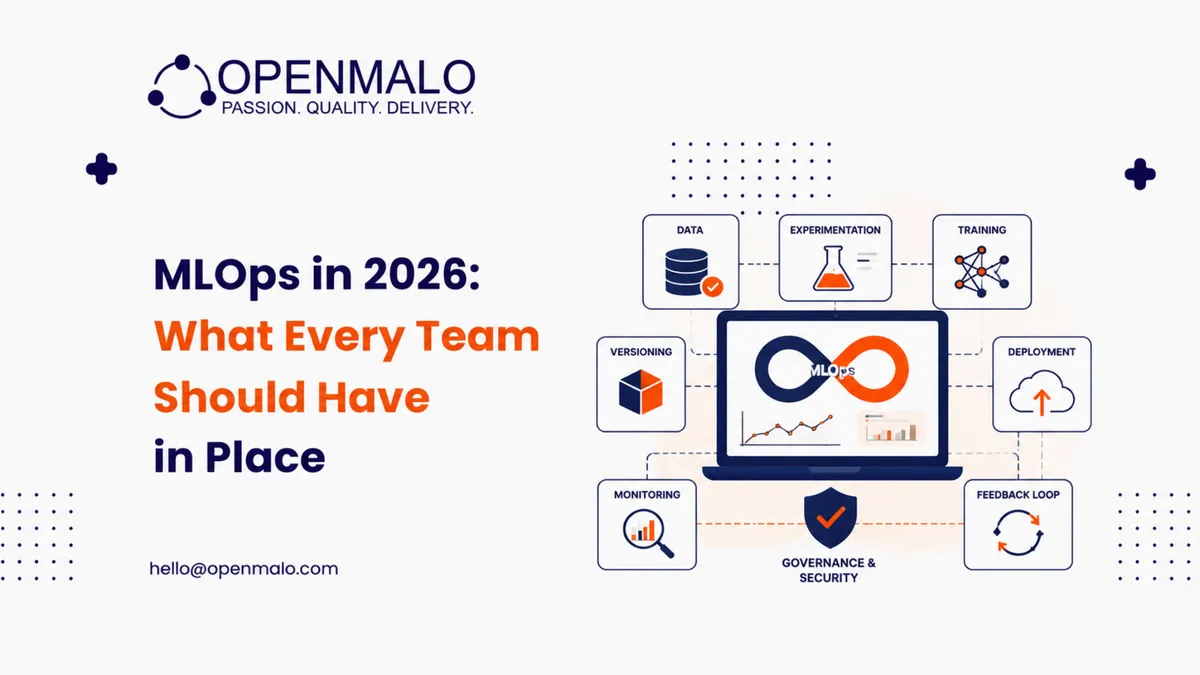
In 2021, MLOps was a luxury. In 2023, it was a buzzword. By 2026, it has become the "entry ticket" for any enterprise serious about Artificial Intelligence. The days of "vibe coding" a model and throwing it over the fence to the DevOps team are officially dead.
At OpenMalo Technologies, we have observed a consistent pattern across our clients in the US, Dubai, and India: the companies winning the AI race aren't the ones with the largest research teams, but those with the most hardened operational pipelines. To move from a fragile prototype to a resilient, production-grade AI agent, you need an architecture that treats Machine Learning as a continuous lifecycle, not a one-time event. Here is the essential MLOps stack every team must have in place this year.
1. The Shift from MLOps to LLMOps
In 2026, the traditional MLOps framework (focused on predictive models like Random Forests) has merged with LLMOps. Modern teams now have to manage not just model weights, but also:
- Vector Database Indices: Managing the retrieval part of RAG.
- Prompt Versioning: Tracking how different "system instructions" affect output.
- Evaluation Loops: Using "LLM-as-a-judge" to score the quality of generative responses.
2. The Three Pillars: CI/CD/CT
Most software teams understand Continuous Integration (CI) and Continuous Deployment (CD). But for AI, you must add a third pillar: Continuous Training (CT).
- CI: Automated testing for data schemas and model code.
- CD: Safely pushing models to production (using Blue/Green or Canary deployments).
- CT: The system should automatically trigger a retraining job when it detects Data Drift—ensuring the model evolves as real-world behavior changes.
At OpenMalo, we advocate for "Zero-Touch Deployment," where a model is only promoted to production if it outperforms the "live" champion model on a strictly defined test set.
3. Unified Feature Stores: Ending Data Silos
The "Training-Serving Skew" is the leading cause of AI failure. This happens when the data used in training is formatted differently than the data provided by the real-time API.
What Works Now: A Unified Feature Store. This acts as a central repository for all pre-calculated features. Whether your data scientist is training a model in a notebook or your app is making a live prediction, they both pull the same feature definition from the same source. This ensures that "1 + 1" always equals "2" across your entire organization.
4. Model Governance and Semantic Monitoring
In 2026, "Is the server up?" is no longer a sufficient monitoring question. You need to know: "Is the model making sense?"
Semantic Monitoring involves tracking the "vibe" and distribution of AI outputs. If your customer service agent suddenly starts sounding aggressive, or if your credit scoring model begins rejecting 50% more applicants from a specific region, your system must alert you immediately.
- Drift Detection: Monitoring for shifts in input data.
- Bias Audits: Automated checks to ensure the model isn't violating global fairness standards (like the AI Act or DPDP).
5. The Rise of the "Human-in-the-Loop" (HITL) Layer
No AI is 100% accurate. High-performance teams now build HITL interfaces as part of their MLOps pipeline. When the AI's "confidence score" falls below a certain threshold (e.g., 70%), the task is automatically routed to a human expert. The expert's correction is then fed back into the training loop, creating a "flywheel" effect that makes the AI smarter over time.
Key Takeaways
- Automate Everything: If you are manually retraining your model, you are already behind.
- Monitor the Content: Track hallucinations and drift with semantic monitoring.
- Govern your Prompts: Treat prompts like code—version them, test them, and audit them.
- Build for Resilience: AI failure is silent. Your MLOps stack must be loud enough to catch it.
Conclusion
The complexity of AI in 2026 requires more than just "good code." It requires a disciplined, systemic approach to operations. By putting these MLOps essentials in place, you move from a state of "hoping the AI works" to a state of predictable, scalable intelligence. At OpenMalo Technologies, we don't just build models; we build the pipelines that make those models thrive. Let's harden your AI infrastructure for the future.
Struggling with AI scaling or silent model failures? OpenMalo Technologies specializes in building and auditing MLOps pipelines that bridge the gap between lab and reality. Harden Your MLOps Stack with OpenMalo Today.