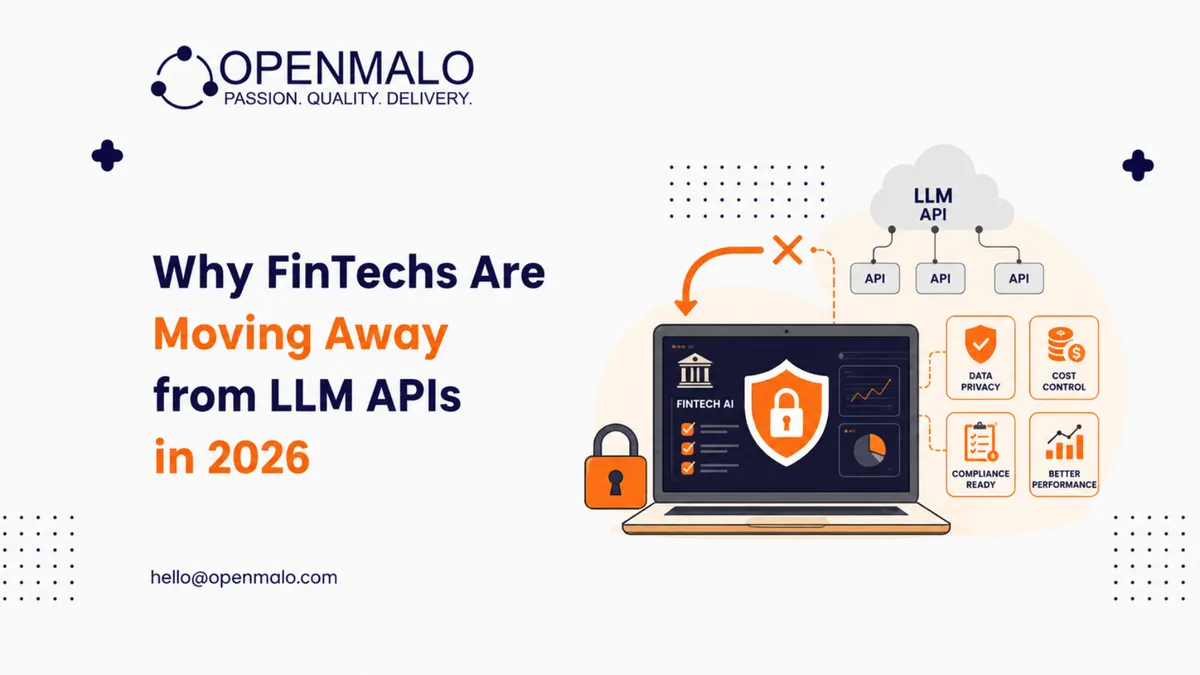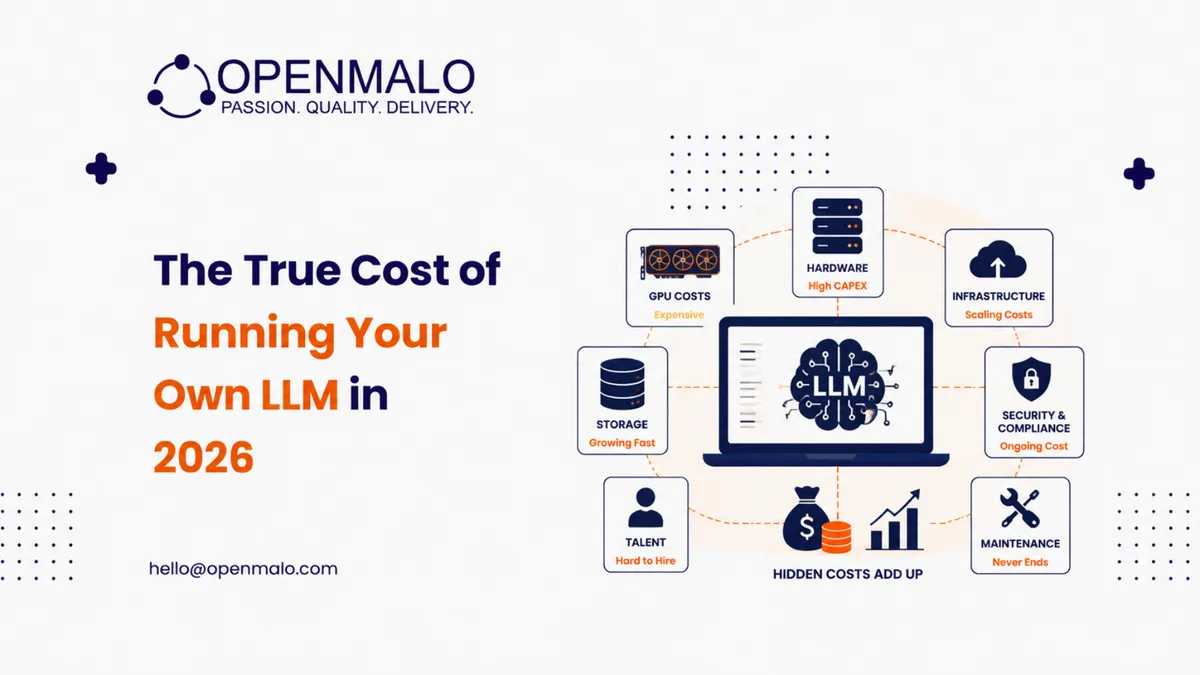
The allure of the "Private LLM" is stronger than ever in 2026. For enterprises in highly regulated sectors like Fintech and Healthcare, the promise of data sovereignty and zero-retention policies is a massive draw. However, many teams leap into self-hosting under the assumption that it will instantly slash their "AI tax."
At OpenMalo Technologies, we've guided countless organizations through this transition. What we've learned is that the Sticker Price (the cost of the GPU) is only about 50% of the total bill. In 2026, the economics of AI are no longer just about hardware; they are about utilization and engineering overhead.
This guide breaks down the actual costs of running your own model—from the surging price of Blackwell GPUs to the hidden "vampire" costs of MLOps.
1. The API vs. Self-Host Break-Even Point
In 2026, the market has settled into a clear "Magic Number." For most enterprises, the break-even point for self-hosting an open-weight model (like Llama 3.3 70B) vs. using a frontier API (like GPT-5.2) sits at approximately 35 million to 50 million tokens per month.
- Low Volume (<10M tokens/mo): Stick with APIs. The engineering time required to maintain a cluster outweighs the per-token savings.
- Mid Volume (50M+ tokens/mo): Self-hosting becomes 50% cheaper. You transition from paying per request to a fixed infrastructure cost.
- High Volume (500M+ tokens/mo): Self-hosting can be up to 80% cheaper, particularly if you use aggressive quantization (NVFP4) and high-density inference servers.
2. Hardware Economics: H100s, B200s, and the RTX 5090
The hardware landscape in 2026 is fragmented. While flagship GPUs have higher performance, their hourly rental rates are volatile.
- NVIDIA B200 (Blackwell): The new gold standard. Expect to pay $5.00 – $6.00 per hour on "Neocloud" providers. While expensive, its throughput per dollar is often 20x higher than 2024-era cards.
- NVIDIA H100: Now a "mature" asset. Prices have stabilized around $2.75 – $3.25 per hour. For 70B models, a 2-GPU H100 cluster is the most common production setup.
- The "Consumer" Revolution: For startups or local testing, the RTX 5090 ($2,000 purchase) has become a viable inference engine for 8B–12B models, offering cost parity with APIs in under four months of use.
3. The "Vampire" Costs: Engineering & Power
This is where most budgets fail. If you rent a GPU for $3,000 a month, your True Cost of Ownership (TCO) is likely closer to $6,000.
- Engineering Talent: A self-hosted model needs a specialized MLOps or DevOps engineer. In 2026, the talent gap is the #1 reason self-hosting fails.
- Idle GPU Time: If your GPU is only processing requests 20% of the time, your "Effective Cost per Token" skyrockets. High-performance teams at OpenMalo solve this by using Serverless GPU architectures (like Modal or RunPod) that scale to zero when not in use.
- Energy & Egress: In regions like Dubai or Europe, power and data transfer fees can add an extra 10–15% to your monthly infrastructure bill.
4. Strategic Hybridization: The 2026 Middle Ground
Most mature organizations in 2026 no longer choose "One or the Other." Instead, they use a Router Architecture:
- Self-Hosted (Small Model): Routes 80% of volume (FAQs, classification, data extraction) to a private 8B or 14B model. Cost: Pennies per million tokens.
- Frontier API (Large Model): Routes the "Hard 20%" (complex reasoning, legal analysis) to a heavy-duty API like GPT-5.2.
- The Result: You get the privacy and cost-efficiency of self-hosting without losing the "IQ" of the world's best models.
Key Takeaways
- Utilization is ROI: If your GPUs aren't running at 60%+ utilization, you are likely losing money compared to APIs.
- Privacy is a Premium: For many OpenMalo clients, the 50% extra cost of self-hosting at low volumes is seen as an "insurance premium" for data security.
- Quantization is Free Money: Using 4-bit (INT4/NVFP4) quantization can cut your VRAM requirements in half with negligible loss in accuracy.
- Hardware breaks even fast: For high-volume SMEs, purchasing hardware can pay for itself in under 6 months.
Conclusion
Running your own LLM in 2026 is a strategic decision that goes far beyond the monthly bill. It's about control, customizability, and compliance. While the upfront engineering and infrastructure costs are significant, the long-term leverage of owning your "Intelligence Engine" is undeniable.
At OpenMalo Technologies, we specialize in architecting these private environments—ensuring they are not just secure, but economically viable from Day 1.
Is your AI budget spiraling? OpenMalo Technologies provides full-stack AI infrastructure audits and private LLM deployments tailored to your scale. Get a TCO Analysis with OpenMalo Today