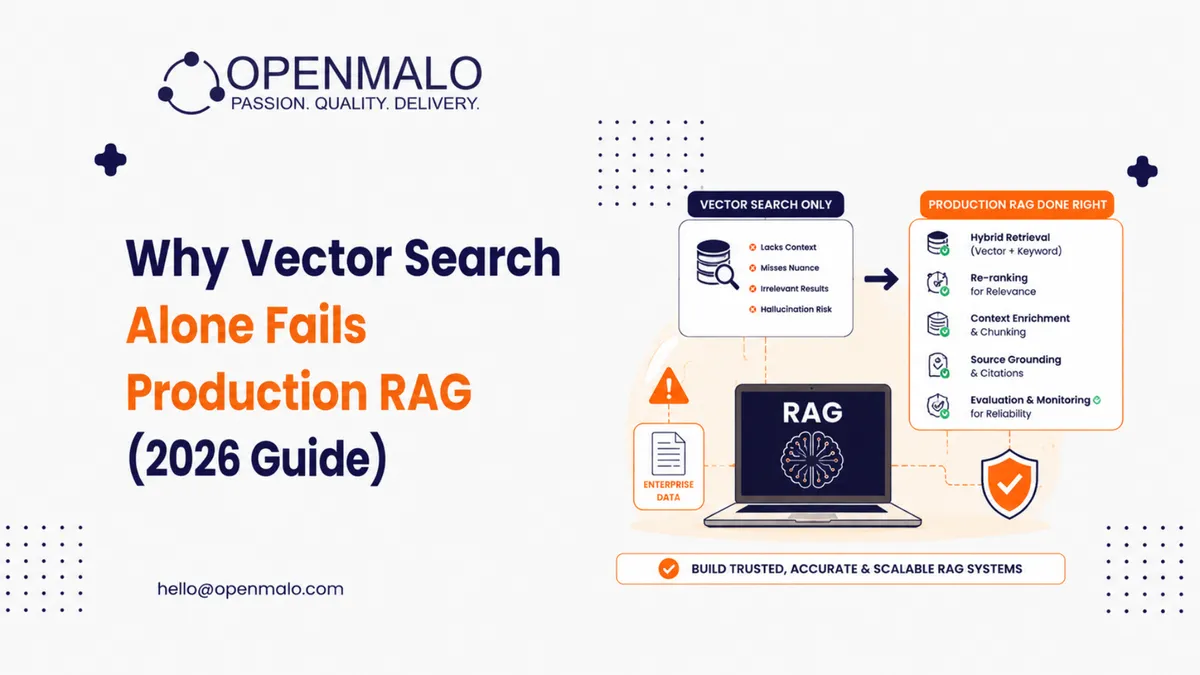
The honeymoon phase of "plug-and-play" AI is over. In the early days of the generative AI boom, the recipe for success seemed simple: take your PDFs, turn them into vectors, dump them into a database, and let a Large Language Model (LLM) do the rest.
But as we move through 2026, enterprise developers are hitting a wall. They are discovering that while a basic vector search works for a "cool" demo, it often crumbles under the pressure of production environments. Users are reporting "shallow" answers, missing context, and—most dangerously—hallucinations that sound perfectly logical but are factually void.
If you are building AI agents intended for high-stakes industries like fintech, healthcare, or legal tech, you need to understand why vector search is only 20% of the puzzle.
1. The Semantic Gap: What Vector Search Misses
Vector search operates on semantic similarity. It converts text into high-dimensional math (embeddings) and finds "neighbors" in that mathematical space.
The problem? Similarity does not always equal Relevance.
Imagine a user asks: "Did we increase our revenue in Q3 compared to Q2?" A vector search might find a document about "Q3 Marketing Strategies" or "Q2 Revenue Reports" because the words are semantically similar. However, it might miss a small, crucial spreadsheet cell that contains the actual numerical comparison because math-heavy data doesn't always "cluster" well with natural language questions.
2. The "Keyword" Problem (Why BM25 Still Matters)
Vectors are great at understanding that "dog" and "canine" are related. They are surprisingly bad at finding specific, unique identifiers like:
- Product SKUs (e.g., XP-900-Alpha)
- Error codes (e.g., 500.13 Internal Timeout)
- Specific person names or rare legal terms.
In a production RAG system, if a technician searches for a specific part number, they don't want a "semantically similar" part; they want that exact part. Pure vector search often overlooks these "hard matches" in favor of broader conceptual matches.
3. The "Lost in the Middle" Phenomenon
Research has shown that LLMs are excellent at processing information at the very beginning or the very end of a prompt, but they struggle with information buried in the middle.
When you rely solely on vector search, you often retrieve the "Top 10" most similar chunks. If the most important piece of evidence is ranked at #5 or #6 by the vector math, there is a high statistical probability that the LLM will ignore it. This is why ranking is often more important than retrieval.
4. Beyond Vectors: The Production-Grade RAG Stack
To move from a prototype to a production-grade AI agent, you must implement a "Multi-Stage" retrieval architecture.
Hybrid Search (Keyword + Semantic)
The gold standard in 2026 is Hybrid Search. This combines the "fuzzy" understanding of vectors with the "exact" precision of traditional keyword search (like BM25). By running both searches and merging the results, you catch both the intent and the specifics.
Re-ranking Models
Once you retrieve 20–30 potential documents, you shouldn't just shove them into the LLM. You apply a Cross-Encoder Re-ranker. This is a smaller, specialized AI model that looks at the specific query and the retrieved documents together to verify their actual relevance. It re-orders them so the "smoking gun" evidence is always at the #1 spot.
GraphRAG (Knowledge Graphs)
Vector search treats your data like independent "islands" of text. GraphRAG connects those islands. By using a Knowledge Graph, the AI can understand relationships—like knowing that "Project X" is owned by "Manager Y," who works in "Department Z." This allows the AI to answer complex, multi-hop questions that vector search alone would fail to navigate.
5. Real-World Example: The "Financial Report" Failure
A mid-market investment firm recently deployed a RAG bot to help analysts query 10-K filings.
- The Setup: Pure Vector Search + GPT-4.
- The Query: "What were the primary risks mentioned in the 2025 report that weren't in the 2024 report?"
- The Result: The bot gave a generic summary of 2025 risks. It failed to perform the comparison because the vector search retrieved pieces of both documents but couldn't "reason" across the temporal link.
The Fix: By implementing a Metadata Filter (restricting search by year) and a Comparison Agentic Workflow, the system was able to isolate the two datasets and provide a precise delta report.
Key Takeaways
- Vector search is a tool, not a strategy. It is the foundation, but not the finished building.
- Precision requires Hybrid Search. You need to match specific terms (SKUs, names, IDs) using keyword search alongside vectors.
- Ranking is the bottleneck. Use Re-rankers to ensure the most relevant information is in the LLM's "prime" attention span (the beginning of the prompt).
- Context is King. Use Knowledge Graphs (GraphRAG) to help your AI understand the relationships between different pieces of data.
Conclusion
Building RAG for production is an exercise in Reliability Engineering. While vector databases are more powerful than ever in 2026, they lack the nuance required for complex enterprise workflows.
To build an AI that your users can truly trust, you must look beyond similarity. You must design a system that understands context, respects specific identifiers, and intelligently ranks information before it ever reaches the LLM. Don't let a simple vector search be the reason your AI fails the production test.
Is your RAG system struggling with accuracy or shallow answers? At OpenMalo, we specialize in "Hardening" AI prototypes. We move you beyond simple vector search to advanced Hybrid and GraphRAG architectures that deliver enterprise-grade precision. Book a Technical Strategy Audit with our Engineers