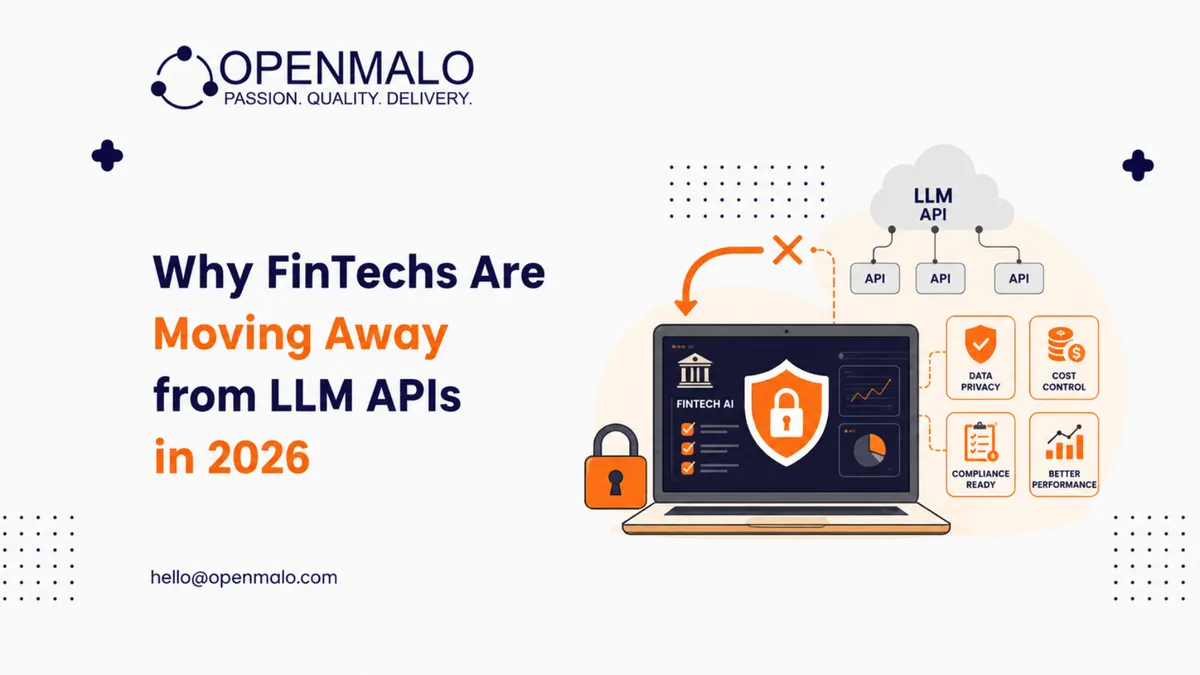
For the past few years, the "API-first" approach was the golden ticket for AI adoption. It was fast, scalable, and required zero hardware management. But as we move through 2026, the honeymoon phase is officially over. Across major financial hubs—from Wall Street to Dubai and Mumbai—we are seeing a massive strategic migration: FinTechs are pulling their "intelligence" in-house.
At OpenMalo Technologies, we've spent the last 12 years building resilient digital products. In 2026, "resilient" means "sovereign." The shift away from closed-source APIs like GPT-5 or Claude 4 isn't about a lack of performance; it's about control, compliance, and long-term commercial ROI.
Here is why the world's most sophisticated financial platforms are trading API keys for private GPU clusters.
1. The Sovereignty Crisis: Data Residency & DPDP
In 2026, data localization is no longer a suggestion—it is a mandate.
- In India: The Digital Personal Data Protection (DPDP) Act and RBI guidelines strictly regulate how financial data is processed. Calling an offshore API that stores prompts in a US-based data center for "training" is a non-starter for enterprise compliance.
- In Europe and the UAE: Similar sovereignty laws (GDPR and local AI frameworks) demand that sensitive PII (Personally Identifiable Information) never leaves the geographical perimeter of the institution.
The OpenMalo Solution: By self-hosting open-weight models (like Llama 3.3 or Mistral) on local infrastructure, FinTechs ensure that 100% of the data stays within their approved VPC, making audits a breeze.
2. The "Black Box" Liability in Regulated Markets
Regulators in 2026 are increasingly targeting "Algorithmic Accountability." If an AI denies a loan or flags a suspicious transaction, the bank must be able to explain why.
When you use a third-party API, you are using a Black Box. You don't know when the provider updates the weights, changes the system prompt, or "lobotomizes" the model to save on their own compute costs. This "Model Drift" can lead to inconsistent compliance outcomes. Self-hosting allows FinTechs to freeze their models, ensuring that a decision made today is based on the same logic as a decision made six months ago.
3. The 50M Token Threshold: When APIs Stop Making Sense
The economics of AI have shifted. In 2026, the break-even point for self-hosting has dropped significantly.
- The Math: Once a FinTech hits approximately 35M to 50M tokens per month, the per-token cost of high-end APIs (like GPT-5.2) starts to exceed the monthly cost of renting or owning dedicated H100/B200 GPU nodes.
- The ROI: One FinTech partner we worked with recently reduced their monthly "AI tax" from $47,000 to just $8,000 by migrating high-volume document classification tasks to a fine-tuned, self-hosted 8B model. That is an 83% cost reduction.
4. Performance: Cutting Out the "Middleman" Latency
In high-frequency trading or real-time fraud detection, a 300ms network round-trip to a US-based API is an eternity.
By hosting models locally—especially with India-based GPU clouds—FinTechs are achieving sub-20ms network latency. When combined with optimization techniques like vLLM's PagedAttention and Continuous Batching, the local inference experience is significantly smoother for the end-user than a congested public API.
5. The OpenMalo Perspective: Hardening Your Private Stack
At OpenMalo Technologies, we help FinTechs make this transition without the traditional "DevOps headache." Our hardening process includes:
- Quantization: Shrinking models to fit on cost-effective hardware without losing accuracy.
- Automated Lineage: Tracking exactly how every data point flows from your database into the private LLM for regulatory proof.
- Human-in-the-loop (HITL): Building the "safety valves" that allow human officers to override AI decisions in real-time.
Key Takeaways
- Compliance is the Driver: Data localization laws (DPDP, GDPR) are making external APIs a liability for Finance.
- Cost Efficiency at Scale: If you are processing over 50M tokens, you are likely overpaying for APIs.
- Explainability is Mandatory: Owning the model means owning the audit trail.
- Latency Matters: Local hosting provides the "instant" feel required for modern digital banking.
Conclusion
The move away from LLM APIs isn't a retreat; it's an evolution. It's the sign of a mature industry moving from "experimentation" to "industrialization." For the FinTechs of 2026, the most valuable asset isn't just the data—it's the private intelligence engine that processes it.
At OpenMalo Technologies, we provide the blueprint and the engineering talent to help you claim your AI sovereignty.
Ready to take your AI off the public cloud? OpenMalo Technologies specializes in deploying and hardening private LLM infrastructure for the world's most demanding FinTech platforms. Schedule Your Infrastructure Audit with OpenMalo