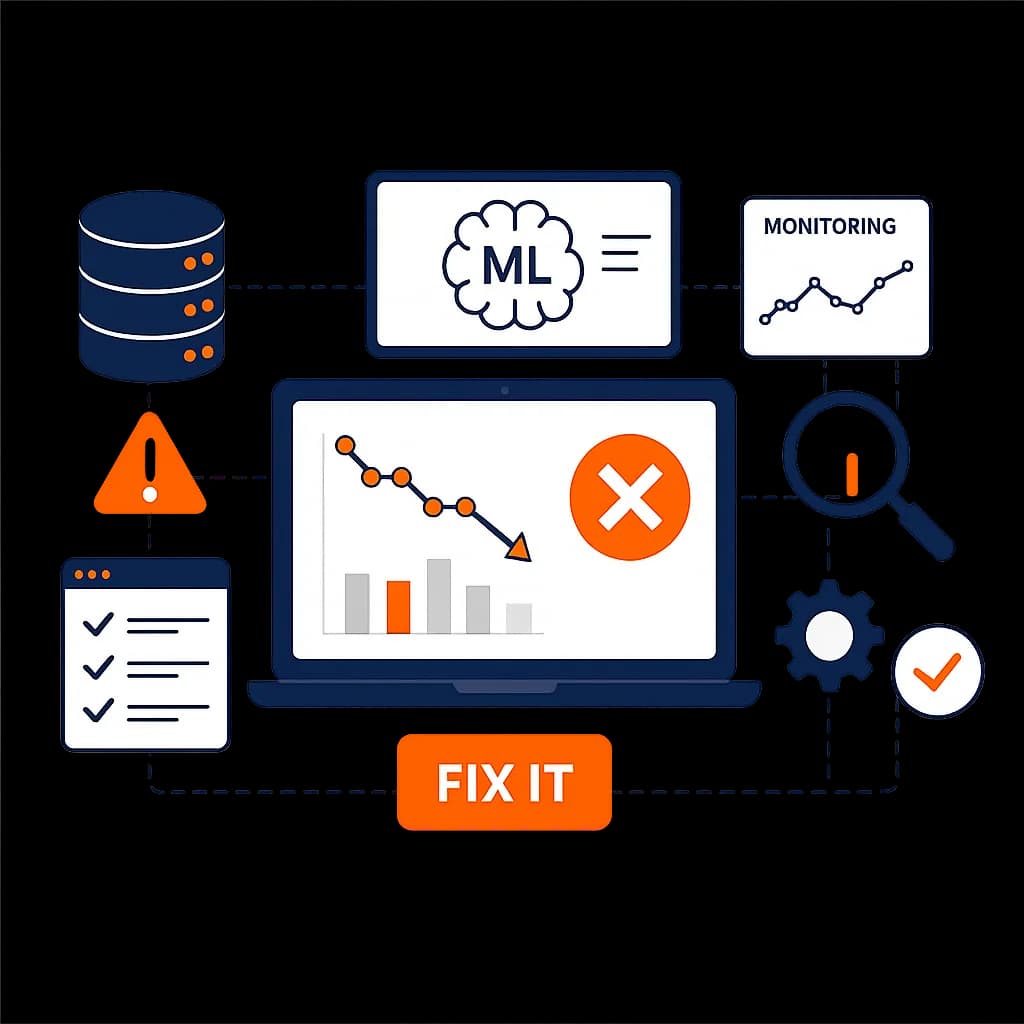
The "AI Revolution" of 2026 has a dirty secret: despite billions of dollars in investment, the majority of Machine Learning (ML) models still die in the "lab." Industry data suggests that nearly 80% of AI projects fail to reach production, and of those that do, many become liabilities within months.
At OpenMalo Technologies, we've spent over a decade helping enterprises move beyond the "prototype trap." We've seen that the failure rarely lies in the math or the code—it lies in the production gap. Transitioning a model from a static Jupyter notebook to a dynamic, real-world API is a feat of engineering, not just science.
If your AI initiatives are struggling to deliver ROI, or if your models are "hallucinating" in production, this guide identifies the root causes and provides the technical blueprint to fix them.
1. The "Notebook to Production" Wall
In a research environment, data is clean, static, and curated. But the real world is messy, noisy, and constantly shifting. A model that achieves 99% accuracy on a 2024 dataset will likely fail when faced with the consumer behaviors of 2026.
Most models fail because they are built as artifacts rather than living systems. To succeed, you must treat your ML model like a software product, requiring continuous integration, monitoring, and updates.
2. Reason 1: Training-Serving Skew (The Data Mismatch)
This is the "Silent Killer" of ML projects. Training-Serving Skew occurs when the data the model sees during training is fundamentally different from the data it encounters in production.
- The Cause: Often, features are engineered differently in the pipeline than they are in the real-time app. For example, a fraud model might use a "daily average spend" during training, but in production, the API only provides "transaction amount."
- The Fix: Implement a Unified Feature Store. This ensures that both your training pipeline and your production API pull from the same "source of truth" for feature logic.
3. Reason 2: Silent Failure and Model Drift
Unlike traditional software, an ML model doesn't usually "crash" with a 500 error. Instead, it fails silently. It continues to give answers, but those answers become increasingly inaccurate over time.
- Model Drift: The statistical properties of your target variables change. (e.g., A real estate pricing model failing because interest rates suddenly spiked).
- The Fix: You need Semantic Monitoring. Don't just track if the API is "up"—track the distribution of the outputs. If the model starts predicting "High Risk" 40% more often than last week, your monitoring should trigger an automatic alert for retraining.
4. Reason 3: The Lack of Robust MLOps/LLMOps
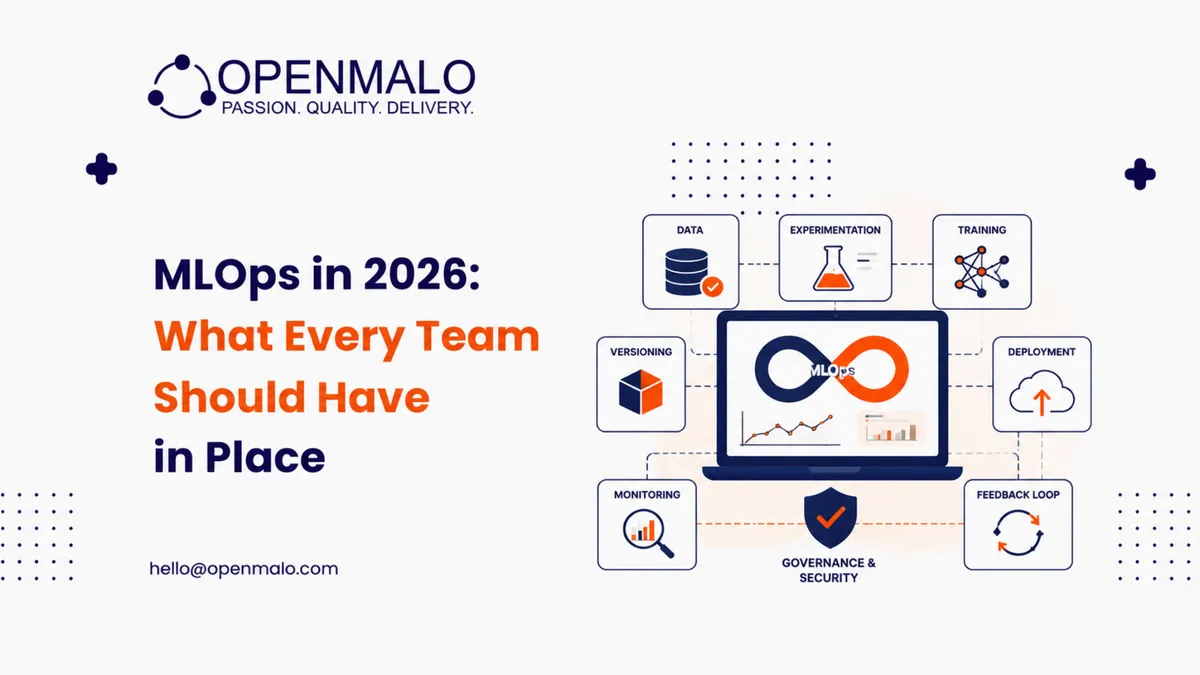
Many organizations treat ML as a one-time deployment. In 2026, MLOps (Machine Learning Operations) and LLMOps are the foundations of AI success. Without automated pipelines, your model becomes "stale" the moment it is deployed.
- The Gap: Manual retraining is slow and error-prone.
- The Fix: Automate the CI/CD/CT (Continuous Training) loop. Use tools like MLflow or Kubeflow to automate the retraining and redeployment of models as new data flows into your system. At OpenMalo, we specialize in "hardening" these pipelines to ensure 99.9% reliability.
5. Reason 4: Solving the Wrong Business Problem
We often see "prestige projects" where a company uses a complex Neural Network to solve a problem that a simple SQL query or Logistic Regression could have handled better.
- The Pitfall: Over-engineering leads to high latency, high costs, and a model that is too "fragile" to maintain.
- The Fix: Start with an MVP (Minimum Viable Product) using the simplest possible model. Only introduce complexity (like LLMs or Deep Learning) once the simple model has proven its value and hit a performance ceiling.
6. The OpenMalo Blueprint: How to Harden Your AI
To move an AI agent into production successfully, OpenMalo follows a "System-First" approach:
- Data Quality Guardrails: Before data hits the model, it passes through an automated validation layer to catch "trash data."
- Shadow Deployment: We run new models in "Shadow Mode" alongside the old ones, comparing results in real-time before switching traffic.
- Human-in-the-Loop (HITL): For high-stakes decisions (FinTech, Health), we build interfaces that allow human experts to "audit" and correct AI decisions, creating a "Gold Dataset" for future training.
Key Takeaways
- Models are Systems: Stop viewing ML as an algorithm; view it as a continuous software pipeline.
- Data is the Foundation: Most "AI failures" are actually "Data Pipeline failures."
- Monitor the Output: Use semantic monitoring to catch "Silent Failures" and drift before they impact your customers.
- Simplicity Wins: Solve for business impact, not for model complexity.
Conclusion
The gap between a research model and a production-grade AI agent is where the most value is created—or lost. By implementing robust MLOps, focusing on data integrity, and solving clearly defined business problems, you can ensure your ML initiatives survive the transition to the real world.
In 2026, the winners won't be the companies with the "smartest" models, but those with the most resilient ones.
Is your AI stuck in the prototype phase? At OpenMalo Technologies, we specialize in hardening AI agents and building production-ready MLOps pipelines that deliver real-world ROI. Consult with our AI Deployment Experts at OpenMalo.