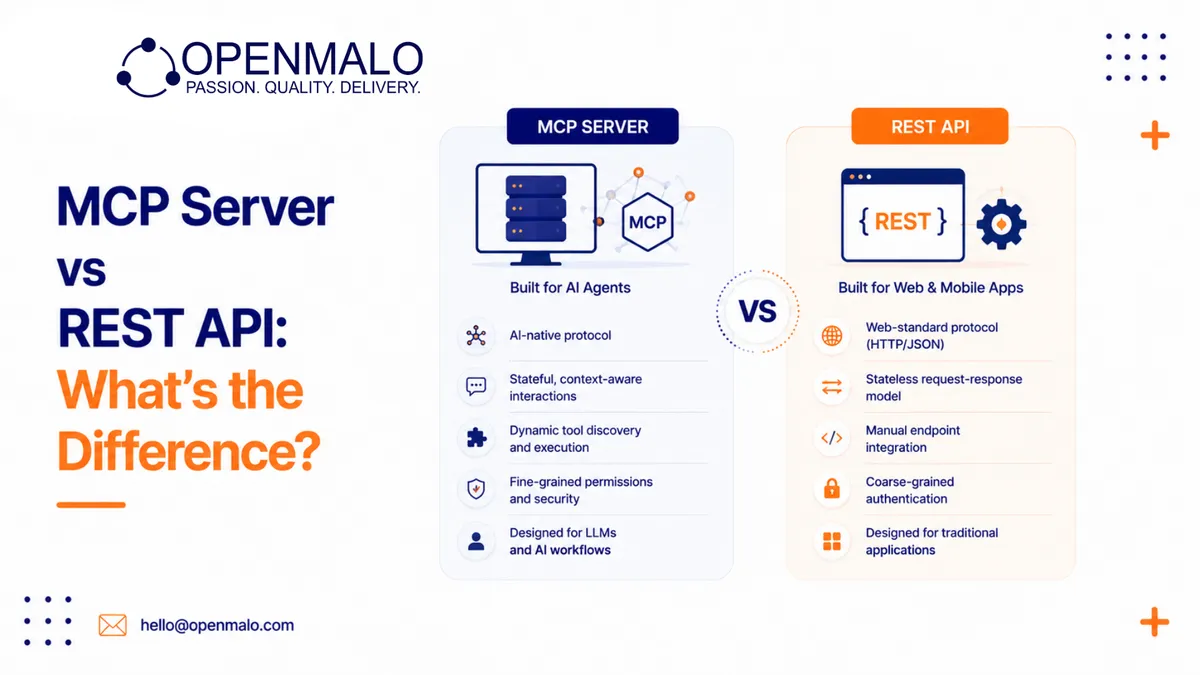
A REST API is a general-purpose web interface that any program calls over HTTP to read or change data. An MCP server is a purpose-built interface that exposes tools, resources, and prompts to AI assistants like Claude and ChatGPT through the Model Context Protocol. Both expose data and actions — the difference is the audience and the contract: REST is for any software, MCP is for AI assistants.
What is a REST API?
A REST API (Representational State Transfer) is a way for programs to talk to each other over HTTP. A client sends a request to a URL using a verb like GET or POST, and the server returns data, usually as JSON. It is the default way most web and mobile apps reach a backend today.
REST is general-purpose. It does not assume anything about who is calling — a browser, a mobile app, another server, or a script can all use the same endpoints. The calling code is expected to know which endpoints exist and what each one does.
What is an MCP server?
An MCP server exposes capabilities to AI assistants using the Model Context Protocol (MCP) — an open standard that lets assistants connect to outside tools and data in a consistent way. Instead of arbitrary endpoints, an MCP server advertises a structured list of capabilities the assistant can discover and use:
- Tools — actions the assistant can call, with named parameters and descriptions.
- Resources — read-only data the assistant can fetch for context.
- Prompts — reusable prompt templates the server provides.
The key idea is discoverability for AI: the server tells the assistant what it can do and how, in a format the assistant is built to understand.
How are they different?
They overlap in that both can sit in front of the same database or service. The differences are in who they serve and how the caller learns what is available.
- Audience. REST APIs serve any software client. MCP servers serve AI assistants specifically.
- Discovery. With REST, a developer reads documentation to learn the endpoints. With MCP, the assistant queries the server at runtime to discover tools and their descriptions.
- Self-description. MCP tools carry plain-language descriptions written so an assistant can decide when to use them. REST endpoints rely on external docs.
- Contract shape. REST is organized around URLs and HTTP verbs. MCP is organized around tools, resources, and prompts over its own transports (stdio, HTTP, SSE).
- Scope. An MCP server is typically built to expose a deliberately scoped set of actions to an assistant, rather than a full public surface.
When should you use a REST API?
Reach for a REST API when the caller is conventional software and you control or document the integration:
- Powering a web or mobile front end.
- Server-to-server integrations between services.
- A public or partner API meant for developers.
- Any case where a human developer writes the calling code against your docs.
REST is mature, universally supported, and the right default for most application backends.
When should you use an MCP server?
Reach for an MCP server when the caller is an AI assistant and you want it to use your tools safely:
- Letting Claude or ChatGPT read your internal data for grounded answers.
- Letting an assistant take scoped actions in your systems, like creating a record or running a report.
- Exposing the same capability to multiple AI clients without rebuilding the integration each time.
- Keeping access narrow and governed, with one place for permissions and logging.
Can they work together?
Yes, and they often do. A common pattern is to keep your existing REST API as the system of record and build a thin MCP server in front of it. The MCP server calls your REST endpoints under the hood and presents a small, well-described set of tools to the assistant. You get to keep your proven API while giving AI assistants a safe, scoped way in.
Which one is right for my project?
If you are building for human-written software, a REST API is almost always the answer. If you are building for AI assistants — and you want discovery, self-describing tools, and scoped access — an MCP server is the better fit. Many teams end up with both: REST for their apps, MCP layered on top for AI access.
Want a custom MCP server connecting your tools to AI assistants? See MCP Server Development.