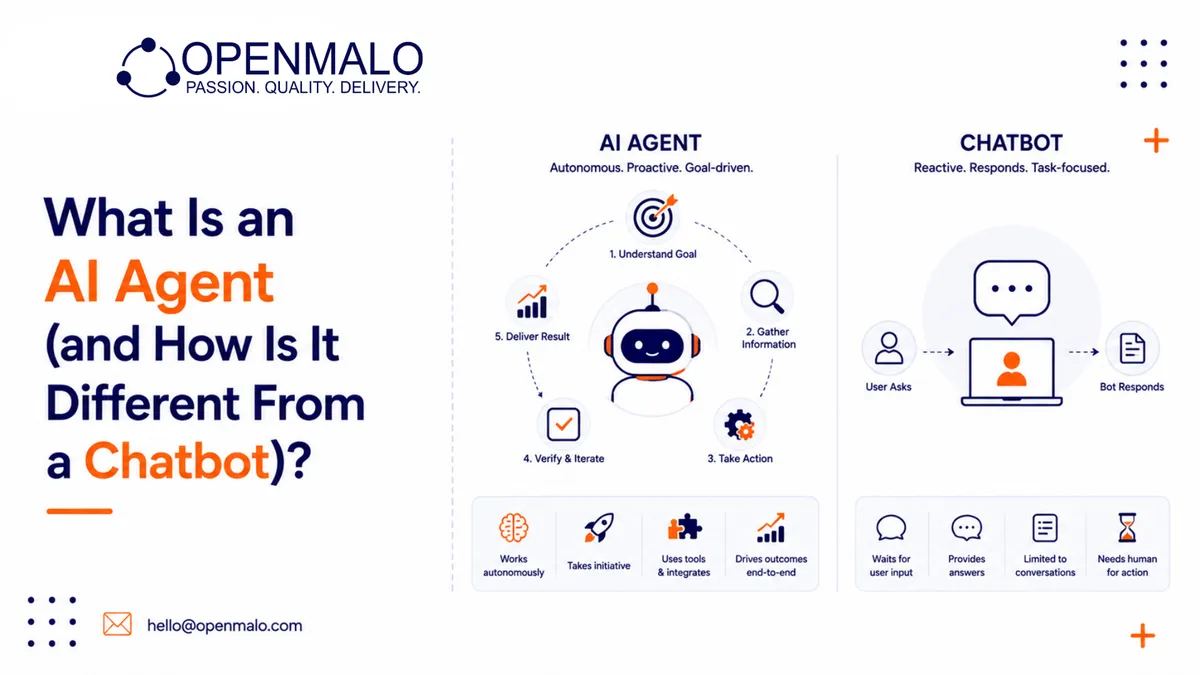
An AI agent is software that takes a goal, breaks it into steps, calls external tools or APIs, observes the results, and keeps going until the goal is done — with little or no human prompting at each step. A chatbot, by contrast, mostly answers one message at a time and waits for you to ask the next thing. The agent acts; the chatbot replies.
What exactly is an AI agent?
An AI agent is built on top of a large language model (LLM — the prediction engine, such as the models behind ChatGPT or Claude, that turns a prompt into text). But the LLM is only the brain. The agent wraps that brain in a loop: it reasons about what to do, picks a tool, runs it, reads the output, and decides the next move.
That loop — reason, act, observe, repeat — is what makes it an agent rather than a single-shot question answerer. The agent can book a meeting, query a database, file a ticket, or trigger a workflow, because it has been given tools and the permission to use them.
What is a chatbot, then?
A chatbot is a conversational interface. Classic chatbots followed scripted decision trees ("press 1 for billing"). Modern LLM chatbots are far more fluent and can answer open questions, but their job is still mostly to respond inside a conversation. They retrieve information and phrase it well; they rarely take real-world actions on your behalf.
Many products marketed as "AI agents" are actually chatbots with a friendlier label. The honest test is simple: does it only talk, or does it also do?
What are the core differences?
- Goal vs. turn: An agent works toward a goal across many steps. A chatbot handles one turn at a time.
- Action vs. answer: An agent calls tools and changes things (sends email, updates records). A chatbot returns text.
- Autonomy: An agent decides the next step itself. A chatbot waits for your next message.
- Memory and state: Agents track progress, intermediate results, and context over a long task. Chatbots usually carry only short conversational history.
- Failure surface: A chatbot that is wrong gives a bad answer. An agent that is wrong can take a bad action — which is why agents need stronger guardrails.
What pieces make up a real AI agent?
When our senior engineers build a production-grade agent, it is rarely "just an LLM." A working agent usually combines several parts:
- The LLM for reasoning and language.
- Tools / function calling — the APIs, databases, and services the agent is allowed to use.
- Orchestration — the controller logic that runs the reason-act-observe loop, decides when the task is done, and handles retries. (Orchestration simply means coordinating the steps and tools in the right order.)
- RAG (Retrieval-Augmented Generation) — fetching relevant documents or data at runtime and feeding them to the model so answers are grounded in your real content instead of the model guessing.
- Memory — short-term state for the current task and, sometimes, long-term storage of past interactions.
- Guardrails — the safety rules that constrain what the agent can say or do (allowed tools, spending limits, content filters, approval gates).
When should you use an agent vs. a chatbot?
Use a chatbot when the job is to answer questions, deflect support tickets, or guide users — and the cost of a wrong word is low. It is cheaper, faster to ship, and easier to keep safe.
Use an agent when the job involves multiple steps and real actions: reconciling invoices, triaging and routing tickets, running research across systems, or executing a multi-stage workflow. The payoff is automation of work, not just answers — but the engineering bar is higher.
Why are agents harder to build than chatbots?
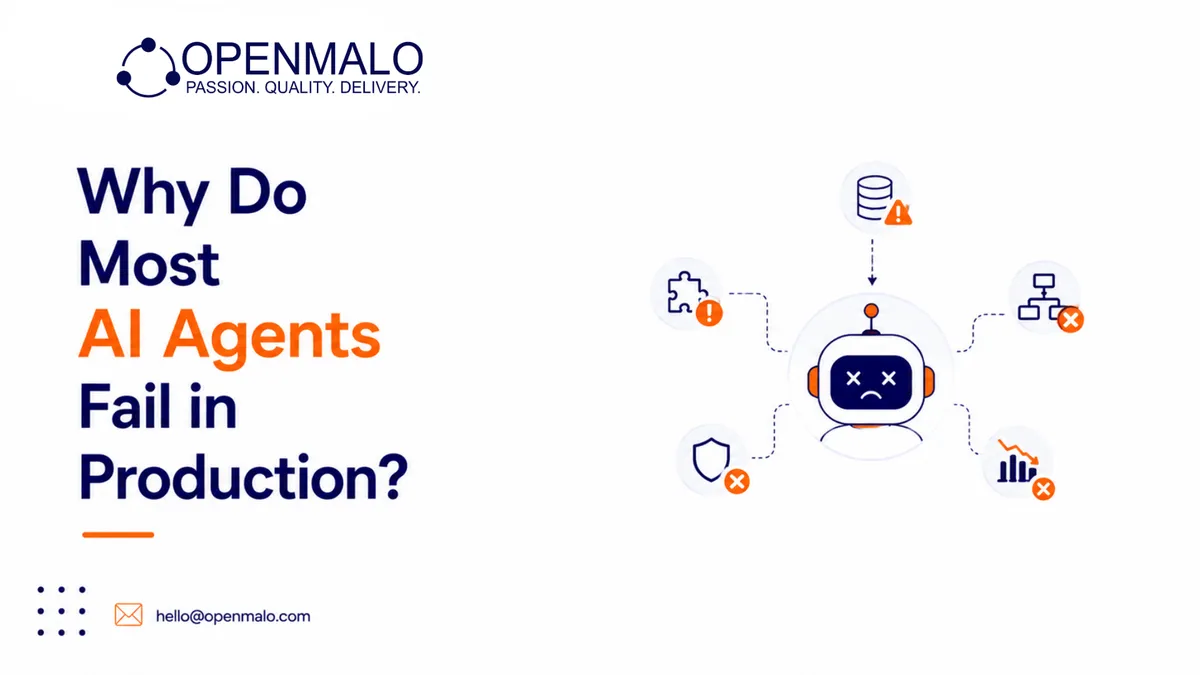
Because they act, agents can fail in expensive ways: looping forever, calling the wrong tool, or taking an action you did not intend. A chatbot's worst day is an awkward answer; an agent's worst day can be a deleted record or a runaway API bill. That is why agents need evaluations, guardrails, cost limits, and usually a human-in-the-loop checkpoint before high-stakes actions.
Need help shipping a production AI agent? See how OpenMalo builds them: AI Agent Development Services.