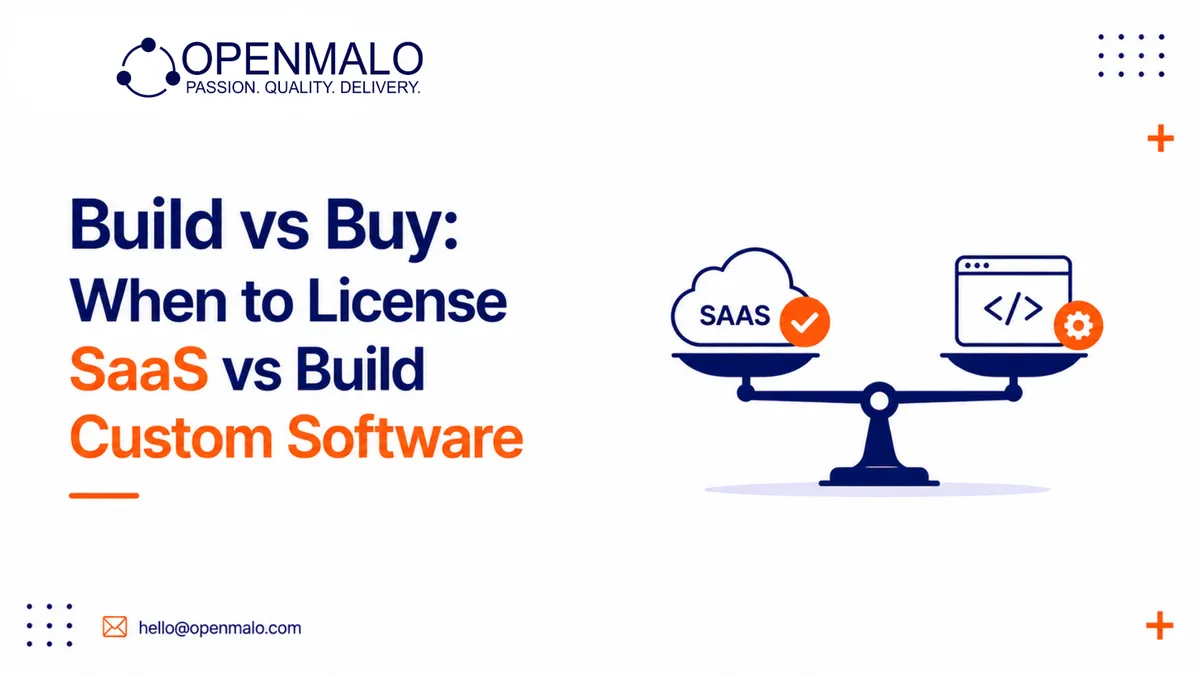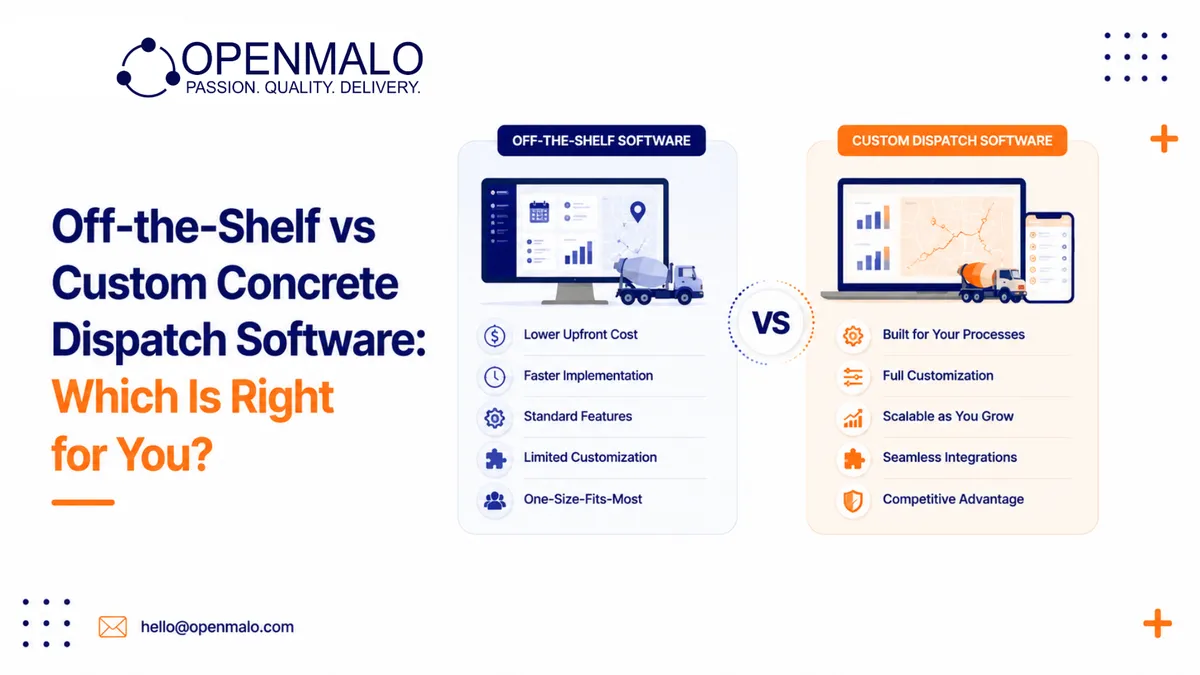
Off-the-shelf concrete dispatch software is a ready-made product you subscribe to and configure, while custom software is built around your specific batch plant, routing rules, and integrations. Off-the-shelf is faster and cheaper to start; custom fits your operation exactly. The right choice depends on how unusual your workflow is and how much you need to integrate.
What is off-the-shelf dispatch software?
Off-the-shelf (sometimes called packaged or commercial software) is a product built for many ready-mix producers at once. You sign up, configure your plants, mixes, and trucks, and start dispatching. It reflects the vendor's view of how a concrete operation should run, and you adapt your process to fit it.
It works well when your operation looks like most others: standard mix designs, conventional scheduling, and common plant equipment.
What is custom dispatch software?
Custom software is built specifically for your business. Instead of adapting your process to a product, the product is shaped around your batch plant integration, your routing rules, your e-ticket layout, and the systems you already use. You own the roadmap and decide what gets built next.
It makes sense when your workflow has rules a packaged product cannot express, or when integrations are central to how you operate.
How do they compare on speed?
- Off-the-shelf: Fastest to start. You can often be dispatching within weeks once your data is configured.
- Custom: Slower to launch because it is designed and built for you. The trade-off is that what launches matches your operation without workarounds.
If you need something running quickly and your process is conventional, off-the-shelf wins on speed.
How do they compare on cost?
- Off-the-shelf: Lower upfront cost, typically a recurring subscription per user or per plant. Costs are predictable but ongoing, and they can rise as you add seats or volume.
- Custom: Higher upfront investment to build, then ongoing maintenance. You are not paying per-seat licensing, which can favor custom at larger scale, but you carry responsibility for upkeep.
The honest framing: off-the-shelf trades a lower start cost for less control; custom trades a higher start cost for ownership.
How do they compare on fit to your plant and routing rules?
This is where the decision usually turns. Every producer has its own way of sequencing loads, handling short loads, managing multiple batch plants, and routing trucks. A batch plant is the facility that measures and mixes raw materials, and the way it connects to dispatch varies by manufacturer and controls.
- Off-the-shelf: Configurable within the limits the vendor allows. If your rules fit the product's options, the fit is good. If they don't, you adapt or use workarounds.
- Custom: Built to match your routing rules and plant setup exactly, including unusual sequencing or multi-plant logic that a packaged product may not support.
How do they compare on integrations?
Integrations include your batch plant controls, accounting or billing system, telematics (the data feed from truck GPS and sensors), and any customer portal. Off-the-shelf products support a fixed list of integrations the vendor maintains — broad, but not unlimited. Custom software can integrate with whatever you need, including older or in-house systems, though each integration is something you build and maintain.
If your stack is mainstream, off-the-shelf connectors may cover you. If you depend on a system the vendor doesn't support, custom may be the only clean path.
How do they compare on scale?
As you add plants, trucks, and users, the economics shift. Off-the-shelf pricing often scales with usage, so a large fleet can become expensive over time. Custom software's cost is more tied to what you build and maintain than to seat counts, which can favor larger producers. Smaller producers usually find off-the-shelf the more economical starting point.
A quick way to decide
- Choose off-the-shelf if your process is conventional, you want to start quickly, you prefer predictable subscription costs, and the product's integrations cover your stack.
- Choose custom if your routing or batching rules don't fit packaged options, you depend on integrations the products don't offer, you want to own the roadmap, or your scale makes per-seat licensing costly.
Many producers also use a hybrid path: start on off-the-shelf to get moving, then build custom once they hit the limits of the packaged product.
Thinking about custom dispatch software for your plant? See Concrete Dispatch Software Development.